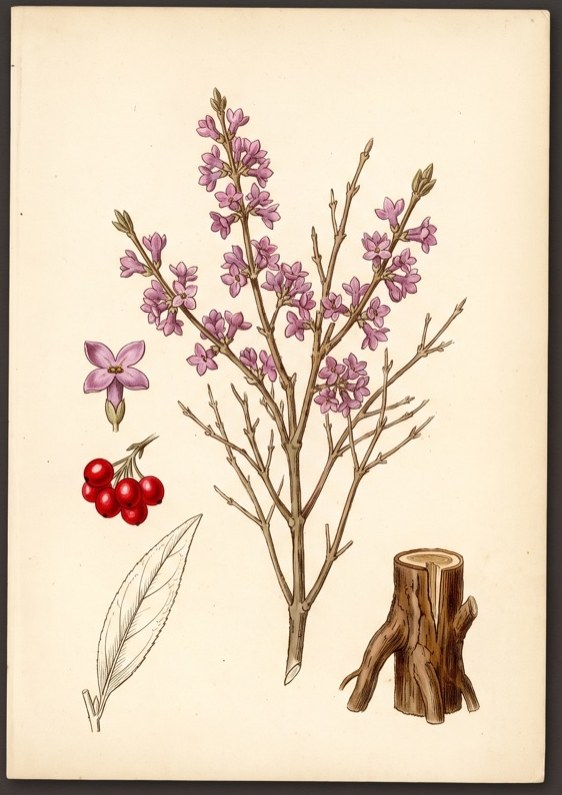
Western Herbalism
Mezereum
Daphne mezereum
Also known as Cortex mezerei, Cortex thymeleae, Cortex coccognidii, Mezereon-bark, Mezerei cortex.
In large doses, mezereon is an irritant poison, causing redness and vesication of the skin when left in contact with it, and causing when swallowed, dryness and burning of the throat, vomiting, hypercatharsis, and frequently renal irritation.

Ask Herbert about Mezereum. Herbert is the master herbalist inside Bountiful Herbs: he answers from this plate and eleven hundred others, with dosing, pairing and cautions. Your first ten questions are free.
Ask HerbertSafety
Recognised toxicity. This plant carries a toxicity flag in the record; it is for trained practitioners only.
Pregnancy: Not safe. Do not use in pregnancy. A natural medicines monograph rates mezereon likely unsafe by mouth or on the skin in pregnancy: it causes severe diarrhoea, a fast heart rate, spasms and blistering, and has caused death.
Breastfeeding: Not safe. Do not use while breastfeeding. A natural medicines monograph rates mezereon likely unsafe by mouth or on the skin while breastfeeding.
Dosing as the sources wrote it
| Preparation | As written |
|---|---|
| decoction | Dose of the decoction, from 1 to 3 fluid ounces; of the powder, 10 grains. |
Doses are reproduced from the sources for practitioners and are not a recommendation for any person.
From the sources
Action, Medical Uses, and Dosage. In large doses, mezereon is an irritant poison, causing redness and vesication of the skin when left in contact with it, and causing when swallowed, dryness and burning of the throat, vomiting, hypercatharsis, and frequently renal irritation.
History and Description. All species of Daphne possess active properties, but the bark met with in commerce is usually obtained from the three above described, that from the latter being less active than the others. The D. Mezereum is a native of the northern parts of Europe, where it is cultivated both as a medicine and as an ornament; it flowers very early in the spring, often before the snow has disappeared.
From King's entry on Ointment of Ipecacuanha. Action and Medical Uses: Rubbed on the skin for a few minutes, once or twice a day, this ointment produces an eruption. It is used as a counter-irritant in diseases of the throat, and in pulmonary affections is applied to the chest. When it is desired to make it more active, 1 ½ fluid drachms of croton oil may be added to the formula. If rubbed on the surface for 20 or 30 minutes at a time, repeated 3 or 4 times a day, and covered with flannel after each application, it will produce vesicles in 36 hours.
From King's entry on Ointment of Ipecacuanha. Related Preparation: UNGUENTUM MEZEREI (N. F.), Mezereum ointment. "Fluid extract of mezereum (F. 170), twenty-five cubic centimeters (25 Cc.) [406♏︎]; lard, eighty grammes (80 Gm.) [2 ozs. av., 360 grs.]; yellow wax, twelve grammes (12 Gm.) [185 grs.]. Melt together with lard and wax with a moderate heat, add the fluid extract, and stir the mixture constantly until the alcohol has evaporated. Then continue to stir until cool" ... (Nat. Form.). This is an irritant, and is applied to obstinate ulcers, wounds, etc., to excite suppuration; sometimes it is used to keep up the discharge from vesicated surfaces.
Drawn from King's American Dispensatory, 18th edition (Felter and Lloyd), and the Bountiful Herbs editorial.
Often paired with
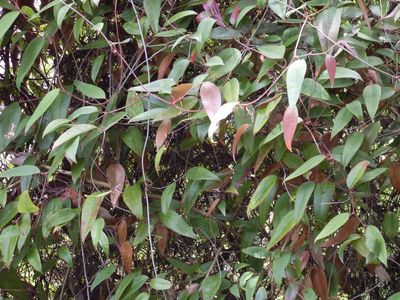 SarsaparillaSmilax spp.
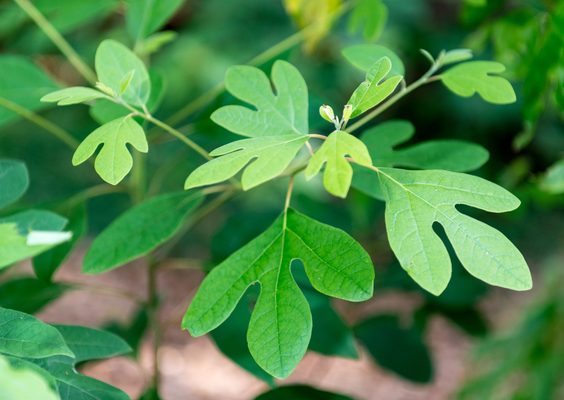 SassafrasSassafras albidum
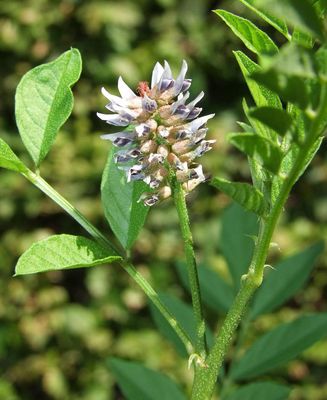 Licorice rootGlycyrrhiza glabra
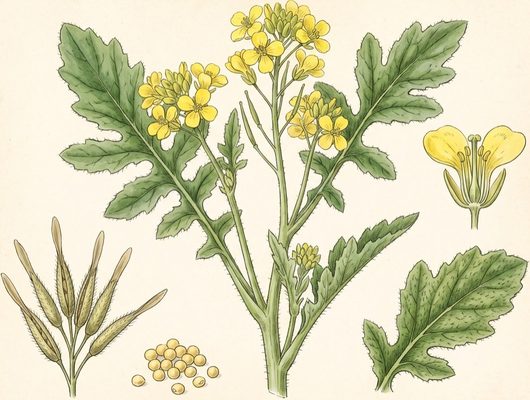 white mustardBrassica alba
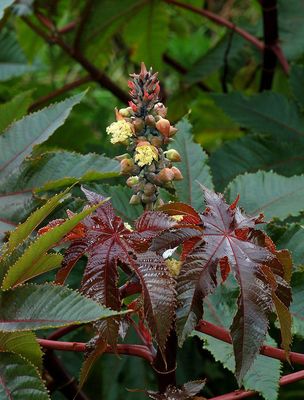 Oleum RiciniOleum Ricini
Nearby on the shelf
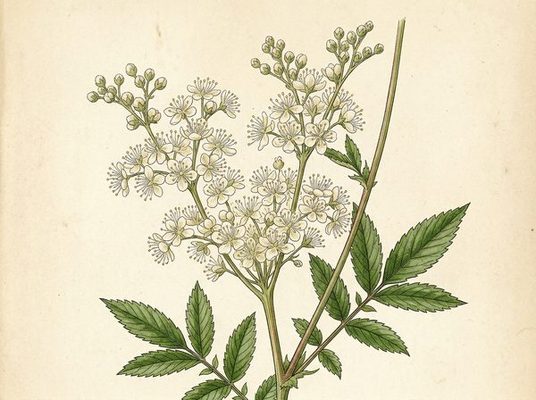 MeadowsweetFilipendula ulmaria
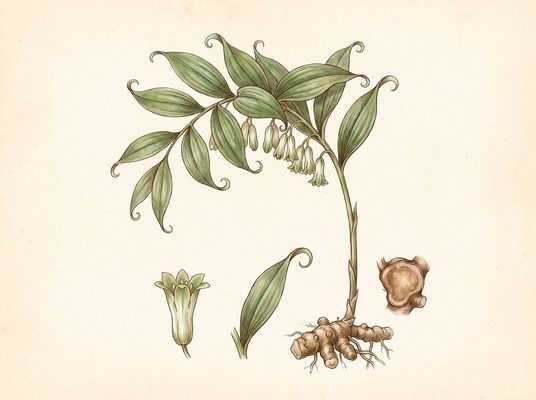 MedaPolygonatum cirrhifolium
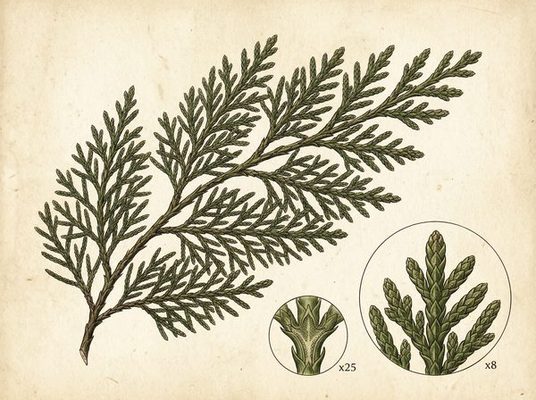 Mediterranean CypressCupressus sempervirens
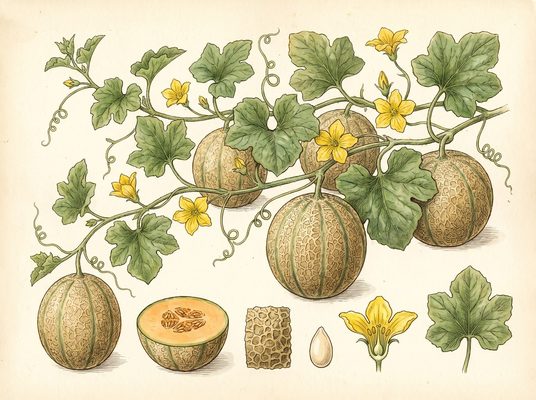 MelonCucumis melo
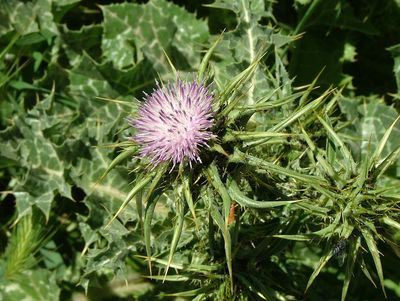 Milk thistleSilybum marianum
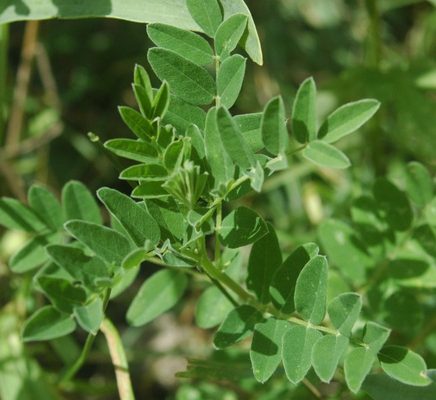 Milk Vetch RootAstragalus membranaceus
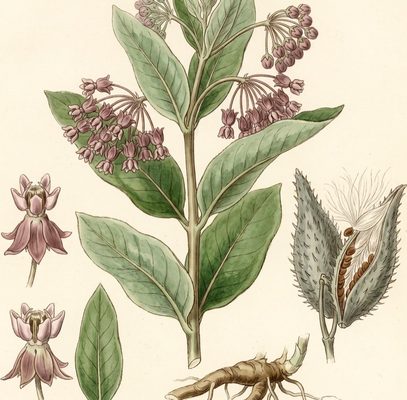 MilkweedAsclepias syriaca
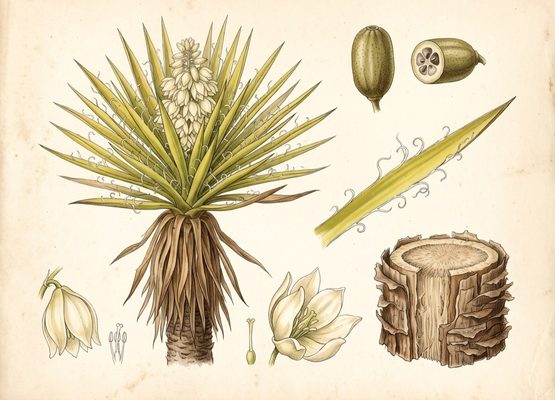 Mojave yuccaYucca schidigera
The whole plate is in the library. The compass, Compare, the Sky of eleven hundred plants and the formulary open with an email address and a password, free, with the formula builder and its safety engine. Herbert in full, his formulating, clients, the handouts and the labels are the paid room.
Open the library, free