Ayurvedic Herbalism
Ivy gourd
Coccinia grandis
Also known as bimbi, scarlet gourd, little gourd, tindora, kovakkai, Bimbi, Bimba, Tundika.
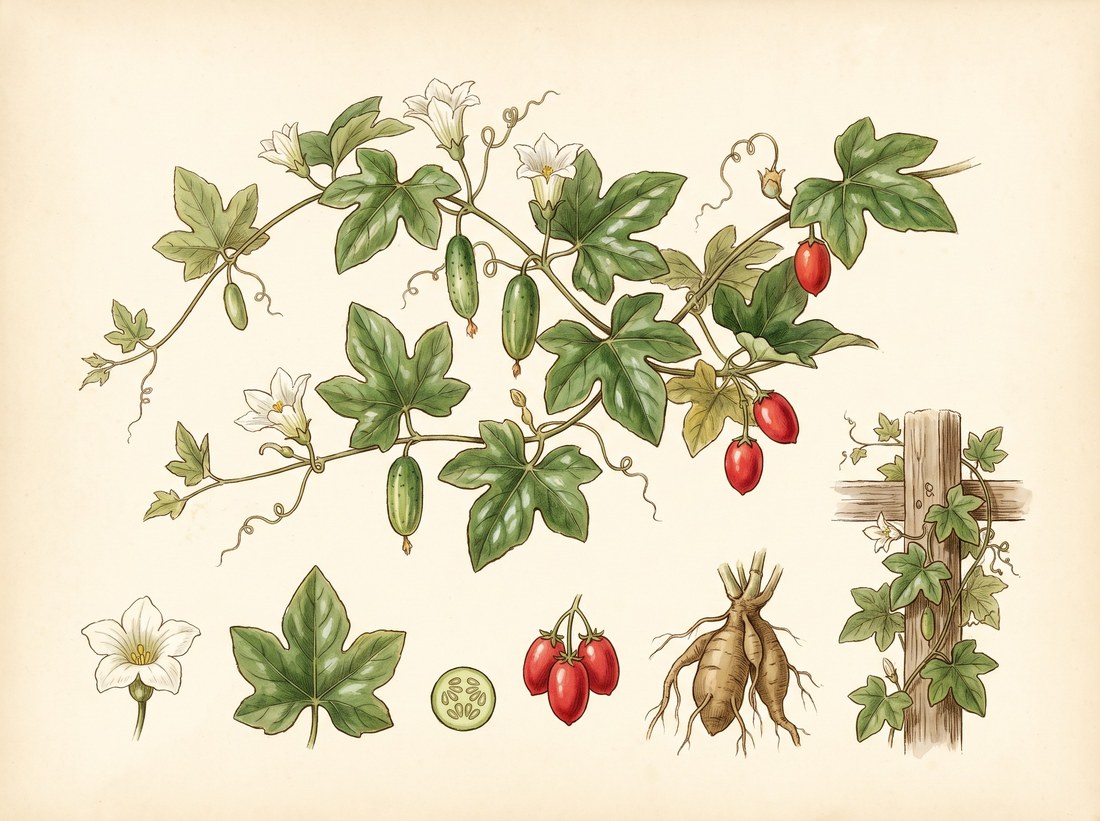
Coccinia grandis is a perennial climbing gourd with glossy lobed leaves, white bell flowers and small cucumber-like fruits that turn scarlet when ripe, growing wild on hedges and fences throughout India, Sri Lanka and tropical Asia and cultivated as a vegetable. Ayurveda knows it as Bimbi, whose red fruit is the classical comparison for beautiful lips, and uses the leaf and root above all for prameha, the group of urinary disorders that includes diabetes, and for skin disease and fever. It is one of a handful of Ayurvedic diabetes herbs that has been tested in placebo-controlled trials with encouraging results.

Ask Herbert about Ivy gourd. Herbert is the master herbalist inside Bountiful Herbs: he answers from this plate and eleven hundred others, with dosing, pairing and cautions. Your first ten questions are free.
Ask HerbertActions
Indications what the tradition reached for it in
- Newly diagnosed type 2 diabetes managed with diet and lifestyle
- Prediabetes and insulin resistance with raised postprandial glucose
- Diabetes with recurrent skin infections and slow healing
- Fungal and bacterial skin eruptions, scabies and itching (leaf juice topical)
- Mouth ulcers and sore tongue in diabetics (leaf juice)
- Fever with thirst and burning
- Jaundice and hepatic congestion (traditional)
- Cough with sticky phlegm (traditional)
- Wounds and ulcers (leaf paste)
- Excess thirst and frequent urination
Specific indications
A newly diagnosed diabetic with mildly raised fasting glucose and HbA1c who is motivated to manage with diet and wants a food-like herb rather than a drug
A patient with diabetes whose skin itches, breaks down easily and heals slowly, with a hot, damp constitution
Thirst, frequent urination and heat in a pitta-kapha patient with rising blood sugar
A diabetic who eats ivy gourd as a vegetable and wants to know how to use the leaf medicinally
Safety
Pregnancy: Avoid medicinal doses in pregnancy as a precaution: no published safety class is known to us, glucose lowering herbs are unsuitable without supervision, and there are no safety data, although the fruit is eaten freely as a vegetable.
The record lists 6 contraindications; open the plate in the library to read them in full.
In practice
Bimbi is the cooling, bitter, astringent herb for prameha with heat: thirst, frequent urination, itching, boils and slow healing in a patient who is warm and often overweight. The fresh leaf juice on an empty stomach is the traditional form, and the young fruit is recommended as a daily vegetable for diabetics, lightly cooked with cumin and turmeric.
In Ayurveda
Rasa: tikta (bitter), kashaya (astringent), madhura (sweet, ripe fruit). Virya: sheeta (cooling). Vipaka: katu (pungent); the ripe fruit madhura (sweet). Guna: laghu (light), ruksha (dry). Dosha: pacifies pitta and kapha; may aggravate vata in excess. Karma: pramehaghna (useful in urinary disorders and diabetes); pittahara (pacifies pitta); kaphahara (reduces kapha); raktashodhaka (purifies the blood); kushthaghna (cures skin disease); shothahara (reduces swelling); vranaropana (heals wounds); jvaraghna (relieves fever); stambhana (astringent, checks discharge); trishnanigrahana (relieves thirst). Classical indications: prameha (urinary disorders including diabetes); madhumeha (diabetes mellitus); kushtha (skin disease); jvara (fever); kamala (jaundice); shvasa and kasa (dyspnea and cough); vrana (wounds and ulcers); shotha (swelling); trishna (thirst); raktapitta (bleeding disorders); kandu (itching). The leaf is the main medicinal part, used fresh as swarasa and kalka and dried as churna and kwatha; the root is decocted for diabetes and skin disease; the tender green fruit is eaten as a vegetable and considered dietetic for diabetics, while the ripe red fruit is sweet and cooling. Classical formulations: Bimbi swarasa, Bimbi patra kwatha, Bimbi mula kwatha, Bimbi patra kalka (topical), Bimbi taila (topical). Described in: Charaka Samhita, Sushruta Samhita, Bhavaprakasha Nighantu, Dhanvantari Nighantu, Raja Nighantu, Kaiyadeva Nighantu, Ayurvedic Pharmacopoeia of India.
Dosing as the sources wrote it
| Preparation | As written | Metric |
|---|---|---|
| Swarasa | 10-20 mL fresh leaf juice once or twice daily before food | 10-20 mL |
| Churna | 3-6 g powdered leaf twice daily with water | 3000-6000 mg |
| Kwatha | 50-100 mL leaf or root decoction twice daily | 50-100 mL |
| Standardized extract | 500-1000 mg leaf extract daily | 500-1000 mg |
| Kalka, topical | 5-10 g fresh leaf paste applied to eruptions once or twice daily | 5000-10000 mg |
Doses are reproduced from the sources for practitioners and are not a recommendation for any person.
From the sources
Overview. Coccinia grandis is a perennial climbing gourd with glossy lobed leaves, white bell flowers and small cucumber-like fruits that turn scarlet when ripe, growing wild on hedges and fences throughout India, Sri Lanka and tropical Asia and cultivated as a vegetable. Ayurveda knows it as Bimbi, whose red fruit is the classical comparison for beautiful lips, and uses the leaf and root above all for prameha, the group of urinary disorders that includes diabetes, and for skin disease and fever. It is one of a handful of Ayurvedic diabetes herbs that has been tested in placebo-controlled trials with encouraging results.
Clinical Notes. Bimbi is the cooling, bitter, astringent herb for prameha with heat: thirst, frequent urination, itching, boils and slow healing in a patient who is warm and often overweight. The fresh leaf juice on an empty stomach is the traditional form, and the young fruit is recommended as a daily vegetable for diabetics, lightly cooked with cumin and turmeric.
Ayurvedic Profile. Rasa: tikta (bitter), kashaya (astringent), madhura (sweet, ripe fruit). Virya: sheeta (cooling). Vipaka: katu (pungent); the ripe fruit madhura (sweet). Guna: laghu (light), ruksha (dry). Dosha: pacifies pitta and kapha; may aggravate vata in excess.
In formulas
Ivy gourd stands in 1 documented formula in the library, among them Vastyāmayāntaka Ghṛta.
Often paired with
 prickly chaff flowerAchyranthes aspera
 brahmiBacopa monnieri
 Indian barberryBerberis aristata
 crown flowerCalotropis gigantea
 Himalayan cedarCedrus deodara
 coconutCocos nucifera
Nearby on the shelf
 Irish MossChondrus crispus
 Iron WeedVernonia
 IvyHedera
 JaborandiPilocarpus jaborandi
 JacarandaJacaranda
 JalapIpomea jalapa
 Jamaican dogwoodPiscidia piscipula
The whole plate is in the library. The compass, Compare, the Sky of eleven hundred plants and the formulary open with an email address and a password, free, with the formula builder and its safety engine. Herbert without limit, his formulating, clients, the handouts and the labels are the paid room.
Open the library, free