Western Herbalism
Ironweed
Vernonia fasciculata
Also known as Prairie ironweed, Common ironweed, Western ironweed.
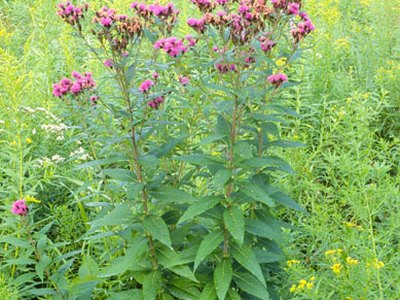
Vernonia fasciculata, prairie ironweed, is a tall perennial composite native to prairies, streambanks, and open ground across the central and eastern United States, easily recognized by its dense corymbs of deep purplish-red disc flowers blooming in late summer. The root is the part used medicinally. It belongs to the physiomedicalist and older American eclectic root-and-herb tradition, where it was valued as a bitter tonic root with combined stimulating and relaxing qualities, used mainly for menstrual complaints and periodic (intermittent) fevers.

Ask Herbert about Ironweed. Herbert is the master herbalist inside Bountiful Herbs: he answers from this plate and eleven hundred others, with dosing, pairing and cautions. Your first ten questions are free.
Ask HerbertActions
Indications what the tradition reached for it in
- Sluggish digestion with poor appetite
- Delayed or scanty menstruation
- Painful menstruation
- Leucorrhea
- Recurrent intermittent fevers (ague)
- Torpid liver with sluggish bile flow
- General debility with poor tone
- Chronic low-grade dyspepsia
Specific indications
Painful, deficient menstruation with a dragging, congested feeling in the pelvis
Recurring intermittent (periodic) fever with a torpid liver, where a bitter hepatic tonic is wanted
Safety
Pregnancy: Avoid in pregnancy given its traditional use as an emmenagogue and lack of modern safety data.
Breastfeeding: Avoid during lactation because no safety data exist and its traditional reputation as an emmenagogue root raises theoretical concern.
The record lists 4 contraindications; open the plate in the library to read them in full.
In practice
In the older physiomedical literature, ironweed root was reached for chiefly in two settings: painful or deficient menstruation with a sense of pelvic congestion, and recurring intermittent fevers where the liver was thought to be torpid and in need of a bitter hepatic stimulant.
Dosing as the sources wrote it
| Preparation | As written | Metric |
|---|---|---|
| Decoction | 2-4 g dried root daily, simmered gently | 2000-4000 mg |
| Tincture (1:5, 40-50%) | 1-2 mL two to three times daily | 1-2 mL |
Doses are reproduced from the sources for practitioners and are not a recommendation for any person.
From the sources
Overview. Vernonia fasciculata, prairie ironweed, is a tall perennial composite native to prairies, streambanks, and open ground across the central and eastern United States, easily recognized by its dense corymbs of deep purplish-red disc flowers blooming in late summer. The root is the part used medicinally. It belongs to the physiomedicalist and older American eclectic root-and-herb tradition, where it was valued as a bitter tonic root with combined stimulating and relaxing qualities, used mainly for menstrual complaints and periodic (intermittent) fevers.
Clinical Notes. In the older physiomedical literature, ironweed root was reached for chiefly in two settings: painful or deficient menstruation with a sense of pelvic congestion, and recurring intermittent fevers where the liver was thought to be torpid and in need of a bitter hepatic stimulant.
Properties and Uses. The root is bitter, with stimulating and relaxing qualities, and leaving a full tonic impression. It has been commended in deficient and painful menstruation, and leucorrhea. The use to which it seems best adapted, is in the treatment of ague as a hepatic and an antiperiodic; in which connection several reliable physicians have commended it to me in high terms, and J.
Description. Natural Order, Compositae. Root perennial. Stem annual, four to ten feet high, an inch in diameter, purplish- green, striate, hollow, with a few short corymbose branches above. Leaves alternate, narrow-elliptical or lanceolate, tapering, four to eight inches long, serrate, coarse and rough. Flowers in crowded corymbose heads, all perfect, discoid, tubular, deep purplish-red; involucre of many appressed scales. Common on prairies, by streams, and in all places, through the West; sometimes in whole fields. Blooming from August to October.
Drawn from Cook's Physio-Medical Dispensatory, and the Bountiful Herbs editorial.
Nearby on the shelf
 InmortalAsclepias asperula
 IpecacCarapichea ipecacuanha
 Irish MossChondrus crispus
 IvyHedera
 Ivy gourdCoccinia grandis
 JaborandiPilocarpus jaborandi
 JacarandaJacaranda
The whole plate is in the library. The compass, Compare, the Sky of eleven hundred plants and the formulary open with an email address and a password, free, with the formula builder and its safety engine. Herbert without limit, his formulating, clients, the handouts and the labels are the paid room.
Open the library, free