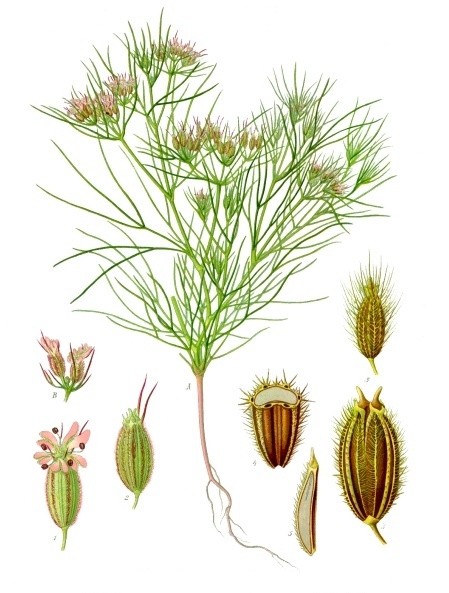
Western and Ayurvedic herbalism
Cumin
Cuminum cyminum
Also known as Cummin, Cummin seeds, white cumin, jeera, Jiraka, Shveta jiraka, Ajaji.
Cumin is the small, ridged, aromatic fruit of an annual umbellifer native to the eastern Mediterranean and western Asia, long cultivated across Egypt, the Middle East, India, and southern Europe. The seed has been used since antiquity both as a kitchen spice and as a warming digestive medicine. In the older physiomedicalist literature it was grouped with the other aromatic umbellifer seeds such as dill, caraway, and fennel as a stimulating carminative, though noted even then to be less pleasant and less used than its relatives.

Ask Herbert about Cumin. Herbert is the master herbalist inside Bountiful Herbs: he answers from this plate and eleven hundred others, with dosing, pairing and cautions. Your first ten questions are free.
Ask HerbertActions
Indications what the tradition reached for it in
- Flatulent dyspepsia
- Colic
- Abdominal bloating
- Poor appetite
- Diarrhea with cramping
- Insufficient lactation
- Menstrual cramps
- Mild functional gut discomfort
- Common cold with sluggish digestion
- Metabolic support alongside diet in mild insulin resistance
- Bloating and flatulence after meals
- Weak appetite and slow digestion
- Irritable bowel with loose stools
- Nausea and morning sickness (as infusion)
- Infant colic (through the nursing mother)
- Poor lactation
- Postpartum recovery and uterine involution
- Postoperative ileus (adjunct)
- Mild dyslipidemia and central weight gain (adjunct)
- Recurrent low-grade fever with poor digestion
- Intestinal worms (adjunct)
- Chronic skin conditions rooted in poor digestion
Specific indications
Griping, colicky abdominal pain with flatulence in a person whose digestion runs cold and slow
Poor or diminishing milk supply in a nursing mother with weak, sluggish digestion
Safety
The record lists 3 contraindications; open the plate in the library to read them in full.
In practice
Cumin seed is reached for when digestion is sluggish, cold, and prone to gas and cramping griping pain, particularly in constitutions that also run cold. It combines well with fennel, caraway, dill, or ginger in a simple after-meal infusion, and its warming, slightly bitter aromatic character makes it a reasonable substitute where a patient dislikes the taste of dill or caraway.
In Ayurveda
Rasa: katu (pungent). Virya: ushna (heating). Vipaka: katu (pungent). Guna: laghu (light), ruksha (dry). Dosha: pacifies kapha and vata; mild enough that it does not aggravate pitta in ordinary doses. Karma: deepana (kindles digestion); pachana (digests ama); grahi (absorbent, binds stool); ruchya (improves taste and appetite); garbhashaya shodhana (cleanses the uterus after delivery); stanyajanana (promotes breast milk); chakshushya (benefits the eyes); medhya (supports intellect); balya (strengthening); vrishya (aphrodisiac); krimighna (anthelmintic); kaphahara (reduces kapha). Classical indications: agnimandya (weak digestion); ajirna (indigestion); atisara (diarrhea); grahani (malabsorption, irritable bowel); gulma (abdominal mass, bloating); adhmana (distension); chardi (vomiting); krimi (worms); jvara (fever); kushtha (skin disease); stanya kshaya (poor lactation); sutika roga (postpartum disorders). The dried ripe fruit is the drug, roasted and powdered as churna, given as kwatha or as a simple infusion (jiraka jala), fermented into Jirakadyarishta for postpartum care, and combined with sugar and ghee in confections for nursing mothers. Classical formulations: Jirakadyarishta, Jirakadi modaka, Hingvashtaka churna, Lavanabhaskara churna, Ajamodadi churna, Jirakadi churna, Dhanyaka-jiraka kwatha, Jiraka jala. Described in: Charaka Samhita, Sushruta Samhita, Ashtanga Hridaya, Bhavaprakasha Nighantu, Dhanvantari Nighantu, Raja Nighantu, Kaiyadeva Nighantu, Sharngadhara Samhita, Ayurvedic Pharmacopoeia of India.
Dosing as the sources wrote it
| Preparation | As written | Metric |
|---|---|---|
| Infusion | 1-4 g crushed seed steeped as tea, up to three times daily | 1000-4000 mg |
| Tincture (1:5, 45%) | 0.5-2 mL three times daily | 0.5-2 mL |
| Whole seed (chewed or culinary) | 0.5-1 teaspoon seed after meals | |
| Dose, from 15 to 60 grains. | 972-3888 mg | |
| and Nigella damascena, Linné, or Ragged Lady. They are natives of Syria and south Europe, and are cultivated in gardens. The leaves of these plants resemble those of fennel. The seeds of the first species are rough, triangular, ovate, two surfaces being flat and the other convex, about 1/12 to 1/10 inch long, externally dull-black, and internally white and oleaginous. To the taste they are acrid, somewhat spicy, and pungent. In odor they are aromatic or camphoraceous, reminding some persons of nutmegs, others of cajuput. The seeds of ragged lady are occasionally sold under the name magnolia seeds. They have rounded angles, an a deeply-netted and corrugated testa. When rubbed they exhale an odor comparable with that of strawberries. The seeds of nutmeg flower, according to Husemann and Hilger, contain 1.5 per cent of an essential, colorless and fluorescent oil, and consists of a substance C20H24O and a terpene (Flückiger). Its odor differs from that of the seeds, and a fixed oil to the extent of 35 per cent, was obtained by Reinsch in 1841. Flückiger has shown it to be composed of myristin, stearin, and palmitin. A yellow extract-like mass, having a bitter taste, was isolated by Reinsch and named nigellin. It is not, however, regarded as a distinct body. | ||
| Melanthin (C20H33O7), a glucosid, was isolated by H. G. Greenish, in 1880. It is amorphous, acrid, foams when shaken with water, is very soluble in alcohol, but scarcely soluble in water, benzin, benzol, ether, and carbon disulphide. Acids split it into glucose and melanthigenin (C14H23O2). Both principles impart a rose-red tint with pure sulphuric acid in about 15 minutes. The color changes to violet-red upon long standing. The seeds of Nigella damascena were observed by Greenish to yield to petroleum benzin a fluorescent principle, but contain no melanthin (Amer. Jour. Pharm., 1882, pp. 10 and 304), and A. Schneider (1890) showed that this was due to a crystalline alkaloid which he named damascenine, the compounds of which, however, are non-fluorescent. |
Doses are reproduced from the sources for practitioners and are not a recommendation for any person.
From the sources
Overview. Cumin is the small, ridged, aromatic fruit of an annual umbellifer native to the eastern Mediterranean and western Asia, long cultivated across Egypt, the Middle East, India, and southern Europe. The seed has been used since antiquity both as a kitchen spice and as a warming digestive medicine. In the older physiomedicalist literature it was grouped with the other aromatic umbellifer seeds such as dill, caraway, and fennel as a stimulating carminative, though noted even then to be less pleasant and less used than its relatives.
Overview. Cuminum cyminum is a slender annual of the carrot family grown across the dry plains of Gujarat and Rajasthan, which supply most of the world's cumin, and its small ridged fruits are the spice found in nearly every Indian kitchen. Ayurveda calls it Jiraka and treats it as the everyday deepana and pachana: a warming, light, aromatic seed that kindles digestion, settles wind and diarrhea, and is given in confections and fermented preparations to women after childbirth to restore digestion and milk.
Clinical Notes. Cumin seed is reached for when digestion is sluggish, cold, and prone to gas and cramping griping pain, particularly in constitutions that also run cold. It combines well with fennel, caraway, dill, or ginger in a simple after-meal infusion, and its warming, slightly bitter aromatic character makes it a reasonable substitute where a patient dislikes the taste of dill or caraway.
Clinical Notes. Jiraka is the digestive remedy that sits between the fire of Trikatu and the gentleness of Dhanyaka. Reach for it in agnimandya with gas, bloating, loose stools and a coated tongue, in grahani where the gut is irritable and absorbs poorly, and in the postpartum period, where the tradition uses it in Jirakadyarishta and sweet ghee confections to restore appetite, promote milk and cleanse the uterus.
Drawn from Cook's Physio-Medical Dispensatory; King's American Dispensatory, 18th edition (Felter and Lloyd), and the Bountiful Herbs editorial.
In formulas
Cumin stands in 48 documented formulas in the library, among them Amṛtāriṣta, Ayaskṛti, Aśokāriṣta, Jīrakādyariṣṭa, Mustakāriṣṭa, Mṛtasaṅjīvanī Surā.
Often paired with
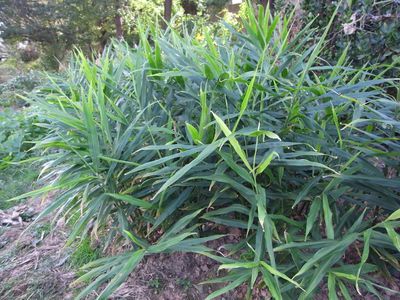 GingerZingiber officinale
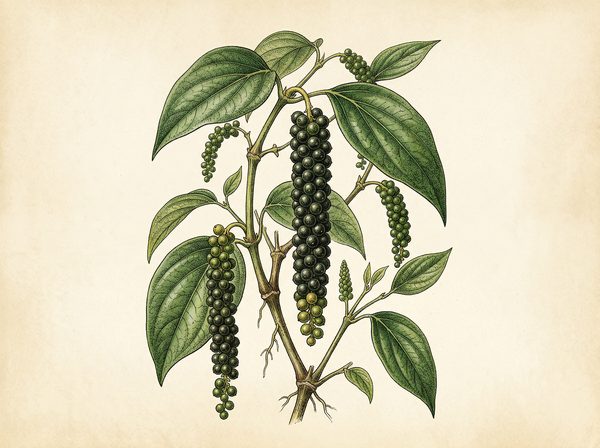 black pepperPiper nigrum
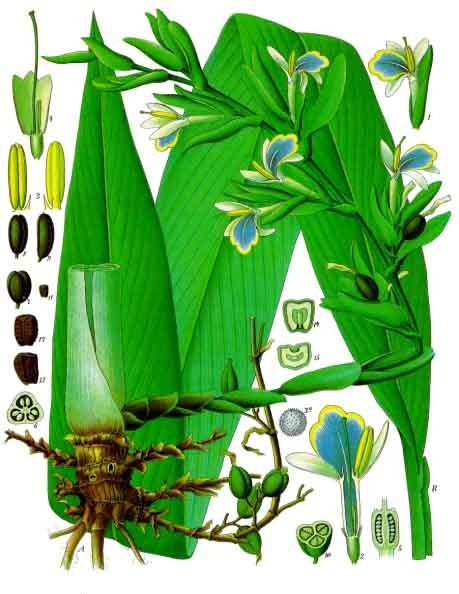 cardamomElettaria cardamomum
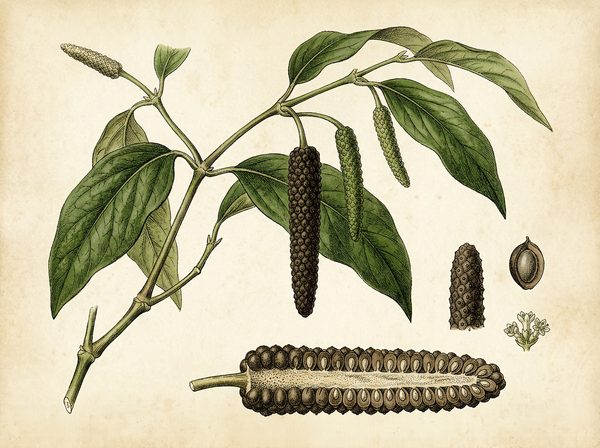 long pepperPiper longum
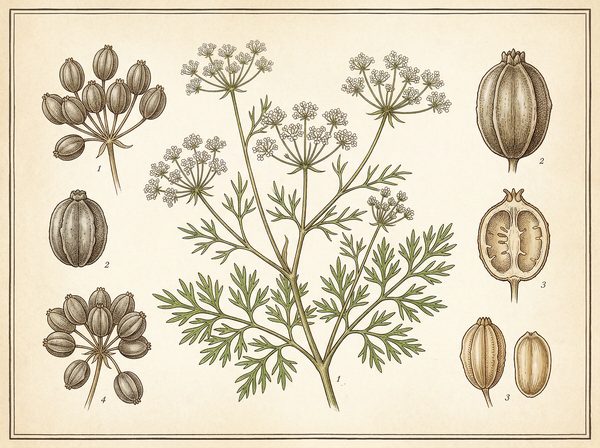 ajwainTrachyspermum ammi
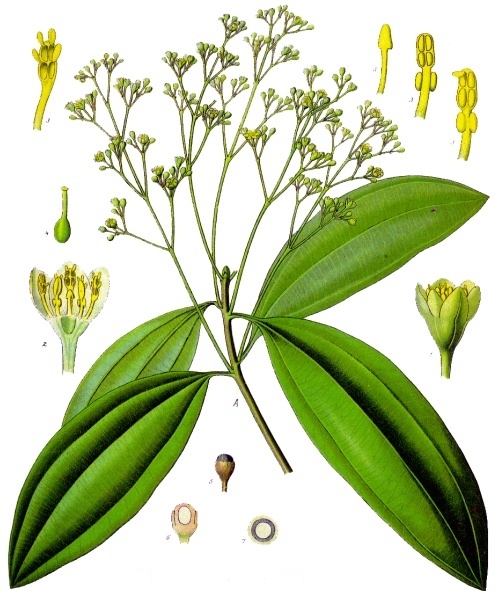 Indian bay leafCinnamomum tamala
Nearby on the shelf
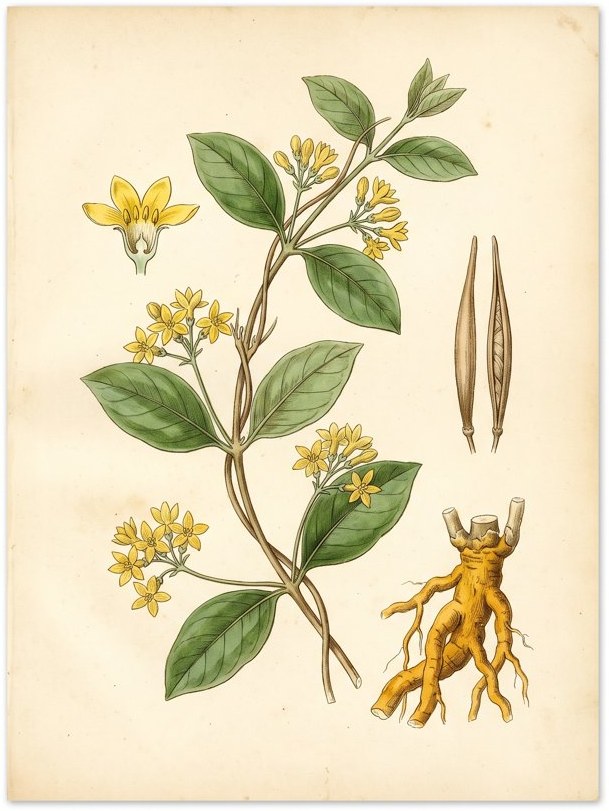 CryptolepisCryptolepis sanguinolenta
 CubebPiper cubeba
 CucumberCucumis sativus
 Culver's rootVeronicastrum virginicum
 Cup plantSilphium perfoliatum
 CurculigoCurculigo orchioides
 Curly dockRumex crispus
 CurrantRibes
The whole plate is in the library. The compass, Compare, the Sky of eleven hundred plants and the formulary open with an email address and a password, free, with the formula builder and its safety engine. Herbert without limit, his formulating, clients, the handouts and the labels are the paid room.
Open the library, free