Ayurvedic Herbalism
Kurchi
Holarrhena antidysenterica
Also known as conessi tree, tellicherry bark, bitter oleander, ivory tree, Kutaja, Indrayava (seed), Kalinga.
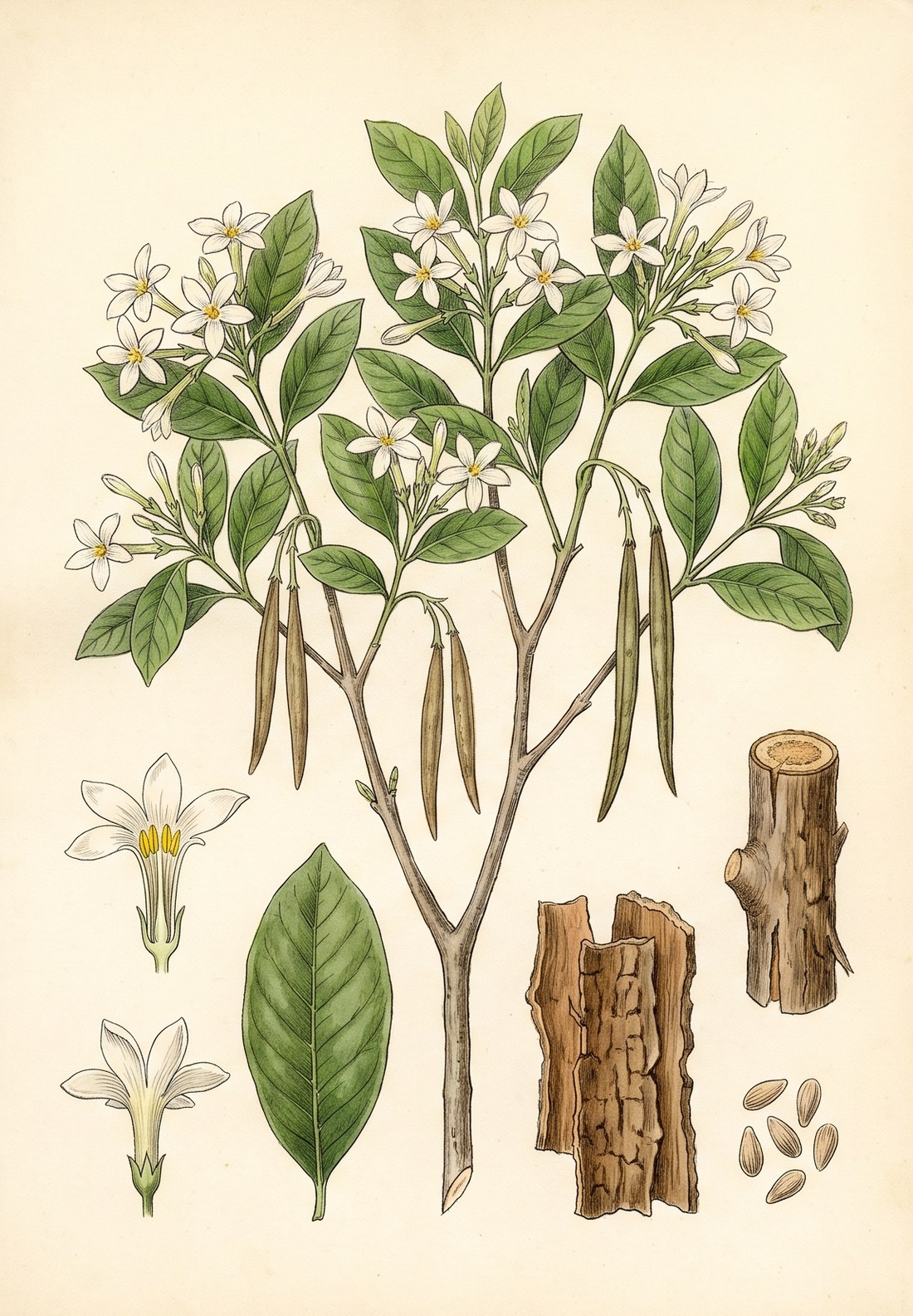
Holarrhena antidysenterica, accepted today as Holarrhena pubescens, is a small deciduous tree of the dry forests of India from the Himalayan foothills through central India to the Deccan, with fragrant white flowers and long paired follicles. Its bitter bark is Kutaja, the drug Ayurveda turns to first for diarrhea and dysentery, and its seed is Indrayava, a bitter febrifuge and anthelmintic. The tree carried its reputation into colonial medicine as kurchi bark, a treatment for amebic dysentery before the era of synthetic antiamebics.

Ask Herbert about Kurchi. Herbert is the master herbalist inside Bountiful Herbs: he answers from this plate and eleven hundred others, with dosing, pairing and cautions. Your first ten questions are free.
Ask HerbertActions
Indications what the tradition reached for it in
- Acute infectious diarrhea
- Amebic dysentery
- Bacillary dysentery (adjunct to rehydration)
- Chronic diarrhea with mucus and blood
- Irritable bowel with diarrhea predominance
- Inflammatory bowel disease in mild flare (adjunct)
- Bleeding hemorrhoids
- Post-infectious malabsorption
- Intestinal worms (adjunct)
- Fever with loose stools
- Traveler's diarrhea
- Type 2 diabetes with loose stools (seed, adjunct)
Specific indications
Frequent loose stools with mucus, blood and griping, foul smell and a burning anus, the picture of pitta and kapha in the colon
The traveler or child who has had a dysenteric illness and now passes soft, mucoid stool many times a day without regaining strength
Chronic irritable bowel with urgency after meals where sticky, offensive stool and a coated tongue point to ama rather than to a dry vata gut
Bleeding piles with loose motions in a patient who cannot tolerate heating astringents
Safety
Low dose botanical. Used in drop doses in the classical practice; not a plant to dose freely.
Pregnancy: Avoid concentrated preparations in pregnancy; the steroidal alkaloids have not been studied in pregnant women and the tradition uses milder drugs for diarrhea in pregnancy; no published safety class is known to us.
The record lists 7 contraindications; open the plate in the library to read them in full.
In practice
Kutaja is the classical answer to atisara and pravahika of every kind, and it is chosen over the plain astringents because it also kindles digestion and clears the ama that keeps the bowel loose. The classical anupana is buttermilk or rice water, and the bark is usually decocted rather than given raw.
In Ayurveda
Rasa: tikta (bitter), kashaya (astringent). Virya: sheeta (cooling). Vipaka: katu (pungent). Guna: laghu (light), ruksha (dry). Dosha: pacifies kapha and pitta; may aggravate vata in excess. Karma: sangrahi (binds and absorbs, antidiarrheal); deepana (kindles digestion); pachana (digests ama); raktastambhana (checks bleeding); kushthaghna (useful in skin disease); krimighna (anthelmintic); jvaraghna (relieves fever); arshoghna (relieves hemorrhoids); stanyashodhana (purifies breast milk); kaphapittahara (pacifies kapha and pitta). Classical indications: atisara (diarrhea); pravahika (dysentery); raktatisara (bloody diarrhea); grahani (malabsorption, chronic bowel disorder); arsha (hemorrhoids); jvara (fever); kushtha (skin disease); krimi (worms); raktapitta (bleeding disorders); trishna (thirst in diarrhea); amadosha (toxins of poor digestion). The stem bark is the main drug, given as kwatha, as churna, as the concentrated ghana vati (solidified decoction), as the avaleha Kutajavaleha and as the fermented Kutajarishta. The seed, Indrayava, is a separate drug of the same tree, more bitter, used in fever, worms and diarrhea in churna and kwatha. Classical formulations: Kutajarishta, Kutajavaleha, Kutajaghana vati, Kutaja twak churna, Kutajashtaka kwatha, Indrayavadi churna, Mahatiktaka ghrita. Described in: Charaka Samhita, Sushruta Samhita, Ashtanga Hridaya, Bhavaprakasha Nighantu, Dhanvantari Nighantu, Raja Nighantu, Kaiyadeva Nighantu, Madanapala Nighantu, Sharngadhara Samhita, Ayurvedic Pharmacopoeia of India.
Dosing as the sources wrote it
| Preparation | As written | Metric |
|---|---|---|
| Kwatha | 50-100 mL bark decoction twice daily | 50-100 mL |
| Churna | 3-6 g bark powder twice daily with buttermilk | 3000-6000 mg |
| Ghana vati | 500-1000 mg tablets twice daily after food | 500-1000 mg |
| Arishta | 12-24 mL twice daily after food | 12-24 mL |
| Avaleha | 5-10 g twice daily | 5000-10000 mg |
| Seed churna (Indrayava) | 1-3 g seed powder twice daily | 1000-3000 mg |
Doses are reproduced from the sources for practitioners and are not a recommendation for any person.
From the sources
Overview. Holarrhena antidysenterica, accepted today as Holarrhena pubescens, is a small deciduous tree of the dry forests of India from the Himalayan foothills through central India to the Deccan, with fragrant white flowers and long paired follicles. Its bitter bark is Kutaja, the drug Ayurveda turns to first for diarrhea and dysentery, and its seed is Indrayava, a bitter febrifuge and anthelmintic. The tree carried its reputation into colonial medicine as kurchi bark, a treatment for amebic dysentery before the era of synthetic antiamebics.
Clinical Notes. Kutaja is the classical answer to atisara and pravahika of every kind, and it is chosen over the plain astringents because it also kindles digestion and clears the ama that keeps the bowel loose. The classical anupana is buttermilk or rice water, and the bark is usually decocted rather than given raw.
Ayurvedic Profile. Rasa: tikta (bitter), kashaya (astringent). Virya: sheeta (cooling). Vipaka: katu (pungent). Guna: laghu (light), ruksha (dry). Dosha: pacifies kapha and pitta; may aggravate vata in excess. Karma: sangrahi (binds and absorbs, antidiarrheal); deepana (kindles digestion); pachana (digests ama); raktastambhana (checks bleeding); kushthaghna (useful in skin disease); krimighna (anthelmintic); jvaraghna (relieves fever); arshoghna (relieves hemorrhoids); stanyashodhana (purifies breast milk); kaphapittahara (pacifies kapha and pitta).
In formulas
Kurchi stands in 23 documented formulas in the library, among them Amṛtāriṣta, Ayaskṛti, Ahiphenāsava, Kuṭajāriṣta, Daśamūlāriṣṭa, Devadārvāriṣṭa.
Often paired with
 long pepperPiper longum
 nut grassCyperus rotundus
 Indian gooseberryPhyllanthus emblica
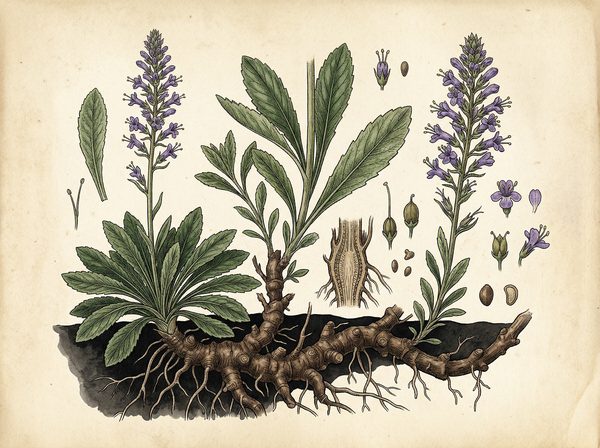 kutkiPicrorhiza kurroa
 chebulic myrobalanTerminalia chebula
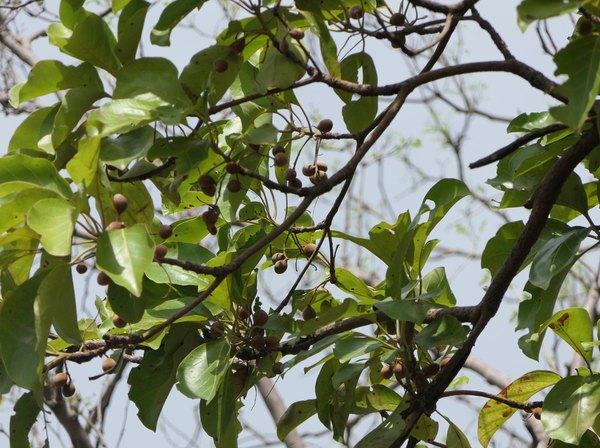 beleric myrobalanTerminalia bellirica
Nearby on the shelf
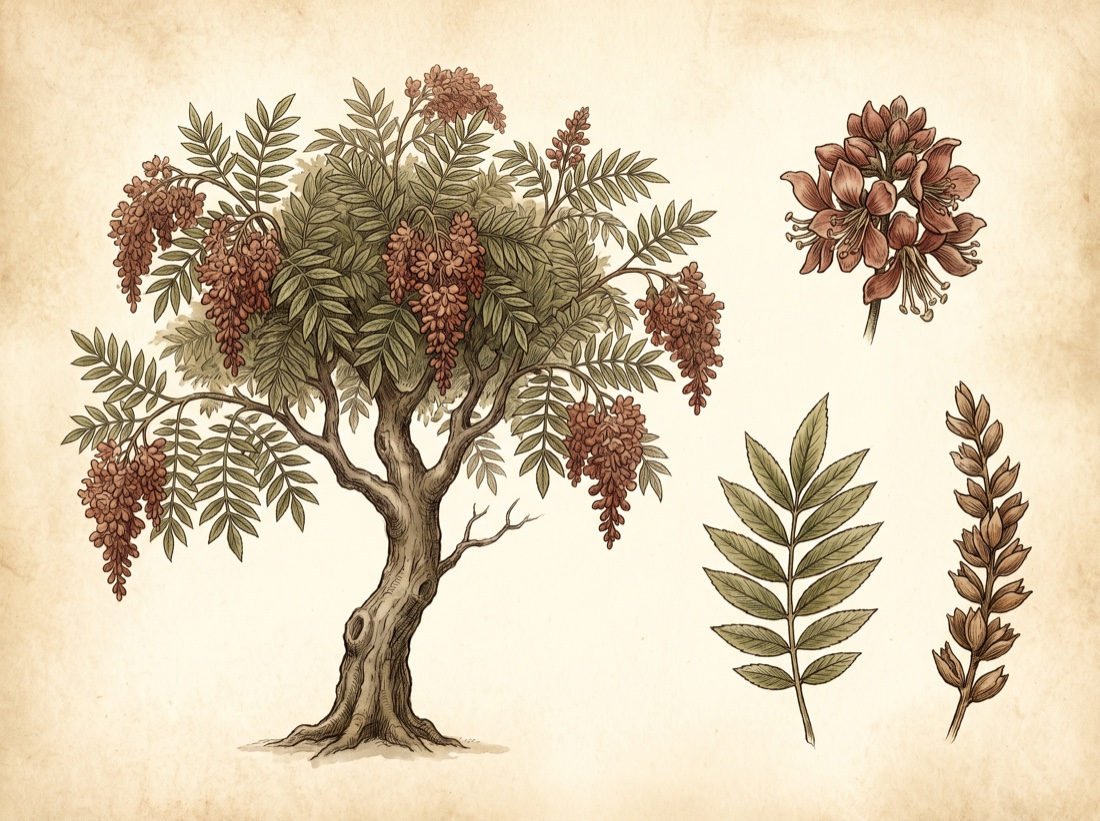 KoussoCusso
 KratomMitragyna speciosa
 Ku ShenSophora flavescens
 KudzuPueraria lobata
 Labrador TeaRhododendron groenlandicum
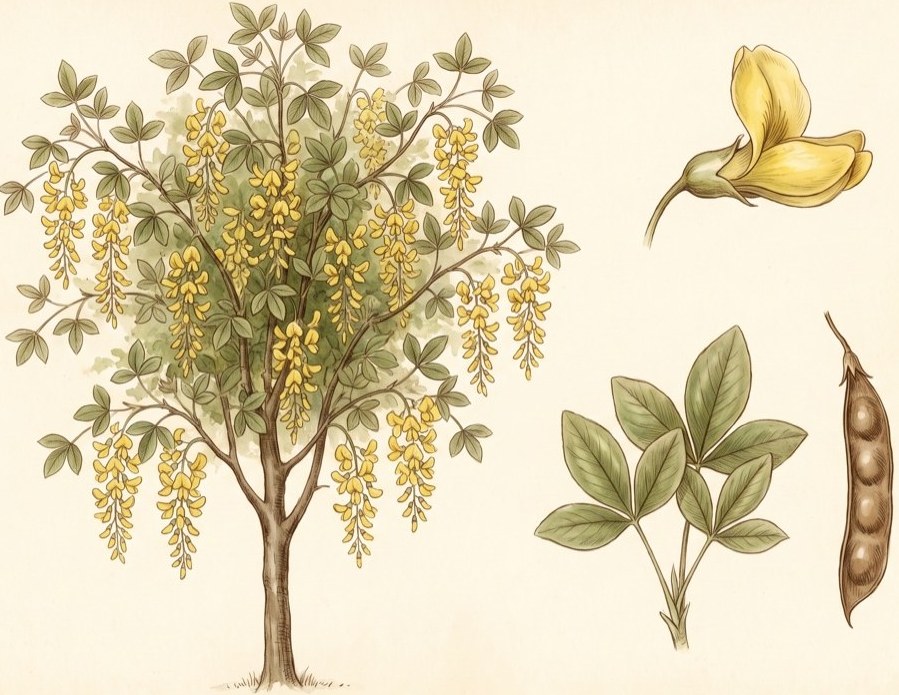 LaburnumLaburnum
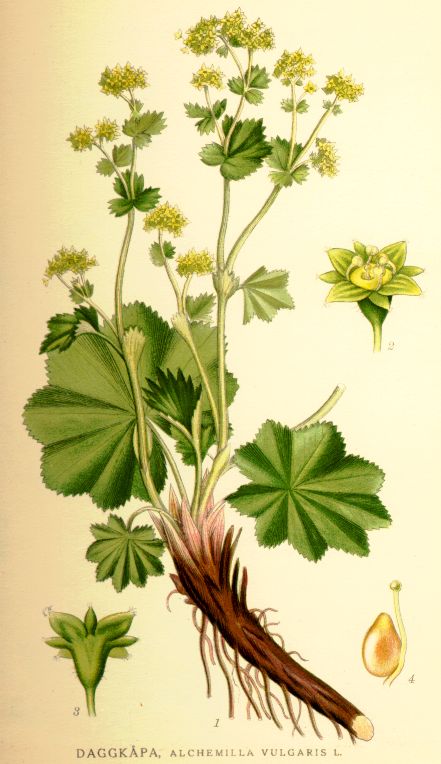 Lady's MantleAlchemilla vulgaris
The whole plate is in the library. The compass, Compare, the Sky of eleven hundred plants and the formulary open with an email address and a password, free, with the formula builder and its safety engine. Herbert without limit, his formulating, clients, the handouts and the labels are the paid room.
Open the library, free