Western Herbalism
Labrador Tea
Rhododendron groenlandicum
Also known as Bog Labrador Tea, James' tea.
Traditional use by indigenous North American peoples as beverage and medicine contains toxic alkaloids, use only as weak tea in moderation ledol content varies by species and location, lower in R. groenlandicum

Ask Herbert about Labrador Tea. Herbert is the master herbalist inside Bountiful Herbs: he answers from this plate and eleven hundred others, with dosing, pairing and cautions. Your first ten questions are free.
Ask HerbertActions
Indications what the tradition reached for it in
- Chest ailments
- Joint pain
- Chest congestion
- Infectious eruptions
- Rheumatism
- Arthritis
- Bronchitis
- Asthma
- Abdominal cramps
- Burns
- Dyspepsia
- Nausea
- Pneumonia
- Headache
- Ulcers
- Cough
- Muscle pain
- Wounds
- Diarrhea
- Fever
- Skin conditions
- Lung infections
- Dysentery
- Stomach flu
- Sore throat
- Kidney problems
- Indigestion
- Debility
- Edema
- Fatigue
Safety
Low dose botanical. Used in drop doses in the classical practice; not a plant to dose freely.
Pregnancy: Not safe. Not for use in pregnancy (our record's flag)
Pregnancy, our record's flag: Caution. Use with care in pregnancy (our record's flag)
Breastfeeding: Not safe. Not for use while breastfeeding (our record's flag)
The record lists 3 contraindications; open the plate in the library to read them in full.
Dosing as the sources wrote it
| Preparation | As written | Metric |
|---|---|---|
| Weak tea | Weak tea (handful of leaves to boiling water, simmer few minutes), 2-4 fl oz 3-4 times daily | |
| infusion of either of the above plants | Dose of the infusion of either of the above plants, from 2 to 4 fluid ounces, 3 or 4 times a day. | |
| Dose, 1 to 10 minims. | 0.0616-0.616 mL |
Doses are reproduced from the sources for practitioners and are not a recommendation for any person.
From the sources
Clinical Notes. Traditional use by indigenous North American peoples as beverage and medicine contains toxic alkaloids, use only as weak tea in moderation ledol content varies by species and location, lower in R. groenlandicum
Action, Medical Uses, and Dosage. Ledum latifolium is pectoral and tonic, and, in small doses, is useful in coughs, irritations of the pulmonary membranes, and in dyspepsia. It increases the urinary flow. Reputed also to possess similar, but less energetic, properties than the Ledum palustre (see below), which is supposed to possess narcotic powers.
indications. Labrador Tea is traditionally indicated for: Chest ailments, Joint pain, Chest congestion, Infectious eruptions, Rheumatism, Arthritis, Bronchitis, Asthma, Abdominal cramps, Burns, Dyspepsia, Nausea, Pneumonia, Headache, Ulcers, and 26 further conditions.
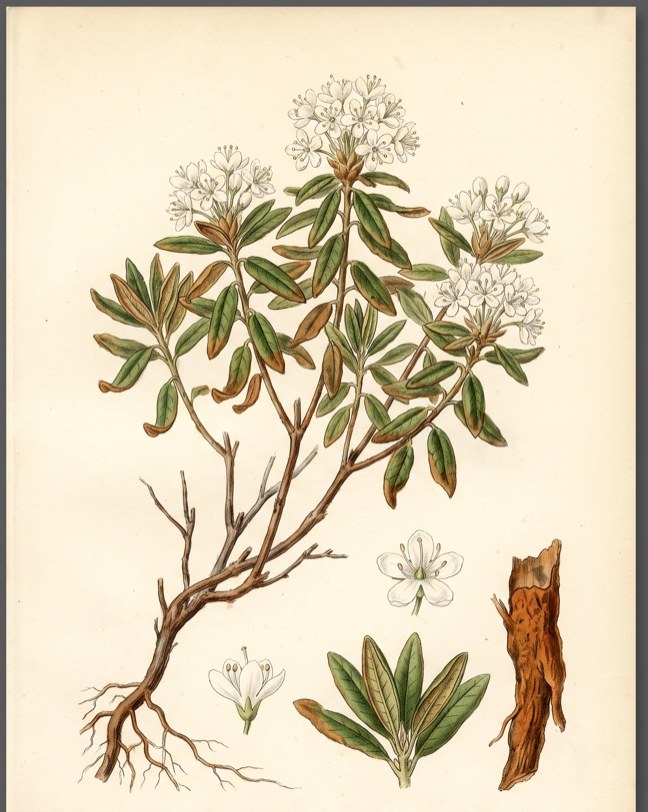
Botanical Source. Ledum latifolium is an evergreen shrub, with an irregularly branched stem, from 2 to 5 feet in height. The branches are woolly. The leaves are alternate, subsessile, entire, 1 or 2 inches in length, nearly one-third as wide, obtuse, elliptical or oblong, smooth above, clothed with a dense, rusty wool beneath, and have revolute or replicate margins.
Drawn from King's American Dispensatory, 18th edition (Felter and Lloyd), and the Bountiful Herbs editorial.
Nearby on the shelf
 Ku ShenSophora flavescens
 KudzuPueraria lobata
 KurchiHolarrhena antidysenterica
 KutkiPicrorhiza kurroa
 LaburnumLaburnum anagyroides
 Lady's MantleAlchemilla vulgaris
 Lady's SlipperCypripedium pubescens
 LadybellsAdenophora stricta
The whole plate is in the library. The compass, Compare, the Sky of eleven hundred plants and the formulary open with an email address and a password, free, with the formula builder and its safety engine. Herbert in full, his formulating, clients, the handouts and the labels are the paid room.
Open the library, free