Ayurvedic Herbalism
Wild turmeric
Curcuma aromatica
Also known as kasturi turmeric, musk turmeric, aromatic turmeric, yellow zedoary, Vana haridra, Aranya haridra, Vanya haridra.
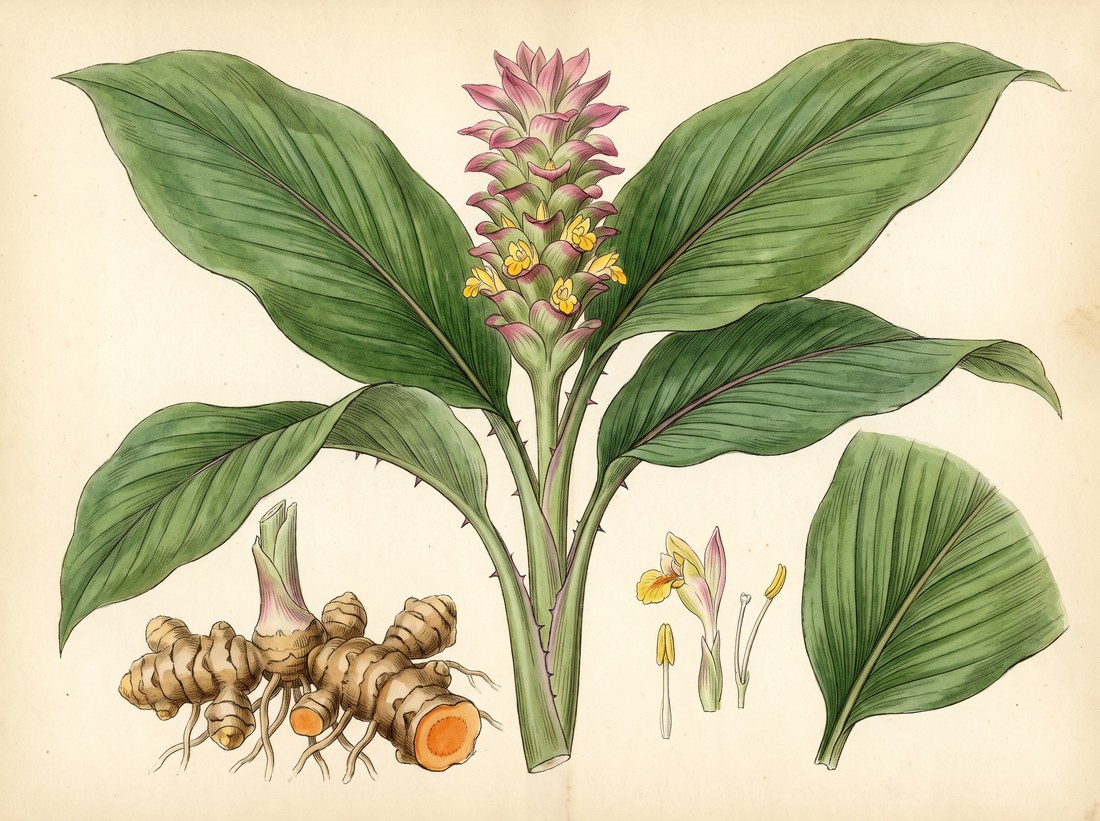
Vana haridra is the wild turmeric, a rhizomatous herb of the ginger family with broad leaves and pink bracted flower spikes, growing wild in the moist deciduous forests and hill slopes of the Western Ghats, the Eastern Ghats, Bengal and the northeastern states, and cultivated on a small scale in Kerala, Tamil Nadu, Karnataka and Odisha for the cosmetic trade. Its pale yellow rhizome smells of camphor and musk and stains far less than cultivated turmeric, which is why it is the turmeric of the face rather than of the kitchen. Ayurveda uses it almost wholly on the skin: for complexion, blemishes, itching, wounds and swellings, and as the daily bathing paste of southern India.

Ask Herbert about Wild turmeric. Herbert is the master herbalist inside Bountiful Herbs: he answers from this plate and eleven hundred others, with dosing, pairing and cautions. Your first ten questions are free.
Ask HerbertActions
Indications what the tradition reached for it in
- Acne and oily, blemished skin (paste)
- Melasma and post-inflammatory hyperpigmentation (paste, adjunct)
- Dull, uneven complexion (bathing paste)
- Eczema, prickly heat and itching eruptions (paste)
- Minor wounds, cuts and abrasions (paste)
- Fungal skin infections (paste, adjunct)
- Insect bites and stings (paste)
- Sprains and joint pain (medicated oil)
- Unwanted facial hair in women (traditional paste, cosmetic)
- Cough and sluggish digestion (small internal doses, traditional)
Specific indications
A young woman with oily, acne prone skin and dark marks who wants a daily plant based face paste rather than drugs
Melasma or dull, uneven facial pigmentation in a pitta or kapha complexion, treated with the paste in milk or rose water
Itchy prickly heat or a mild eczema in summer soothed by a cool paste of the rhizome in sandalwood water
A sprained ankle or aching knee rubbed with a warm oil carrying wild turmeric
Safety
Pregnancy: Topical use is traditional and considered safe; avoid internal use in pregnancy on the traditional caution that aromatic Curcuma rhizomes stimulate the uterus, and no published safety class is known to us.
The record lists 8 contraindications; open the plate in the library to read them in full.
In practice
The Ayurvedic practitioner treats Vana haridra as a cosmetic and dermatological herb. Ground fresh or as powder and mixed with milk, rose water, sandalwood or gram flour, it is applied to the face for acne, oily skin, dark marks, melasma and general dullness, left to dry and washed off; used daily it is said to brighten the complexion and, in women, to discourage fine facial hair.
In Ayurveda
Rasa: tikta (bitter), katu (pungent). Virya: ushna (heating). Vipaka: katu (pungent). Guna: laghu (light), ruksha (dry). Dosha: pacifies kapha and vata; may aggravate pitta in excess when taken internally, though the paste is soothing on the skin. Prabhava: varnya: the tradition values the wild turmeric above the cultivated for brightening the complexion and clearing blemishes. Karma: varnya (improves complexion); kushthaghna (helps skin disease); kandughna (relieves itching); vranaropana (heals wounds); shothahara (reduces swelling); krimighna (kills parasites and microbes); vishaghna (counters poisons, insect bite); twachya (benefits the skin); raktashodhaka (purifies the blood); deepana (kindles digestion, in small internal doses); lekhana (scrapes and clears blockage); vedanasthapana (relieves pain, topical). Classical indications: kushtha (skin disease); kandu (itching); vyanga (facial hyperpigmentation and melasma); twak vikara (skin blemishes, acne, discoloration); vrana (wounds); shotha (swelling); pama (scabies like eruptions); krimi (parasites); visha (insect and scorpion sting, topical); sandhishula (joint pain, topical); yuvana pidaka (acne); kapha vikara (mucus disorders, internal). The fresh or dried rhizome is ground into a paste with water, milk, rose water or sandalwood for application to the face and body; the dried powder is the basis of the traditional bathing paste (ubtan) and of medicated oils for the skin and joints. Internal use is limited to small doses of the powder or decoction for cough and digestive sluggishness, and is much less common than with cultivated turmeric. Classical formulations: Vana haridra lepa, Vana haridra churna (topical), Vanaharidradi taila, Ubtan (traditional bathing paste, regional), Kasturi manjal face paste (southern tradition). Described in: Bhavaprakasha Nighantu, Raja Nighantu, Kaiyadeva Nighantu, Dhanvantari Nighantu.
Dosing as the sources wrote it
| Preparation | As written | Metric |
|---|---|---|
| Lepa, topical | 5-10 g rhizome paste in milk, rose water or sandalwood water applied to the face or skin once daily | 5000-10000 mg |
| Ubtan, topical | 10-20 g powder mixed with gram flour and water as a bathing paste | 10000-20000 mg |
| Taila, topical | 5-10 mL medicated oil massaged into joints or skin twice daily | 5-10 mL |
| Churna, internal | 0.5-1 g powdered rhizome once or twice daily with honey, short courses | 500-1000 mg |
Doses are reproduced from the sources for practitioners and are not a recommendation for any person.
From the sources
Overview. Vana haridra is the wild turmeric, a rhizomatous herb of the ginger family with broad leaves and pink bracted flower spikes, growing wild in the moist deciduous forests and hill slopes of the Western Ghats, the Eastern Ghats, Bengal and the northeastern states, and cultivated on a small scale in Kerala, Tamil Nadu, Karnataka and Odisha for the cosmetic trade. Its pale yellow rhizome smells of camphor and musk and stains far less than cultivated turmeric, which is why it is the turmeric of the face rather than of the kitchen. Ayurveda uses it almost wholly on the skin: for complexion, blemishes, itching, wounds and swellings, and as the daily bathing paste of southern India.
Clinical Notes. The Ayurvedic practitioner treats Vana haridra as a cosmetic and dermatological herb. Ground fresh or as powder and mixed with milk, rose water, sandalwood or gram flour, it is applied to the face for acne, oily skin, dark marks, melasma and general dullness, left to dry and washed off; used daily it is said to brighten the complexion and, in women, to discourage fine facial hair.
Ayurvedic Profile. Rasa: tikta (bitter), katu (pungent). Virya: ushna (heating). Vipaka: katu (pungent). Guna: laghu (light), ruksha (dry). Dosha: pacifies kapha and vata; may aggravate pitta in excess when taken internally, though the paste is soothing on the skin.
Nearby on the shelf
 Wild LettuceLactuca virosa
 Wild quinineParthenium integrifolium
 Wild SarsaparillaAralia nudicaulis
 Wild strawberryFragaria vesca
 Wild yamDioscorea villosa
 Wilford's cranesbillGeranium wilfordii
 WillowSalix spp.
The whole plate is in the library. The compass, Compare, the Sky of eleven hundred plants and the formulary open with an email address and a password, free, with the formula builder and its safety engine. Herbert without limit, his formulating, clients, the handouts and the labels are the paid room.
Open the library, free