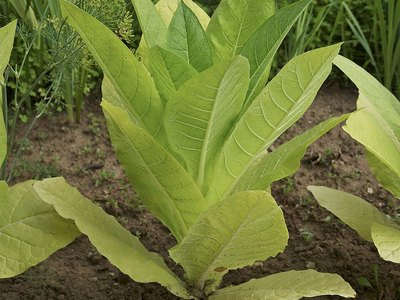
Western Herbalism
Tobacco
Nicotiana tabacum
Also known as common tobacco, AND SYNONYM: Leaf tobacco; Tabaci folia.
Nicotiana tabacum is the cultivated tobacco plant, native to tropical America and now grown worldwide, whose dried leaf is the source of nicotine and related pyridine alkaloids. In nineteenth century Eclectic and regular medicine the leaf was used sparingly, chiefly externally or as an enema, for its powerful relaxant and antispasmodic action on smooth and skeletal muscle. It has no established place in contemporary herbal prescribing because of its narrow margin of safety, but its principal alkaloid remains medically important as nicotine replacement therapy for smoking cessation.

Ask Herbert about Tobacco. Herbert is the master herbalist inside Bountiful Herbs: he answers from this plate and eleven hundred others, with dosing, pairing and cautions. Your first ten questions are free.
Ask HerbertActions
Indications what the tradition reached for it in
- Tetanic spasm (historical, external and rectal use)
- Strangulated hernia (rectal tobacco smoke enema, historical)
- Intestinal obstruction and ileus (historical enema)
- Spasmodic asthma (historical smoking or enema)
- Muscular rigidity before reduction of dislocations (historical)
- Whooping cough (historical, external)
- Snakebite (historical external poultice, unproven)
- Scabies and lice (topical wash, historical)
- Skin ulcers and boils (poultice, historical)
- Strychnine poisoning (historical antidotal claim, unproven and dangerous)
Specific indications
Rigid, spastic muscle tone with tetanic or convulsive contraction, historically relieved by tobacco's profound relaxant effect on nervous and muscular tissue.
Obstinate constipation or strangulated hernia where a tobacco-smoke enema was used by Eclectic physicians to relax the bowel wall, a practice now abandoned for its danger.
Safety
Recognised toxicity. This plant carries a toxicity flag in the record; it is for trained practitioners only.
Low dose botanical. Used in drop doses in the classical practice; not a plant to dose freely.
Pregnancy: Avoid entirely: nicotine crosses the placenta and is a recognized cause of fetal harm, and no dose of the crude plant is considered safe in pregnancy.
Breastfeeding: Not for use while breastfeeding
The record lists 10 contraindications; open the plate in the library to read them in full.
In practice
Historical Eclectic writers valued tobacco as a profound relaxant, reaching for it in tetanus, strangulated hernia, and spasmodic conditions where ordinary antispasmodics failed, typically applying it externally as a fomentation or cautiously as a rectal enema of weak infusion or smoke, never as an internal draught, because the difference between a relaxant dose and a fatal one is small.
Dosing as the sources wrote it
| Preparation | As written | Metric |
|---|---|---|
| Historical external fomentation (Eclectic use, not recommended today) | weak leaf infusion applied externally only, under professional supervision | |
| Nicotine replacement therapy (modern pharmaceutical use, not herbal preparation) | as directed on licensed transdermal patch, gum, or lozenge product | |
| The larger doses may be employed ... from | The larger doses may be employed ... from ½ to 1 drop of nicotine, hypodermatically. | 0.02 mL |
| A wine of tobacco may be used in from | A wine of tobacco may be used in from 1 to 20-drop doses. | |
| The beginning dose should not exceed | The beginning dose should not exceed 1/100 grain, although as high as 1 grain has been recommended. | 0.65-0.65 mg |
| tobacco | The dose of tobacco, as an emetic, is 5 grains. | 324-324 mg |
Doses are reproduced from the sources for practitioners and are not a recommendation for any person.
From the sources
Overview. Nicotiana tabacum is the cultivated tobacco plant, native to tropical America and now grown worldwide, whose dried leaf is the source of nicotine and related pyridine alkaloids. In nineteenth century Eclectic and regular medicine the leaf was used sparingly, chiefly externally or as an enema, for its powerful relaxant and antispasmodic action on smooth and skeletal muscle. It has no established place in contemporary herbal prescribing because of its narrow margin of safety, but its principal alkaloid remains medically important as nicotine replacement therapy for smoking cessation.
Clinical Notes. Historical Eclectic writers valued tobacco as a profound relaxant, reaching for it in tetanus, strangulated hernia, and spasmodic conditions where ordinary antispasmodics failed, typically applying it externally as a fomentation or cautiously as a rectal enema of weak infusion or smoke, never as an internal draught, because the difference between a relaxant dose and a fatal one is small.
Action and Medical Uses. Tobacco ointment forms an anodyne application, useful in various affections of the skin, piles, scald-head, irritable swellings, painful ulcers, etc. Some caution is necessary not to use it too freely, lest it produce its constitutional narcotic effects. An ointment made from the dried leaves is of but little value; one made by rubbing 20 drops of the empyreumatic oil of tobacco with 1 ounce of simple ointment, forms an active preparation.
Specific indications and reasoning. tlesnake, and to have been used with much success. It influences the uervous system directly, and experiment may develop a valuable use for it. It is not in the market, and we will therefore have to depeud upon those who can procure it green, to determine its properties.
Drawn from Scudder's Specific Medication and Specific Medicines; King's American Dispensatory, 18th edition (Felter and Lloyd), and the Bountiful Herbs editorial.
Often paired with
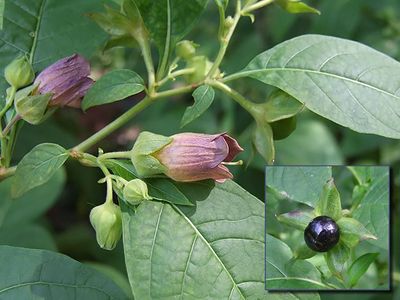 Deadly nightshadeAtropa belladonna
Nearby on the shelf
 ThymeThymus vulgaris
 Tienchi GinsengPanax notoginseng
 Tiger LilyLilium tigrinum
 ToadflaxLinaria vulgaris
 ToluBalsam tolu
 Tongkat AliEurycoma longifolia
 Tongue fernPyrrosia lingua
 Toothache PlantSpilanthes acmella
The whole plate is in the library. The compass, Compare, the Sky of eleven hundred plants and the formulary open with an email address and a password, free, with the formula builder and its safety engine. Herbert without limit, his formulating, clients, the handouts and the labels are the paid room.
Open the library, free