Western Herbalism
Toadflax
Linaria vulgaris
Also known as Yellow Toadflax, Butter-and-eggs, Toad Flax, Snap-dragon, Butter, eggs, Ramsted.
This plant is recommended for "bad blood," splenic and hepatic hypertrophies, jaundice, skin diseases, and scrofula. An ointment prepared by covering 1 part of the bruised fresh plant with 10 parts of hot lard or mutton tallow, forms a soothing application for hemorrhoids and similar conditions. A strong tincture (℥viii to alcohol 98 per cent Oj), may be given in doses of a fraction of a drop to 10 drops. A decoction is prepared from 1 ounce of the plant to 1 pint of water.

Ask Herbert about Toadflax. Herbert is the master herbalist inside Bountiful Herbs: he answers from this plate and eleven hundred others, with dosing, pairing and cautions. Your first ten questions are free.
Ask HerbertActions
Indications what the tradition reached for it in
- Bladder infections
- Digestive tract disorders
- Liver disease
- Sores
- Scrofula
- Spleen obstructions and hypertrophy
- Malignant ulcers
- Oed
- Abdominal cramps
- Gall bladder complaints
- Foot ulcers
- Dropsy
- Cystitis
- Piles
- Urinary tract disorder
- Skin eruptions
- Fluid retention
- Jaundice
- Ulcerous sores
- Wounds
- Diarrhea
- Skin conditions
- Inflammation of eyes
- Enteritis
- Hemorrhoids
- Bloating
- Bleeding
- Edema
- Urinary disorders
- Urinary complaints
Safety
Low dose botanical. Used in drop doses in the classical practice; not a plant to dose freely.
Pregnancy: Not safe. Not for use in pregnancy (our record's flag)
Pregnancy, our record's flag: Caution. Use with care in pregnancy (our record's flag)
Breastfeeding: Not safe. Not for use while breastfeeding (our record's flag)
The record lists 3 contraindications; open the plate in the library to read them in full.
Dosing as the sources wrote it
| Preparation | As written |
|---|---|
| Tincture | Tincture 1:5, 20-30 drops (1ml) 2x daily |
| A strong tincture (℥viii to alcohol 98 per cent Oj), may be given in doses of a fraction of a drop to 10 drops. | |
| Infusion (1 oz to 1 pint, alterative) | |
| Tea (2-4g dried flowering tops/cup, steep 10-15 min, up to 3x daily) |
Doses are reproduced from the sources for practitioners and are not a recommendation for any person.
From the sources
Action, Medical Uses, and Dosage. This plant is recommended for "bad blood," splenic and hepatic hypertrophies, jaundice, skin diseases, and scrofula. An ointment prepared by covering 1 part of the bruised fresh plant with 10 parts of hot lard or mutton tallow, forms a soothing application for hemorrhoids and similar conditions. A strong tincture (℥viii to alcohol 98 per cent Oj), may be given in doses of a fraction of a drop to 10 drops. A decoction is prepared from 1 ounce of the plant to 1 pint of water.
History. Linaria is a native of Europe, but is naturalized in this country, where it is common in waste places, and sometimes becomes so plentiful in fields as to become a nuisance. When fresh the plant has a nauseously unpleasant odor, which it loses for the most part upon drying.
indications. Toadflax is traditionally indicated for: Bladder infections, Digestive tract disorders, Liver disease, Sores, Scrofula, Spleen obstructions and hypertrophy, Malignant ulcers, Oed, Abdominal cramps, Gall bladder complaints, Foot ulcers, Dropsy, Cystitis, Piles, Urinary tract disorder, and 21 further conditions.
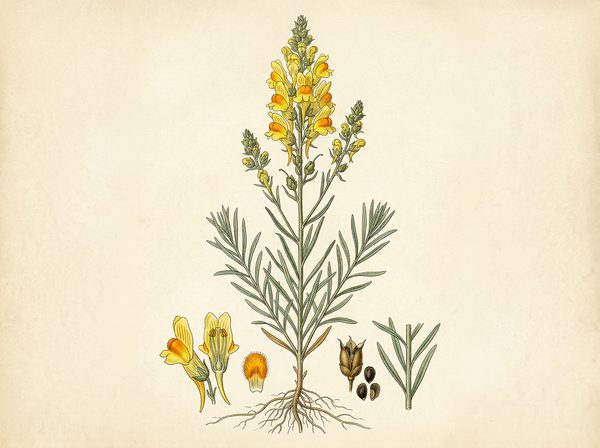
Botanical Source. This plant is a perennial whose stem reaches a height of from 1 to 2 feet, and has pale-green, smooth, lance-linear, crowded, sessile, alternate leaves. The flowers, yellow and orange in color, are dense and imbricate, and borne in a showy terminal spike or raceme. The corolla is personate and its base extended into a spur. The calyx is smooth and not so long as the curved spur.
Drawn from King's American Dispensatory, 18th edition (Felter and Lloyd), and the Bountiful Herbs editorial.
Nearby on the shelf
 Thunder god vineTripterygium wilfordii
 ThymeThymus vulgaris
 Tienchi GinsengPanax notoginseng
 Tiger LilyLilium tigrinum
 TobaccoNicotiana tabacum
 ToluBalsam tolu
 Tongkat AliEurycoma longifolia
 Tongue fernPyrrosia lingua
The whole plate is in the library. The compass, Compare, the Sky of eleven hundred plants and the formulary open with an email address and a password, free, with the formula builder and its safety engine. Herbert in full, his formulating, clients, the handouts and the labels are the paid room.
Open the library, free