Ayurvedic Herbalism
Safed musli
Chlorophytum borivilianum
Also known as white musli, Indian spider plant, Shveta Musali, Musali, Dhavala Musali.
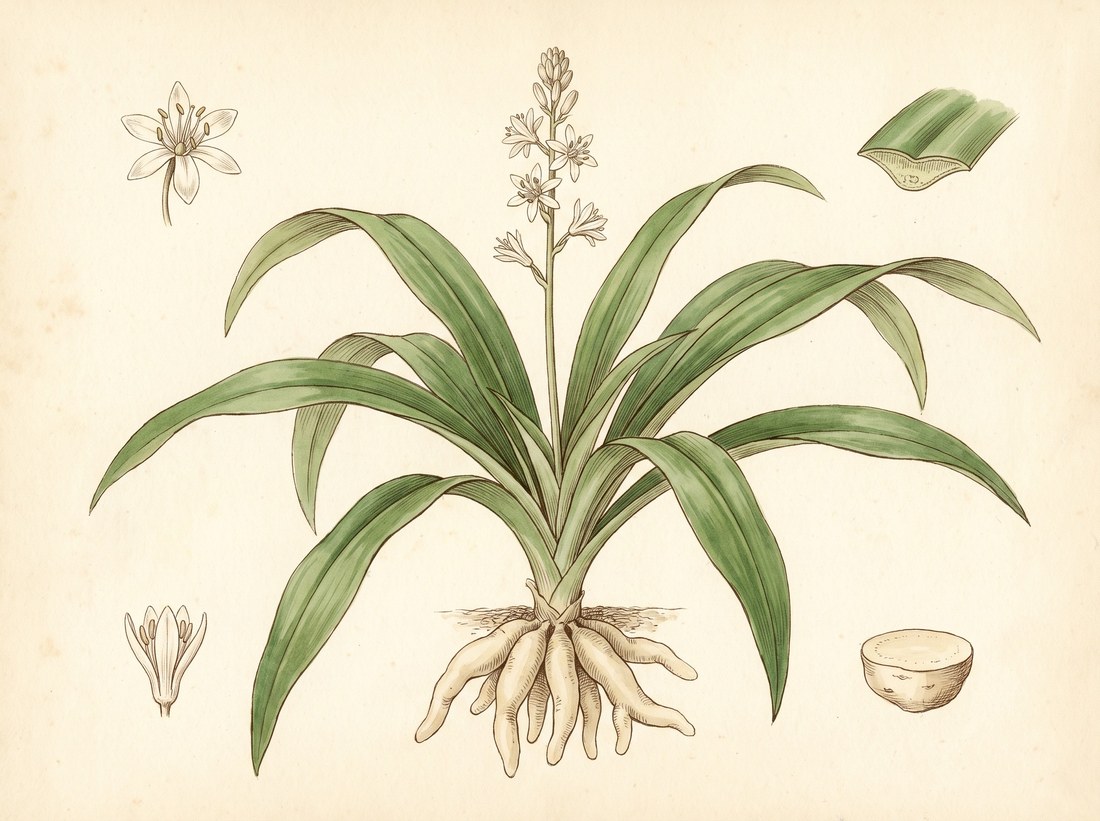
Chlorophytum borivilianum is a small herbaceous plant of the asparagus family with a rosette of strap-like leaves and a cluster of fleshy white tubers, native to the forests of central India, especially Madhya Pradesh, Gujarat, Rajasthan and Maharashtra, and now widely cultivated because wild stocks were nearly collected out. Ayurveda knows the peeled dried tubers as Shveta Musali or safed musli, a sweet, cooling vajikarana and rasayana root that builds semen, strength and tissue, and it is traded across India as a premium sexual tonic. Its cooling character sets it apart from the more heating tonics like Ashwagandha.

Ask Herbert about Safed musli. Herbert is the master herbalist inside Bountiful Herbs: he answers from this plate and eleven hundred others, with dosing, pairing and cautions. Your first ten questions are free.
Ask HerbertActions
Indications what the tradition reached for it in
- Low libido and erectile weakness with fatigue
- Male subfertility with low sperm count or motility
- Post-illness or postpartum debility
- Underweight, dry, depleted constitutions
- Low milk supply in a depleted mother
- Leukorrhea with weakness (traditional)
- Burning urination in a dry, hot patient
- Poor recovery from exercise in the thin athlete
- Type 2 diabetes with weight loss and weakness (adjunct)
- Chronic stress with sexual disinterest
Specific indications
A thin, anxious man in his forties with low desire, weak erections and tiredness after work, who feels dried out rather than congested and wants to be rebuilt rather than stimulated
A couple with unexplained subfertility where the semen analysis shows low count and motility and the man is overworked and underslept
A new mother who is exhausted, thin, with scanty milk and a hot, dry feel to her, where Shatavari alone has not been enough
The pitta-vata patient who cannot tolerate Ashwagandha's heat but needs a building sexual tonic
Safety
The record lists 6 contraindications; open the plate in the library to read them in full.
In practice
Safed musli is the vajikarana of choice when the patient is hot, dry and depleted: a pitta-vata man with low libido, poor semen quality and no reserves, who flushes or gets irritable on Ashwagandha. The classical anupana is warm milk with sugar or misri taken in the morning or at bedtime, and the root is cooked into Musali paka with milk, ghee and spices for a longer building course in the cold season.
In Ayurveda
Rasa: madhura (sweet), with a faint tikta (bitter) note. Virya: sheeta (cooling). Vipaka: madhura (sweet). Guna: guru (heavy), snigdha (unctuous), picchila (slimy). Dosha: pacifies vata and pitta; increases kapha when taken in excess. Karma: vajikarana (aphrodisiac, promotes sexual vigor); shukrala (increases semen); balya (strengthening); brimhana (nourishing, builds tissue); rasayana (rejuvenative); stanyajanana (promotes breast milk); mutrala (diuretic); dahaprashamana (relieves burning). Classical indications: klaibya (male sexual dysfunction); shukra kshaya (depletion of semen); daurbalya (weakness and debility); karshya (emaciation); prameha (urinary disorders including diabetes); pradara (leukorrhea and excessive vaginal discharge); sutika roga (postpartum debility); arsha (hemorrhoids, in some regional traditions); mutrakrichra (painful urination). The peeled and dried tuberous roots are the drug, powdered and taken with warm milk and sugar, cooked into a paka (a sweet confection with milk and ghee), or combined with other vajikarana herbs. The root is not usually decocted alone because its virtue lies in the mucilaginous saponin-rich powder. Classical formulations: Musali paka, Musalyadi churna, Shveta Musali churna, Vajikarana yogas with Ashwagandha, Kapikacchu and Gokshura. Described in: Bhavaprakasha Nighantu, Raja Nighantu, Kaiyadeva Nighantu.
Dosing as the sources wrote it
| Preparation | As written | Metric |
|---|---|---|
| Churna | 3-6 g powdered root once daily with warm milk and sugar | 3000-6000 mg |
| Paka | 10-20 g Musali paka confection once daily in the morning | 10000-20000 mg |
| Capsule | 500-1000 mg root powder two or three times daily | 500-1000 mg |
| Kshirapaka | 5-10 g root simmered in 200 mL milk and water, taken once daily | 5000-10000 mg |
Doses are reproduced from the sources for practitioners and are not a recommendation for any person.
From the sources
Overview. Chlorophytum borivilianum is a small herbaceous plant of the asparagus family with a rosette of strap-like leaves and a cluster of fleshy white tubers, native to the forests of central India, especially Madhya Pradesh, Gujarat, Rajasthan and Maharashtra, and now widely cultivated because wild stocks were nearly collected out. Ayurveda knows the peeled dried tubers as Shveta Musali or safed musli, a sweet, cooling vajikarana and rasayana root that builds semen, strength and tissue, and it is traded across India as a premium sexual tonic. Its cooling character sets it apart from the more heating tonics like Ashwagandha.
Clinical Notes. Safed musli is the vajikarana of choice when the patient is hot, dry and depleted: a pitta-vata man with low libido, poor semen quality and no reserves, who flushes or gets irritable on Ashwagandha. The classical anupana is warm milk with sugar or misri taken in the morning or at bedtime, and the root is cooked into Musali paka with milk, ghee and spices for a longer building course in the cold season.
Ayurvedic Profile. Rasa: madhura (sweet), with a faint tikta (bitter) note. Virya: sheeta (cooling). Vipaka: madhura (sweet). Guna: guru (heavy), snigdha (unctuous), picchila (slimy). Dosha: pacifies vata and pitta; increases kapha when taken in excess.
Nearby on the shelf
 Rue AnemoneThalictrum
 Sacred figFicus religiosa
 Sacred lotusNelumbo nucifera
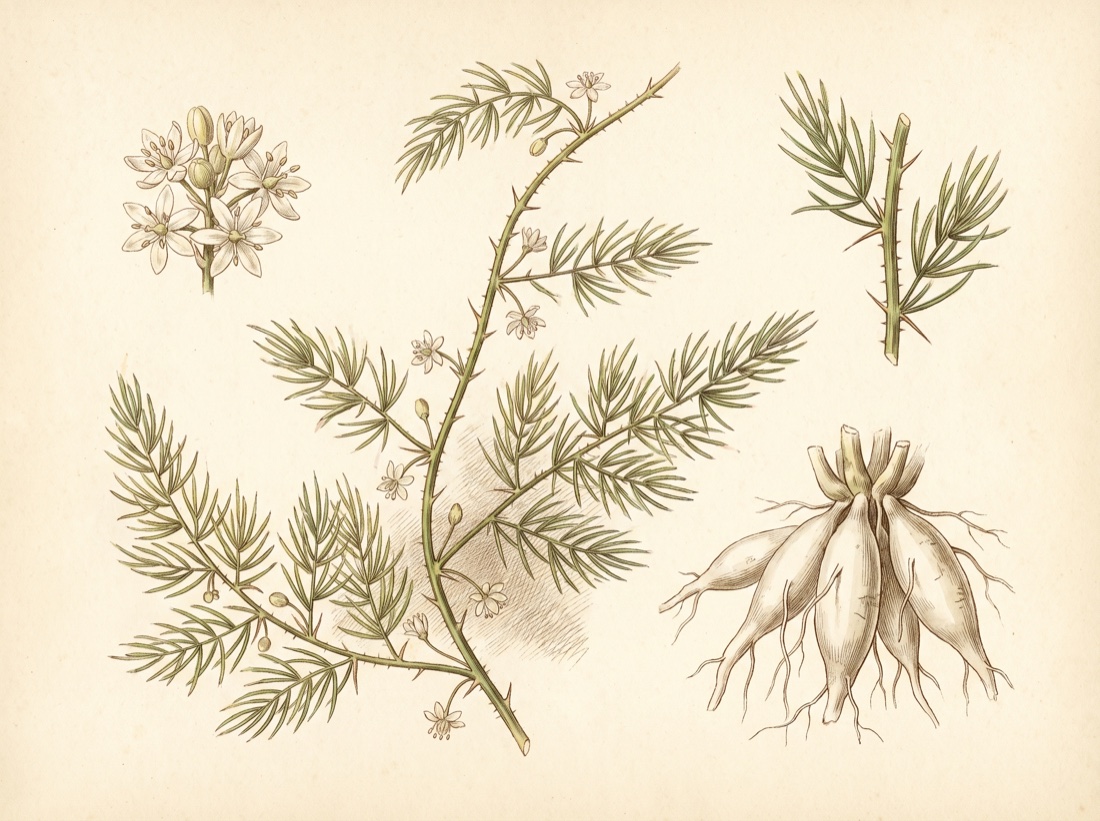 Safed musliAsparagus adscendens
 SafflowerCarthamus tinctorius
 SaffronCrocus sativus
 SageSalvia officinalis
 SagoSago
The whole plate is in the library. The compass, Compare, the Sky of eleven hundred plants and the formulary open with an email address and a password, free, with the formula builder and its safety engine. Herbert without limit, his formulating, clients, the handouts and the labels are the paid room.
Open the library, free