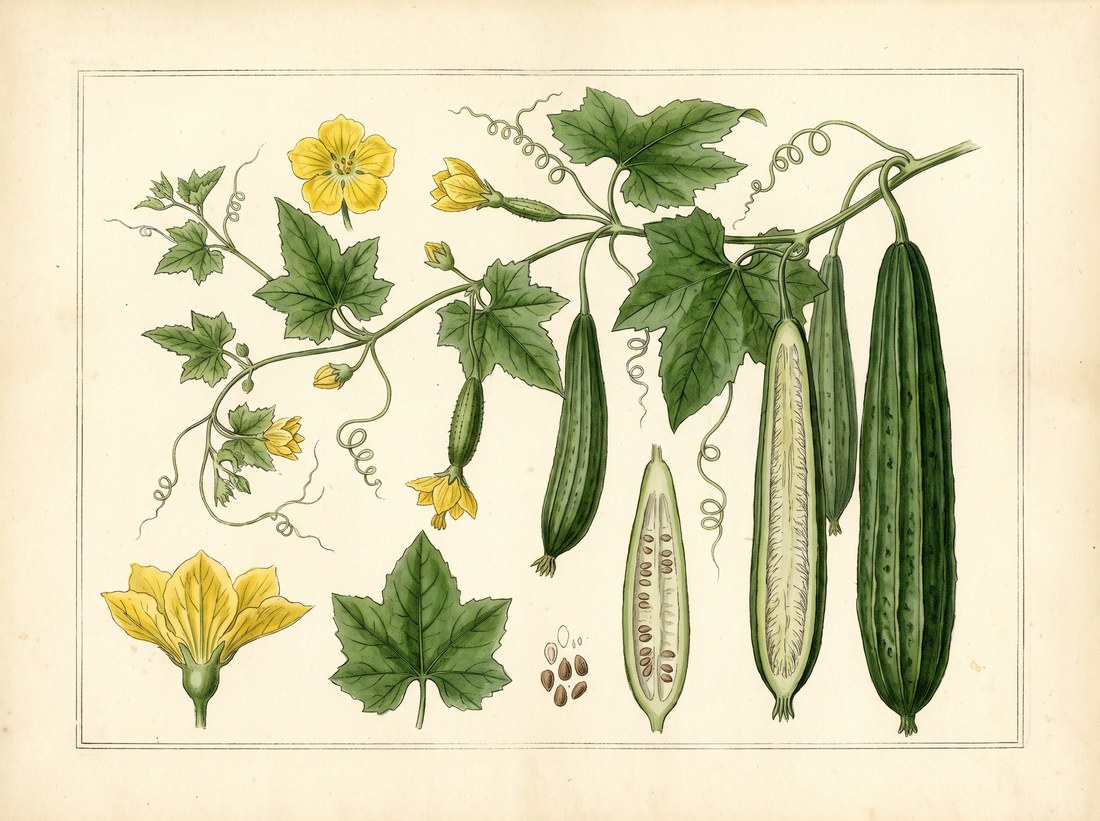
Ayurvedic Herbalism
Ridge gourd
Luffa acutangula
Also known as angled luffa, ribbed gourd, Chinese okra, bitter luffa (the wild form), Koshataki, Krutavedhana, Jalini.
Luffa acutangula is a vigorous annual climber of the gourd family with yellow flowers and long, ten-ribbed fruits, grown as a vegetable across India from Punjab to Kerala and throughout tropical Asia; a wild bitter form, once named Luffa amara, grows on hedges and waste ground and is the medicinal plant. Ayurveda names the group Koshataki. The cultivated fruit is a cooling, light food for kapha and pitta, while the bitter wild fruit and its seeds are among the classical emetic and purgative drugs, listed by the Charaka Samhita among the urdhvabhagahara group, and its fresh juice is dropped into the nose for jaundice.

Ask Herbert about Ridge gourd. Herbert is the master herbalist inside Bountiful Herbs: he answers from this plate and eleven hundred others, with dosing, pairing and cautions. Your first ten questions are free.
Ask HerbertActions
Indications what the tradition reached for it in
- Kapha accumulation requiring therapeutic emesis (supervised Panchakarma)
- Jaundice and hepatic congestion (traditional, nasal and oral)
- Chronic headache and sinus congestion (nasal drops, traditional)
- Constipation with kapha and pitta (bitter form, small doses)
- Intestinal worms
- Skin eruptions, ringworm and boils (leaf juice, topical)
- Conjunctivitis and eye irritation (leaf juice, traditional)
- Splenic enlargement (traditional)
- Edema and fluid retention
- Elevated blood sugar (cultivated fruit as food, preclinical for the bitter form)
- Hemorrhoids with sluggish bowels
Specific indications
A heavy kapha patient with a coated tongue, nausea, excess mucus and a thick, sluggish body who is a candidate for supervised vamana
Jaundice with a heavy head, dull ache over the eyes and a bitter taste, where the tradition drops the bitter fruit juice into the nose
Sluggish, constipated digestion with heat and itching skin in a pitta-kapha constitution, for a small dose of the bitter fruit powder
Cooling summer fare for a hot, overweight patient, for the cultivated gourd as a regular vegetable
Safety
Low dose botanical. Used in drop doses in the classical practice; not a plant to dose freely.
Breastfeeding: The cultivated fruit is a safe food while nursing; avoid the bitter medicinal form because purgative principles may pass into milk.
The record lists 10 contraindications; open the plate in the library to read them in full.
In practice
For the Ayurvedic physician the bitter Koshataki is a Panchakarma drug. Its fruit powder or seeds, alone or with Madanaphala, Yashtimadhu and salt water, are given in the vamana procedure to bring up accumulated kapha in asthma, chronic skin disease, obesity and poisoning, always after preparatory oleation and under supervision, and the same drug in smaller repeated doses acts as a purgative for kapha-pitta constipation, worms and splenic congestion.
In Ayurveda
Rasa: tikta (bitter), katu (pungent); the cultivated fruit is madhura (sweet). Virya: sheeta (cooling); the bitter form is described as ushna in some texts. Vipaka: katu (pungent). Guna: laghu (light), ruksha (dry), tikshna (sharp, the bitter form). Dosha: pacifies kapha and pitta; the bitter form aggravates vata in excess. Prabhava: vamaka (emetic) in the bitter form, one of the classical urdhvabhagahara drugs. Karma: vamaka (emetic, the bitter fruit and seed); virechana (purgative, in larger doses of the bitter form); kaphahara (reduces kapha); pittahara (reduces pitta); shirovirechana (clears the head, as nasal drops); krimighna (anthelmintic); kushthaghna (relieves skin disease); shothahara (reduces swelling); deepana (kindles digestion, the cultivated fruit); mutrala (diuretic); jvaraghna (relieves fever). Classical indications: kapha and pitta disorders requiring vamana (emesis); kamala (jaundice, as nasal drops and internally); shirahshula (headache, as nasal drops); kushtha (skin diseases); krimi (worms); shotha (swelling and edema); gulma (abdominal mass); pleeha vriddhi (splenomegaly); arsha (hemorrhoids); prameha (urinary and metabolic disorders); jvara (fever); visha (poisoning, as emetic). Two plants live under one name. The cultivated sweet ridge gourd is a cooling vegetable for pitta and kapha. The wild bitter form, with its bitter fruit and seeds, is a medicine: the dried fruit powder or seed is a classical emetic and purgative, the fresh fruit juice is dropped into the nostrils for jaundice and headache, the leaf juice is used for conjunctivitis and skin eruptions, and the fibrous mature fruit is a bath sponge. Classical formulations: Koshataki phala churna (bitter fruit powder, emetic), Koshataki bija churna (seed powder), Koshataki swarasa nasya (nasal drops for kamala), Koshataki patra lepa (leaf paste), Vamana yogas containing Koshataki. Described in: Charaka Samhita, Sushruta Samhita, Ashtanga Hridaya, Bhavaprakasha Nighantu, Dhanvantari Nighantu, Raja Nighantu, Kaiyadeva Nighantu, Ayurvedic Pharmacopoeia of India.
Dosing as the sources wrote it
| Preparation | As written | Metric |
|---|---|---|
| Bitter fruit churna, purgative | 0.5-1 g dried bitter fruit powder at night with warm water, short courses | 500-1000 mg |
| Bitter fruit or seed, emetic | 1-3 g bitter fruit or seed powder as a single dose, supervised vamana only | 1000-3000 mg |
| Swarasa, nasya | 2-4 drops fresh bitter fruit juice into each nostril, supervised, traditional | 0.04-0.08 mL |
| Leaf juice, topical | 5-10 mL fresh leaf juice applied to affected skin twice daily | 5-10 mL |
| Cultivated fruit, food | 100-200 g cooked ridge gourd as a vegetable | 100000-200000 mg |
Doses are reproduced from the sources for practitioners and are not a recommendation for any person.
From the sources
Overview. Luffa acutangula is a vigorous annual climber of the gourd family with yellow flowers and long, ten-ribbed fruits, grown as a vegetable across India from Punjab to Kerala and throughout tropical Asia; a wild bitter form, once named Luffa amara, grows on hedges and waste ground and is the medicinal plant. Ayurveda names the group Koshataki. The cultivated fruit is a cooling, light food for kapha and pitta, while the bitter wild fruit and its seeds are among the classical emetic and purgative drugs, listed by the Charaka Samhita among the urdhvabhagahara group, and its fresh juice is dropped into the nose for jaundice.
Clinical Notes. For the Ayurvedic physician the bitter Koshataki is a Panchakarma drug. Its fruit powder or seeds, alone or with Madanaphala, Yashtimadhu and salt water, are given in the vamana procedure to bring up accumulated kapha in asthma, chronic skin disease, obesity and poisoning, always after preparatory oleation and under supervision, and the same drug in smaller repeated doses acts as a purgative for kapha-pitta constipation, worms and splenic congestion.
Ayurvedic Profile. Rasa: tikta (bitter), katu (pungent); the cultivated fruit is madhura (sweet). Virya: sheeta (cooling); the bitter form is described as ushna in some texts. Vipaka: katu (pungent). Guna: laghu (light), ruksha (dry), tikshna (sharp, the bitter form).
Nearby on the shelf
 Rhus GlabraRhus Glabra
 RiceOryza
 Rice beanVigna umbellata
 Riddhi orchidHabenaria intermedia
 Rock polypodyPolypodium vulgare
 RooibosAspalathus linearis
 Rosary peaAbrus precatorius
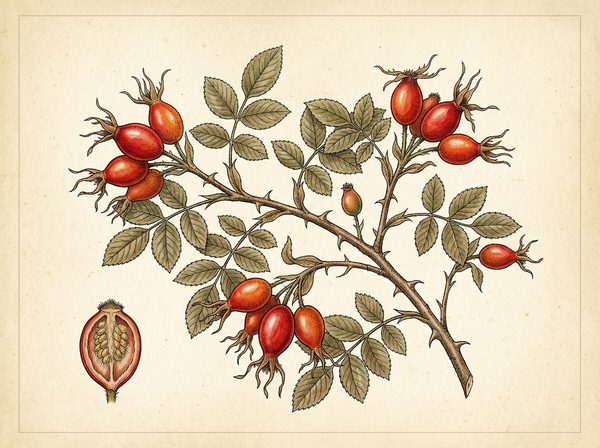 RosehipRosa canina
The whole plate is in the library. The compass, Compare, the Sky of eleven hundred plants and the formulary open with an email address and a password, free, with the formula builder and its safety engine. Herbert without limit, his formulating, clients, the handouts and the labels are the paid room.
Open the library, free