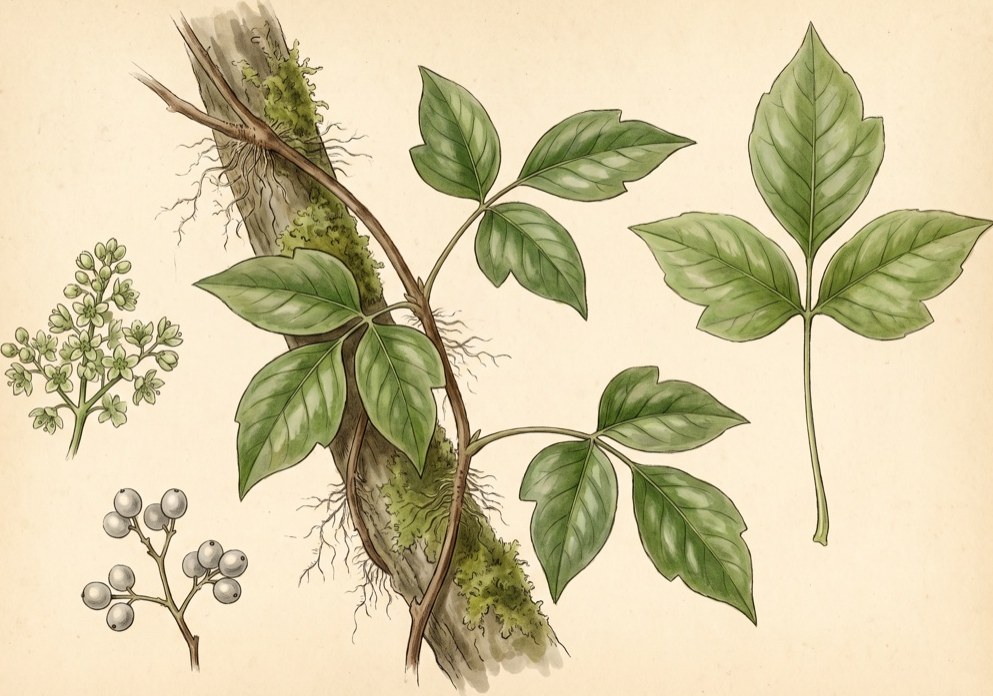
Western Herbalism
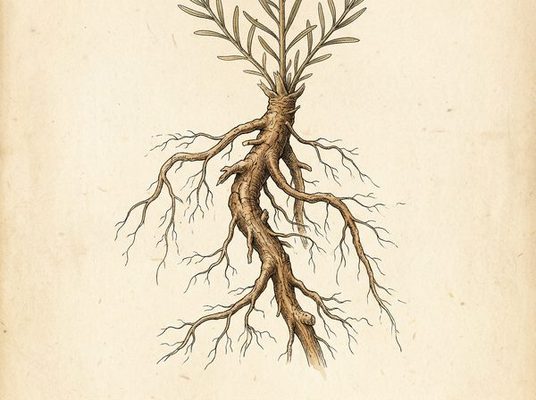
Poison ivy
Toxicodendron radicans
Also known as Poison oak, Poison wine, Rhus, Toxicodendron radicans, Rhus Radicans, Poison Vine.
Rhus is a medicine for nervous irritation, nervous tension, and the typhoid state. Its range of application is wide but distinct. Acting primarily and most pronouncedly upon the nervous system, it proves secondarily an ideal sedative to control excited circulation.

Ask Herbert about Poison ivy. Herbert is the master herbalist inside Bountiful Herbs: he answers from this plate and eleven hundred others, with dosing, pairing and cautions. Your first ten questions are free.
Ask HerbertSafety
Recognised toxicity. This plant carries a toxicity flag in the record; it is for trained practitioners only.
Pregnancy: Not safe. Do not use in pregnancy. A natural products monograph advises avoiding poison ivy in pregnancy and says its preparations should not be taken by mouth because of allergy and toxicity from urushiol.
Breastfeeding: Not safe. Do not use while breastfeeding. A natural products monograph advises avoiding it while breastfeeding, as safety information is lacking and the urushiol in the plant is a potent allergen.
Dosing as the sources wrote it
| Preparation | As written | Metric |
|---|---|---|
| Dose, from one-tenth to two minims. | 0.00616-0.123 mL | |
| Hurd claims that when Lagrippe first made its appearance, the first two cases had a guiding symptom that caused him to give full doses of rhus tox. | ||
| Dose, 1/20 to 5 drops. | ||
| Dose, One teaspoonful every hour in acute disorders; four times a day in chronic affections. | ||
| The proper dose for specific effects, and it is scarcely employed in any other manner, is the fraction of a drop of specific medicine rhus, thus; Rx Specific Medicine Rhus, 5-15 drops; Water, 4 fluidounces. | ||
| hence the reason why washing after contact with ivy does not prevent the appearance of the characteristic eruption. Experimentation (see V. K. Chesnut, United States Yearbook of Department of Agriculture, 1896, p. 141) has shown that if the oil be placed upon the skin, and immediately removed with alcohol, but slight effects are observed. The longer the interval, however, the more pronounced the effects become. In all, the effects were less marked than when no such treatment was given. From the fact that several portions of the skin could be impressed without coalescence of the areas, it has been concluded that the action of the oil is wholly local, and that the poison does not enter the blood. We are not, however, satisfied with this view of the matter, for if so, how are we to explain the recurrence of the trouble after weeks and months, and even years, in persons who have not for some time been near the plants or in the neighborhood of their growth? There are many agents that might be used for the relief of this species of dermatitis, as lobelia, grindelia, sulphate of iron or copper, both of which have served us well, and the more recently recommended echafolta. |
Doses are reproduced from the sources for practitioners and are not a recommendation for any person.
From the sources
Therapy. Rhus is a medicine for nervous irritation, nervous tension, and the typhoid state. Its range of application is wide but distinct. Acting primarily and most pronouncedly upon the nervous system, it proves secondarily an ideal sedative to control excited circulation.
Therapy. The indications for this remedy are present in acute erysipelas to a marked degree, especially in erysipelas of the head and face, or that involving loose cellular tissue. If it be given in the first stages of this disease the symptoms abate rapidly.
Action, Medical Uses, and Dosage. Locally, rhus is a powerful irritant poison. The toxic manifestations produced from the different species is of precisely the same nature, differing only in degree of intensity. Rhus Toxicodendron ranks next to poison dogwood in point of virulence.
Specific Indications and Uses. Small, moderately quick, sharp pulse, sometimes vibratile or wiry; great restlessness; child starts from sleep with a sharp, shrill cry as if from fright; great restlessness with vomiting; tongue red and irritable, showing red spots; strawberry tongue; burning pain; pain in or above left orbit; rheumatic pain aggravated by warmth; bright, superficial redness of the skin with burning, itching, or tingling; bright-red, glistening erysipelas with burning pain; pinched countenance; burning urethral pain with dribbling of urine; redness of mucous tissues; brown sordes; tympanites; acrid discharges from bladder or bowels; inflammation with bright-red tumid surfaces and deep-seated burning pain; inflammation with...
Drawn from Scudder's Specific Medication and Specific Medicines; King's American Dispensatory, 18th edition (Felter and Lloyd); Ellingwood's American Materia Medica, Therapeutics and Pharmacognosy; Felter's Eclectic Materia Medica, Pharmacology and Therapeutics, and the Bountiful Herbs editorial.
Nearby on the shelf
 PlantainPlantago lanceolata
 Pleurisy rootAsclepias tuberosa
 Pointed gourdTrichosanthes dioica
 Poison HemlockConium maculatum
 Poke rootPhytolacca americana
 PoleoHedeoma oblongifolia
 PolygalaPolygala senega
 Polygala rootPolygala tenuifolia
The whole plate is in the library. The compass, Compare, the Sky of eleven hundred plants and the formulary open with an email address and a password, free, with the formula builder and its safety engine. Herbert in full, his formulating, clients, the handouts and the labels are the paid room.
Open the library, free