Western Herbalism
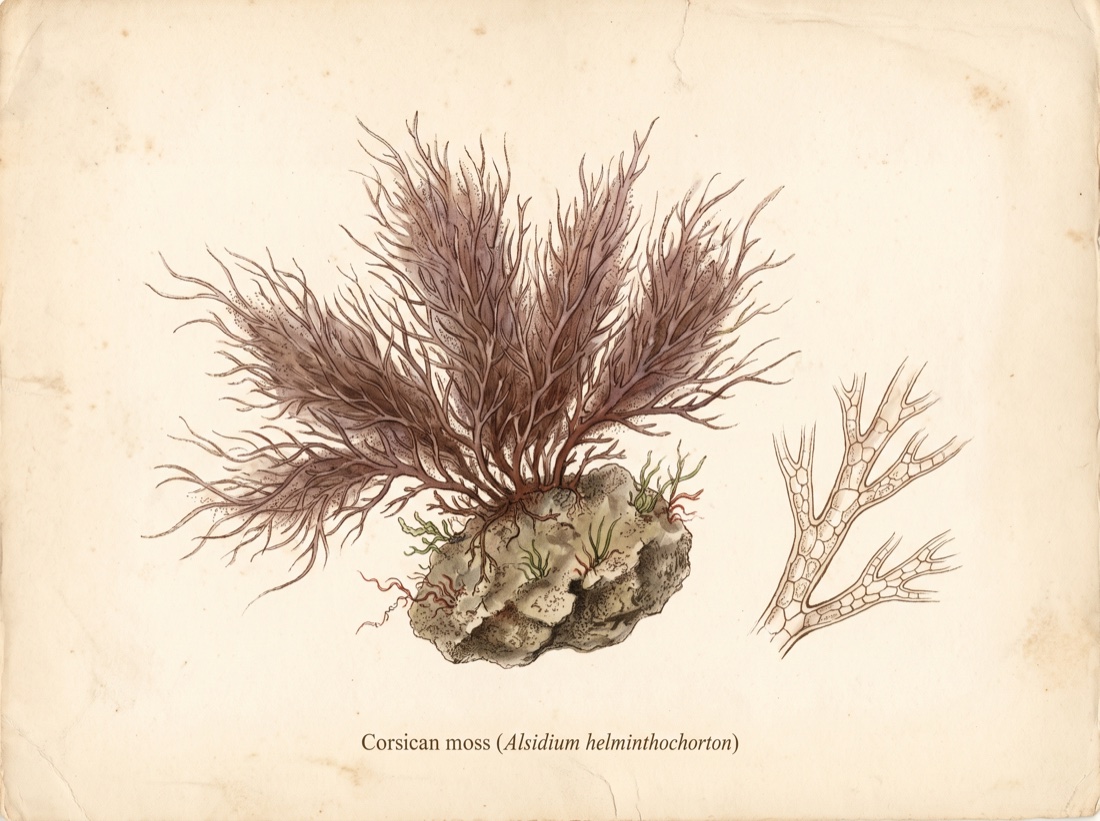
Corsican moss
Fucus Helminthocorton
Also known as Corsican lichen, Helminthocorton, Vermifuge moss.
Corsican moss is not a single seaweed but a traditional mixture of small red algae, chiefly of the family Rhodomelaceae, gathered from rocks along the Corsican coast and dried into a reddish, mossy mass. It was a mainstay European vermifuge from the eighteenth through nineteenth centuries, given to children as a decoction or syrup, and it also found a place in eclectic practice as a tincture for suspected intestinal worms and glandular disorders. Its old Latin trade name, Fucus Helminthocorton, reflects both its supposed anthelmintic property and its confused early classification among the fucoid seaweeds, though it is properly a red alga rather than a brown one.

Ask Herbert about Corsican moss. Herbert is the master herbalist inside Bountiful Herbs: he answers from this plate and eleven hundred others, with dosing, pairing and cautions. Your first ten questions are free.
Ask HerbertActions
Indications what the tradition reached for it in
- Ascariasis (roundworm infestation)
- Pinworm infestation
- Tapeworm infestation
- Intestinal parasitism in children
- Goiter associated with iodine deficiency
- Scrofula and chronic glandular swelling
- Chronic skin eruptions attributed to parasitism or poor nutrition
- Dyspepsia with suspected intestinal worms
Specific indications
A pale, listless child with a poor appetite, itching anus and teeth grinding at night, suggestive of pinworm infestation
Longstanding glandular swelling or goiter in a person from an iodine-poor inland region
Safety
Low dose botanical. Used in drop doses in the classical practice; not a plant to dose freely.
Pregnancy: Avoid in pregnancy: safety has never been formally assessed and the alga's variable iodine and amino acid content make it unsuitable for use without supervision.
Breastfeeding: Avoid during lactation for the same reason: no safety data exist and the remedy has been superseded by better characterized options.
The record lists 5 contraindications; open the plate in the library to read them in full.
In practice
In nineteenth century practice this remedy was reached for chiefly in children with signs of intestinal worm infestation, alongside more mechanically reliable vermifuges such as wormseed or male fern, and it was valued partly because it was thought gentler and safer for pediatric use than harsher purgative anthelmintics of the day.
Dosing as the sources wrote it
| Preparation | As written | Metric |
|---|---|---|
| Traditional decoction | 2-4 g dried thallus simmered in water, taken once or twice daily, historically for children with suspected worms | 2000-4000 mg |
| Tincture (1:5, dilute alcohol), eclectic dosing | 0.3-2 mL (5-30 drops) three times daily | 0.3-2 mL |
| Scudder (specific medication ... low-dose theory) | Dose from gtts ij | 0.04-0.04 mL |
Doses are reproduced from the sources for practitioners and are not a recommendation for any person.
From the sources
Overview. Corsican moss is not a single seaweed but a traditional mixture of small red algae, chiefly of the family Rhodomelaceae, gathered from rocks along the Corsican coast and dried into a reddish, mossy mass. It was a mainstay European vermifuge from the eighteenth through nineteenth centuries, given to children as a decoction or syrup, and it also found a place in eclectic practice as a tincture for suspected intestinal worms and glandular disorders. Its old Latin trade name, Fucus Helminthocorton, reflects both its supposed anthelmintic property and its confused early classification among the fucoid seaweeds, though it is properly a red alga rather than a brown one.
Clinical Notes. In nineteenth century practice this remedy was reached for chiefly in children with signs of intestinal worm infestation, alongside more mechanically reliable vermifuges such as wormseed or male fern, and it was valued partly because it was thought gentler and safer for pediatric use than harsher purgative anthelmintics of the day.
Specific indications and reasoning. (CORSICAN Moss.) Prepare a Tincture in the usual manner, using dilute Alcohol. Dose from gtts. v. to 38s. We wish to determine its influence upon the functions of waste and nutrition, and especially in cases of degenerations and growths.
Drawn from Scudder's Specific Medication and Specific Medicines, and the Bountiful Herbs editorial.
Nearby on the shelf
 CorianderCoriandrum sativum
 CornZea mays
 Corn PoppyPapaver rhoeas
 CornflowerCentaurea cyanus
 CorydalisCorydalis spp.
 CorydalisDicentra canadensis
 CostusSaussurea costus
 Coto barkCoto Bark
The whole plate is in the library. The compass, Compare, the Sky of eleven hundred plants and the formulary open with an email address and a password, free, with the formula builder and its safety engine. Herbert without limit, his formulating, clients, the handouts and the labels are the paid room.
Open the library, free