Western Herbalism
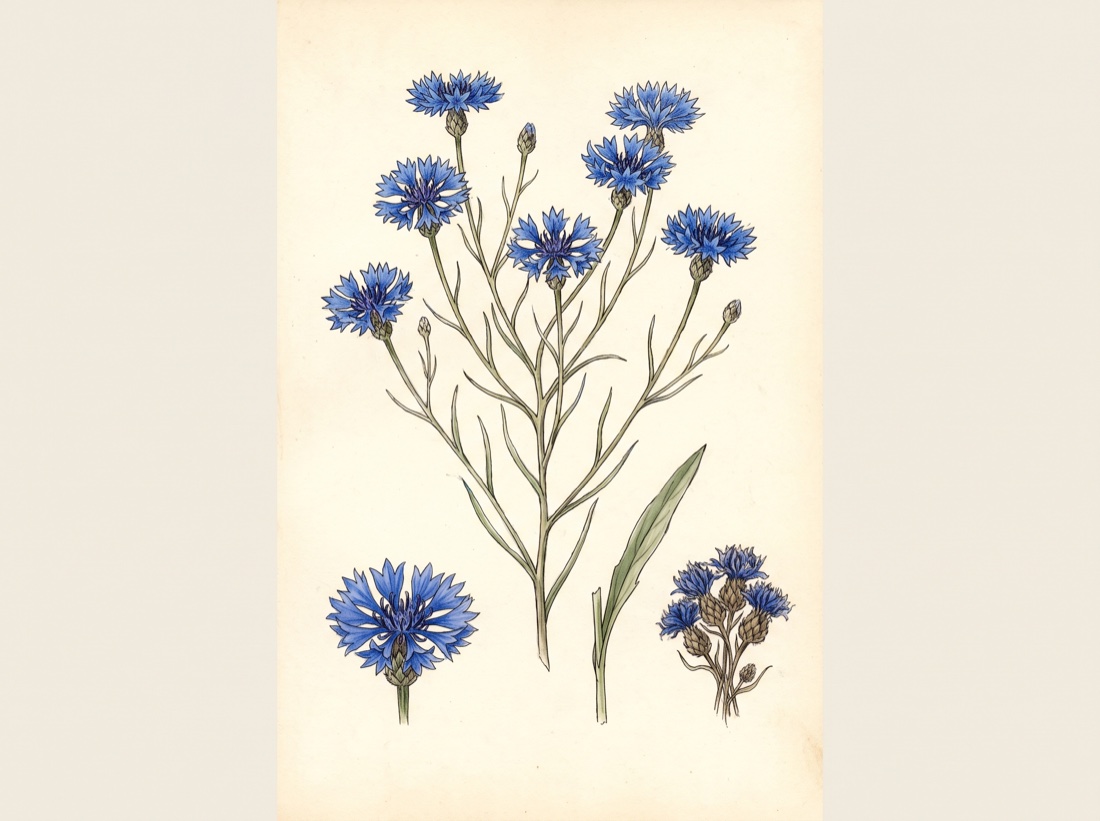
Cornflower
Centaurea cyanus
Also known as bachelor's button, bluebottle, bluet, hurtsickle, blue cap.
Centaurea cyanus is a slender annual of the daisy family with vivid blue flower heads, once a common weed of European grain fields and now grown mostly in gardens and for herbal and culinary use. The dried ray florets are the medicine, prized as much for their color as their gentle action. In European folk and phytotherapy tradition cornflower is a mild, cooling anti-inflammatory used above all for the eyes, and secondarily as a light bitter, a mouthwash, and a skin wash. It is a minor but pleasant remedy, a gentler cousin of eyebright.

Ask Herbert about Cornflower. Herbert is the master herbalist inside Bountiful Herbs: he answers from this plate and eleven hundred others, with dosing, pairing and cautions. Your first ten questions are free.
Ask HerbertActions
Indications what the tradition reached for it in
- Mild conjunctivitis and irritated, red eyes (compress or eyewash)
- Tired, strained eyes from screen work
- Blepharitis and puffy eyelids (compress)
- Mouth ulcers and inflamed gums (mouthwash)
- Mild sore throat (gargle)
- Minor skin irritation, rashes, and slow-healing scrapes (wash)
- Poor appetite and mild dyspepsia (bitter tea)
- Mild urinary irritation (traditional)
- Occasional constipation (traditional, weak)
- Fever and catarrh (historical use)
Specific indications
Red, gritty, watery eyes at the end of a long day of screen work or exposure to wind and dust, without discharge or pain
Puffy irritated eyelids in a patient with hay fever who wants a cooling compress alongside their other treatment
Delicate patient who wants a gentle, pleasant-tasting bitter before meals rather than a strong one
Safety
The record lists 4 contraindications; open the plate in the library to read them in full.
In practice
Cornflower earns its place as the eye herb for people who find eyebright too drying or whose eyes are simply tired and irritated rather than infected. Make a fresh infusion, 1 to 2 g of florets in 150 mL freshly boiled water, steep covered for ten minutes, strain through a sterile filter or unbleached paper, cool, and apply as a compress on closed lids for ten minutes, or as an eyewash in a clean eyecup, once or twice daily.
Dosing as the sources wrote it
| Preparation | As written | Metric |
|---|---|---|
| Infusion (internal) | 1-2 g dried florets per cup, up to three times daily | 1000-2000 mg |
| Eye compress or eyewash | 1-2 g dried florets in 150 mL freshly boiled water, steeped 10 minutes, filtered and cooled, applied once or twice daily, made fresh each time | 1000-2000 mg |
| Tincture (1:5, 25%) | 1-3 mL three times daily | 1-3 mL |
| Mouthwash or gargle | strong infusion of 3-4 g per cup, used two to three times daily | 3000-4000 mg |
Doses are reproduced from the sources for practitioners and are not a recommendation for any person.
From the sources
Overview. Centaurea cyanus is a slender annual of the daisy family with vivid blue flower heads, once a common weed of European grain fields and now grown mostly in gardens and for herbal and culinary use. The dried ray florets are the medicine, prized as much for their color as their gentle action. In European folk and phytotherapy tradition cornflower is a mild, cooling anti-inflammatory used above all for the eyes, and secondarily as a light bitter, a mouthwash, and a skin wash. It is a minor but pleasant remedy, a gentler cousin of eyebright.
Clinical Notes. Cornflower earns its place as the eye herb for people who find eyebright too drying or whose eyes are simply tired and irritated rather than infected. Make a fresh infusion, 1 to 2 g of florets in 150 mL freshly boiled water, steep covered for ten minutes, strain through a sterile filter or unbleached paper, cool, and apply as a compress on closed lids for ten minutes, or as an eyewash in a clean eyecup, once or twice daily.
Conservation. Once abundant as a cornfield weed, the wild plant has declined sharply in Western Europe with modern herbicide use; commercial supply is cultivated, so no wild-harvest concern applies.
Nearby on the shelf
 CordycepsCordyceps militaris
 CorianderCoriandrum sativum
 CornZea mays
 Corn PoppyPapaver rhoeas
 Corsican mossFucus Helminthocorton
 CorydalisCorydalis spp.
 CorydalisDicentra canadensis
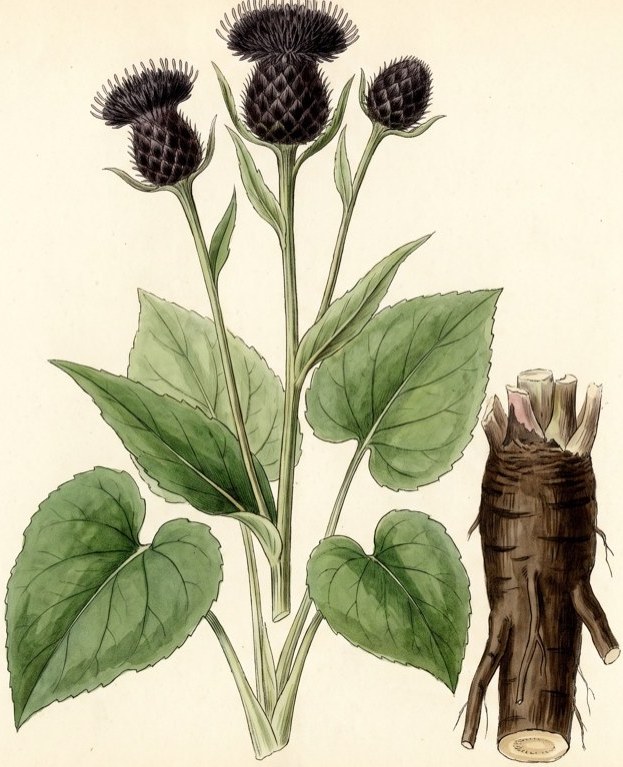 CostusSaussurea costus
The whole plate is in the library. The compass, Compare, the Sky of eleven hundred plants and the formulary open with an email address and a password, free, with the formula builder and its safety engine. Herbert without limit, his formulating, clients, the handouts and the labels are the paid room.
Open the library, free