Western Herbalism
Ambrette seed
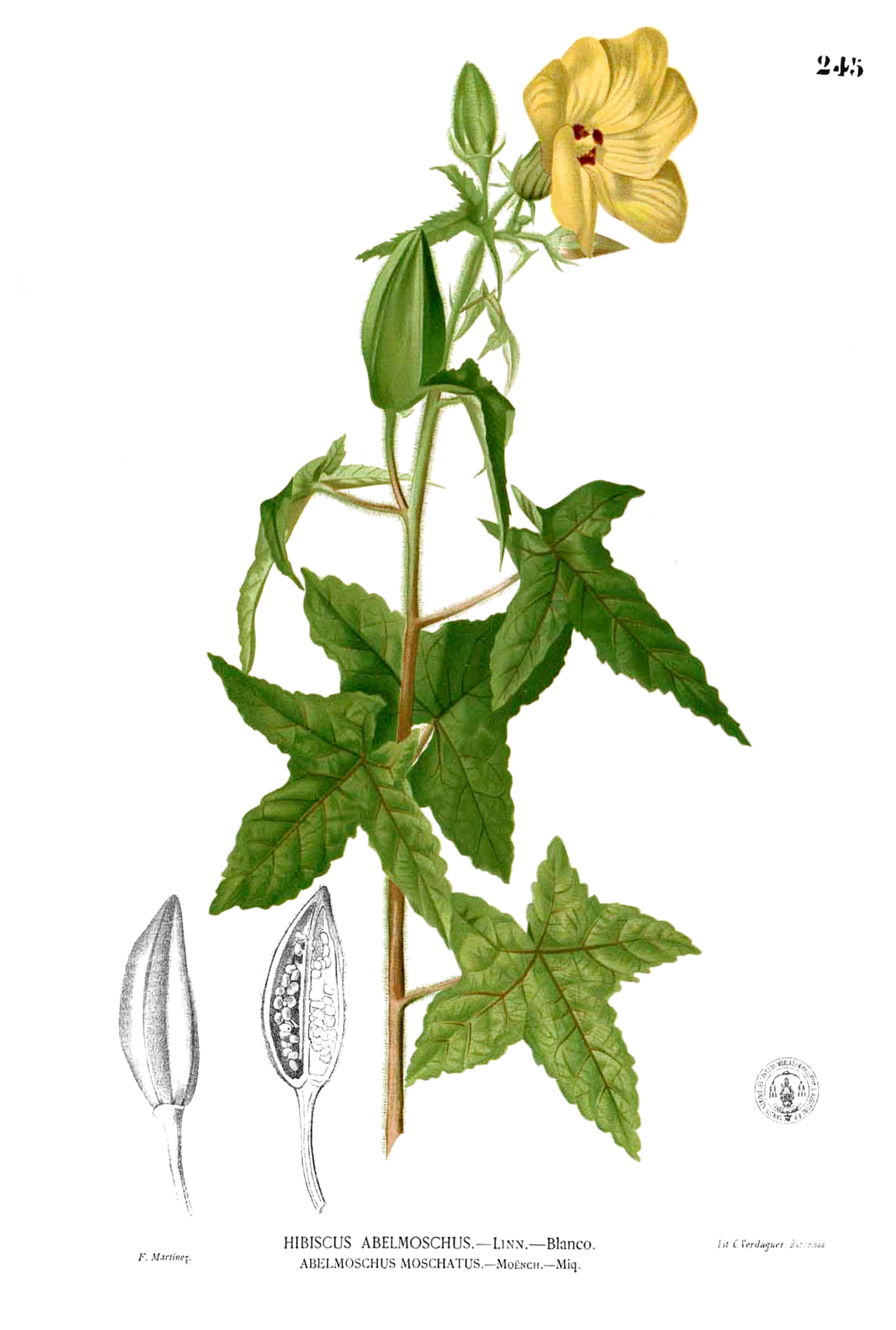
Abelmoschus moschatus
Also known as Musk mallow, Muskmallow, Abelmosk, Musk okra, Grani moschi.
Abelmoschus moschatus, known as ambrette or musk mallow, is a coarse hairy annual or short-lived perennial of the mallow family native to South Asia and now cultivated through the tropics for its musk-scented seeds. The seeds, once traded as grani moschi, have long been used in perfumery, as a coffee and tobacco flavoring among Arab traders, and in South Asian and Unani medicine as an aromatic nervine and digestive. Physiomedicalist writers classed the seed as a mild diffusible stimulant with relaxing properties, distinct from the harsher stimulants of their materia medica.

Ask Herbert about Ambrette seed. Herbert is the master herbalist inside Bountiful Herbs: he answers from this plate and eleven hundred others, with dosing, pairing and cautions. Your first ten questions are free.
Ask HerbertActions
Indications what the tradition reached for it in
- Flatulent dyspepsia
- Mild nervous exhaustion
- Colicky abdominal pain
- Poor appetite
- Halitosis
- Nervous fatigue with low mood
- Muscle spasm of digestive origin
- Traditional adjunct for insect or snake bite
Specific indications
Mild nervous prostration where a gentle diffusible stimulant and relaxant is wanted rather than a harsh one
Cold, sluggish, flatulent digestion with cramping that responds to warm aromatic carminatives
Safety
Pregnancy: Avoid therapeutic doses in pregnancy given its traditional use as an emmenagogue and uterine stimulant, though modern safety data are lacking.
Breastfeeding: No specific safety data exist; use only as a food-level flavoring during lactation and avoid therapeutic dosing.
The record lists 2 contraindications; open the plate in the library to read them in full.
In practice
Ambrette seed sits in the same functional niche as other aromatic carminative seeds such as fennel or nutmeg, but with a softer, muskier profile and a reputation, going back to older physiomedicalist and Eclectic writers, for calming nervous agitation while also lifting a flagging, exhausted patient.
Dosing as the sources wrote it
| Preparation | As written | Metric |
|---|---|---|
| Seed infusion | 1-3 g crushed seed as an infusion, once or twice daily after meals | 1000-3000 mg |
| Tincture (1:5, 45%) | 1-2 mL up to three times daily | 1-2 mL |
Doses are reproduced from the sources for practitioners and are not a recommendation for any person.
From the sources
Overview. Abelmoschus moschatus, known as ambrette or musk mallow, is a coarse hairy annual or short-lived perennial of the mallow family native to South Asia and now cultivated through the tropics for its musk-scented seeds. The seeds, once traded as grani moschi, have long been used in perfumery, as a coffee and tobacco flavoring among Arab traders, and in South Asian and Unani medicine as an aromatic nervine and digestive. Physiomedicalist writers classed the seed as a mild diffusible stimulant with relaxing properties, distinct from the harsher stimulants of their materia medica.
Clinical Notes. Ambrette seed sits in the same functional niche as other aromatic carminative seeds such as fennel or nutmeg, but with a softer, muskier profile and a reputation, going back to older physiomedicalist and Eclectic writers, for calming nervous agitation while also lifting a flagging, exhausted patient.
Properties and Uses. The seeds have a strong aroma of musk, and have been known as grani moschi. Relaxing and stimulating powers are attributed to them; and some cases, apparently authentic, have been recorded, in which they seemed to have a decided influence in casting out the poison of snakes. Possibly a further and more careful investigation of their properties, would show them to be an agreeable and useful article in cases where mild nervous prostration required a diffusible stimulant and relaxant. At present, they seem to be used for nothing beyond giving flavor to the coffee of the Arabs. Medical Herbalism journal and medherb.com The Physiomedical Dispensatory by William Cook, M.D., 1869
Description. The natural order and generic characters the same as those in the preceding species. Mr. Lindley says: “Stem herbaceous, hispid with spreading hairs, not prickly. Leaves (and long petioles) hispid with rigid hairs, unequally and coarsely toothed, deeply five to seven-lobed; lobes all spreading, oblong lanceolate, acuminate. Pedicels harshly pubescent, axillary. Involucral leaves six to ten, linear, hairy. Capsules oblong, acuminate, hairy .” A native of Egypt and the East Indies.
Drawn from Cook's Physio-Medical Dispensatory, and the Bountiful Herbs editorial.
Nearby on the shelf
 Aloe veraAloe vera
 Alstonia barkAlstonia Constricta
 Alum rootHeuchera americana
 AmaranthAmaranthus
 American AconiteAconitum Fischeri
 American beautyberryCallicarpa americana
 American beechFagus ferruginea
 American bittersweetCelastrus scandens
The whole plate is in the library. The compass, Compare, the Sky of eleven hundred plants and the formulary open with an email address and a password, free, with the formula builder and its safety engine. Herbert without limit, his formulating, clients, the handouts and the labels are the paid room.
Open the library, free