Western Herbalism
Alum root
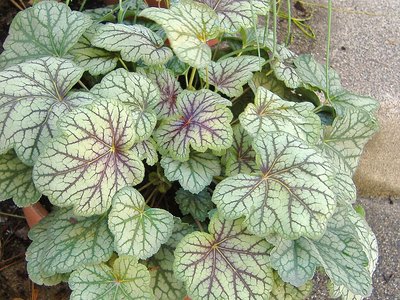
Heuchera americana
Also known as American sanicle, Rock geranium, Coral bells.
Heuchera americana is a native North American perennial of the saxifrage family, growing wild in rocky woodlands across much of the eastern and central United States. Its thick, knotty rootstock is the part used medicinally, valued since indigenous and early American folk use, and later adopted by physiomedicalist and eclectic practitioners, chiefly for its pronounced astringency. It has a modest place in older American herbal practice as a local styptic and bowel astringent, largely displaced today by other tannin-rich botanicals but still occasionally used by practitioners drawing on the older physiomedical materia medica.

Ask Herbert about Alum root. Herbert is the master herbalist inside Bountiful Herbs: he answers from this plate and eleven hundred others, with dosing, pairing and cautions. Your first ten questions are free.
Ask HerbertActions
Indications what the tradition reached for it in
- Diarrhea with mucus or blood
- Chronic passive hemorrhage of the bowel
- Uterine hemorrhage
- Excessive menstrual bleeding
- Leucorrhea
- Mouth ulcers and sore gums
- Sore throat
- Minor wounds and skin ulcers
- Hemorrhoids
- Diarrhea following debilitating fever
Specific indications
Passive, watery or bloody diarrhea occurring in a weakened, low-toned patient after a prolonged febrile illness
Boggy, oozing mucous membranes or tissue that needs firming and drying rather than stimulating
Safety
Pregnancy: Limited safety data in pregnancy
The record lists 4 contraindications; open the plate in the library to read them in full.
In practice
Alum root is one of the most strongly astringent native American roots, rich in tannins, and older writers were careful to note that this astringency is powerful enough to be constipating and drying if used carelessly.
Dosing as the sources wrote it
| Preparation | As written | Metric |
|---|---|---|
| Decoction (dried root) | 2-4 g dried root simmered in 250 mL water, taken three times daily | 2000-4000 mg |
| Tincture (1:5, 40%) | 1-2 mL three times daily | 1-2 mL |
| Topical decoction or powder | Applied as a gargle, wash, or direct application to wounds as needed | |
| The dose of this article is from three to five grains, every second hour | 194-324 mg | |
| Taken internally, in doses of a wineglass half full 3 or 4 times a day, it has been efficient in diabetes, and in bleeding piles, employing it, in this last complaint, by injection also. |
Doses are reproduced from the sources for practitioners and are not a recommendation for any person.
From the sources
Overview. Heuchera americana is a native North American perennial of the saxifrage family, growing wild in rocky woodlands across much of the eastern and central United States. Its thick, knotty rootstock is the part used medicinally, valued since indigenous and early American folk use, and later adopted by physiomedicalist and eclectic practitioners, chiefly for its pronounced astringency. It has a modest place in older American herbal practice as a local styptic and bowel astringent, largely displaced today by other tannin-rich botanicals but still occasionally used by practitioners drawing on the older physiomedical materia medica.
Clinical Notes. Alum root is one of the most strongly astringent native American roots, rich in tannins, and older writers were careful to note that this astringency is powerful enough to be constipating and drying if used carelessly.
Properties and Uses. This root is intensely astringent, with a modicum of stimulating properties. It is too powerfully drying to be suitable for internal use, except in such passive conditions of the bowels as are connected with hemorrhage and coliquative diarrhea suddenly following typhus; when it may be combined with a stimulant and used by injection.
Description. Natural Order, Saxifragaceae. A genus of plants with perennial roots, and herbaceous annual stems. The leaves spring directly from the root, on very long and downy petioles with dilated margins; roundish, five inches by three, usually margined into seven short lobes with short teeth.
Drawn from Cook's Physio-Medical Dispensatory; King's American Dispensatory, 18th edition (Felter and Lloyd), and the Bountiful Herbs editorial.
Nearby on the shelf
 AllspicePimenta dioica
 AlmondAmygdala
 Aloe veraAloe vera
 Alstonia barkAlstonia Constricta
 AmaranthAmaranthus
 Ambrette seedAbelmoschus moschatus
 American AconiteAconitum Fischeri
 American beautyberryCallicarpa americana
The whole plate is in the library. The compass, Compare, the Sky of eleven hundred plants and the formulary open with an email address and a password, free, with the formula builder and its safety engine. Herbert without limit, his formulating, clients, the handouts and the labels are the paid room.
Open the library, free