Western Herbalism
Sanicle
Sanicula europaea
Also known as Wood Sanicle, Blacksnake root, Pool-root.
Sanicle very much resembles valerian in its action on the system, possessing nervine and feebly anodyne properties, together with some astringency. It has been used with advantage as a domestic remedy in intermittent fevers, sore throat, cynanche trachealis, erysipelas, and some cutaneous diseases.

Ask Herbert about Sanicle. Herbert is the master herbalist inside Bountiful Herbs: he answers from this plate and eleven hundred others, with dosing, pairing and cautions. Your first ten questions are free.
Ask HerbertActions
Indications what the tradition reached for it in
- Quinsy
- Bronchial inflammation
- Blood disorders
- Pulmonary affections
- Chest and lung complaints
- Bleeding
- Bronchitis
- Chronic coughs
- Leukorrhea
- Scald-head
- Mild catarrhs of respiratory tract
- Catarrhal affections
- Cough
- Rashes
- Spitting of blood
- Wounds
- Bleeding piles
- Diarrhea
- Dysentery
- Sore throat
- Respiratory congestion
- Inflammation
- Respiratory complaints
- Skin conditions
- Excessive discharge
- Metabolic waste accumulation
Safety
Pregnancy: Not safe. Not for use in pregnancy (our record's flag)
Pregnancy, our record's flag: Caution. Use with care in pregnancy (our record's flag)
Breastfeeding: Not safe. Not for use while breastfeeding (our record's flag)
The record lists 2 contraindications; open the plate in the library to read them in full.
Dosing as the sources wrote it
| Preparation | As written |
|---|---|
| Decoction or infusion of dried herb | Decoction or infusion of dried herb 4-6 g daily |
| Infusion | Infusion 1 oz to 1 pint boiling water, wineglassful doses |
| Fluid extract | Fluid extract 0.5-1 drachm |
| It is very efficient in chorea, in doses of ½ drachm of the powdered root, 3 times a day, to children 8 or 10 years of age. | |
| The decoction of it, administered in doses of from 2 to 4 fluid ounces, and repeated 3 or 4 times a day, is said to be valuable in gonorrhoea, dysentery, passive hemorrhages, and leucorrhoea. | |
| An infusion in wine, or the fresh juice, is generally administered in ½- ounce doses. |
Doses are reproduced from the sources for practitioners and are not a recommendation for any person.
From the sources
Action, Medical Uses, and Dosage. Sanicle very much resembles valerian in its action on the system, possessing nervine and feebly anodyne properties, together with some astringency. It has been used with advantage as a domestic remedy in intermittent fevers, sore throat, cynanche trachealis, erysipelas, and some cutaneous diseases.
History and Chemical Composition. Sanicle is common to the United States and Canada, and is found in low woods and thickets, flowering in June. The fibrous root is the medicinal part. Its taste and odor are somewhat aromatic. An alcoholic tincture contains its medicinal properties. Resin, essential oil, tannin, coloring matters, and ash (9 per cent) were obtained from the root by C. J. Houck (Amer. Jour. Pharm., 1884, p. 463).
indications. Sanicle is traditionally indicated for: Quinsy, Bronchial inflammation, Blood disorders, Pulmonary affections, Chest and lung complaints, Bleeding, Bronchitis, Chronic coughs, Leukorrhea, Scald-head, Mild catarrhs of respiratory tract, Catarrhal affections, Cough, Rashes, Spitting of blood, and 11 further conditions.
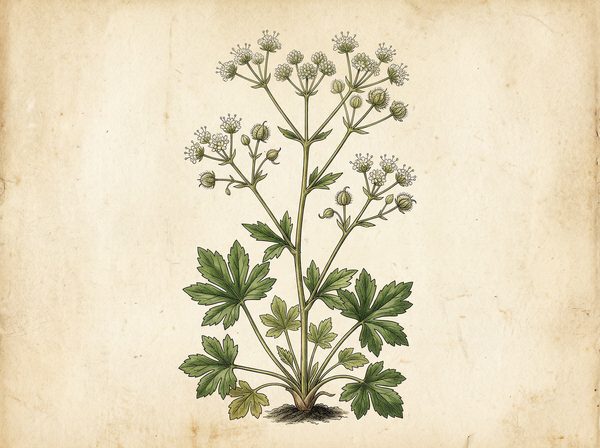
Botanical Source. Sanicle is an indigenous, perennial herb, sometimes known by the name of Blacksnake root, with a stem from 1 to 3 feet high, smooth, furrowed, and dichotomously branched. The leaves are 3 to 5-parted, digitate, mostly radical, on petioles 6 to 12 inches long; the segments 2 to 4 inches long, half as wide, oblong, and irregularly and mucronately toothed.
Drawn from King's American Dispensatory, 18th edition (Felter and Lloyd), and the Bountiful Herbs editorial.
Nearby on the shelf
 SalepOrchis mascula
 Sand-spurreySpergularia rubra
 SandalwoodSantalum album
 Sangre de DragoCroton lechleri
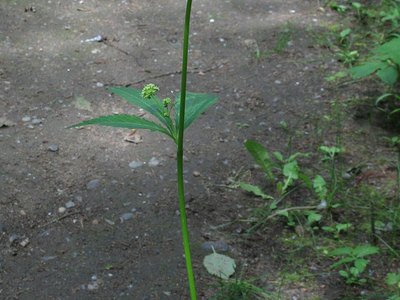 SanicleSanicula marilandica
 SantonicaArtemisia pauciflora
 SapiumSapium salicifolium
 SarsaparillaSmilax spp.
The whole plate is in the library. The compass, Compare, the Sky of eleven hundred plants and the formulary open with an email address and a password, free, with the formula builder and its safety engine. Herbert in full, his formulating, clients, the handouts and the labels are the paid room.
Open the library, free