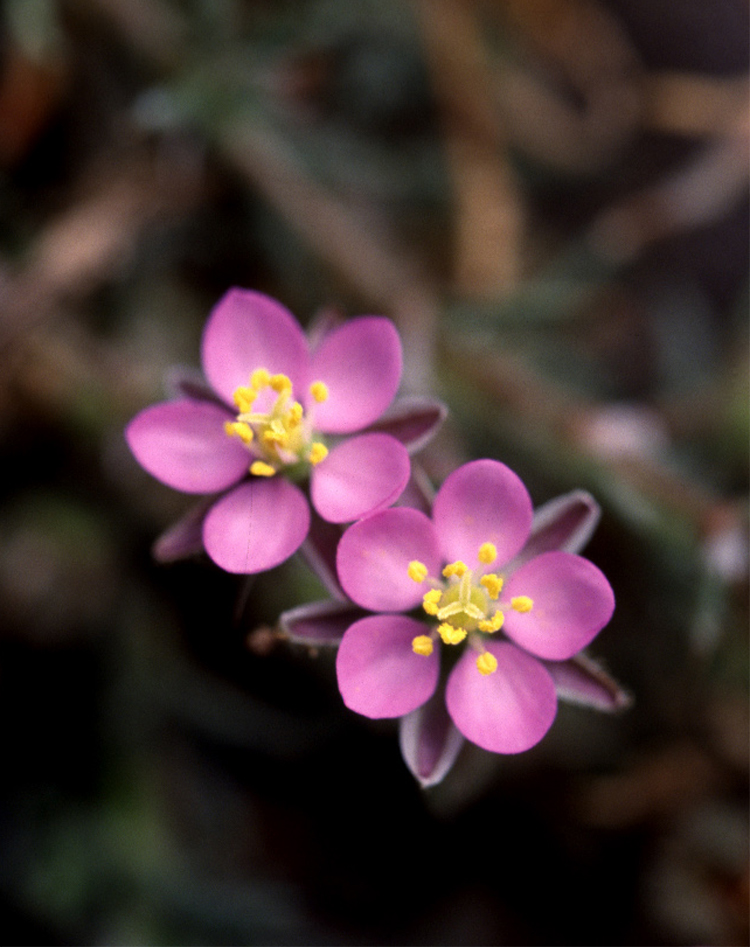
Western Herbalism
Sand-spurrey
Spergularia
Also known as Red sandwort, Red sand-spurry, Spurrey-sandwort.
Sand-spurrey is a small, low-growing annual or short-lived perennial of the pink family, found in sandy, saline, and disturbed soils along coasts and inland waste ground across Europe and now naturalized widely. The flowering aerial herb is the part used. It has a long-standing place in Eclectic and Latin American folk practice as a remedy for gravel and stones of the urinary tract, and was carried into European and Caribbean herbal traditions as a gentle diuretic and depurative for the kidneys and bladder.

Ask Herbert about Sand-spurrey. Herbert is the master herbalist inside Bountiful Herbs: he answers from this plate and eleven hundred others, with dosing, pairing and cautions. Your first ten questions are free.
Ask HerbertActions
Indications what the tradition reached for it in
- Renal calculi
- Gravel and sediment in the urine
- Cystitis
- Urinary tract infection
- Dysuria
- Edema
- Chronic low-grade nephritis (historical use)
- Gouty and rheumatic complaints (historical use)
Specific indications
Gritty urinary sediment or small stones with burning or dragging pain on urination, particularly where uric acid or oxalate gravel is suspected
Scanty, cloudy urine with a dull ache in the low back suggesting early stone or gravel formation
Safety
Pregnancy: Avoid in pregnancy due to lack of safety data.
Breastfeeding: Avoid during lactation due to lack of safety data.
The record lists 3 contraindications; open the plate in the library to read them in full.
In practice
Sand-spurrey is reached for when a patient reports gritty or sandy urinary sediment, recurrent small stones, or a nagging low back ache that suggests gravel is forming rather than an acute obstructing stone. It is used as a simple infusion or tincture, usually as part of a formula rather than alone, paired well with other traditional urinary antilithics such as gravel root, hydrangea root, or parsley piert, and with a demulcent such as marshmallow if there is irritation or burning. Because its main traditional role is preventive and supportive rather than acutely dissolving established stones, it is best used over weeks to months alongside increased fluid intake and dietary attention to oxalate or urate load depending on stone type. Practitioners should rule out an obstructing or infected stone requiring urgent care before relying on herbal management alone.
Dosing as the sources wrote it
| Preparation | As written | Metric |
|---|---|---|
| Infusion | 2-4 g dried herb as infusion, three times daily | 2000-4000 mg |
| Tincture (1:5, 40%) | 2-4 mL three times daily | 2-4 mL |
| Five drachms of the plant to a pint of water is the medium dose, to be taken daily; it may be sweetened, if desired. | ||
| Pills or syrup may be substituted for the decoction, in doses of 15 grains, every 1, 2, or 3 hours. | 972-972 mg | |
| A similar quantity of extract in | A similar quantity of extract in 1 ½ fluid drachms of pure glycerin and 3 fluid ounces of distilled water, gives a solution that keeps well, and of which the dose is a teaspoonful, to be repeated 6 times a day ... equivalent to a quart of the decoction. | 88.72 mL |
Doses are reproduced from the sources for practitioners and are not a recommendation for any person.
From the sources
Overview. Sand-spurrey is a small, low-growing annual or short-lived perennial of the pink family, found in sandy, saline, and disturbed soils along coasts and inland waste ground across Europe and now naturalized widely. The flowering aerial herb is the part used. It has a long-standing place in Eclectic and Latin American folk practice as a remedy for gravel and stones of the urinary tract, and was carried into European and Caribbean herbal traditions as a gentle diuretic and depurative for the kidneys and bladder.
Clinical Notes. Sand-spurrey is reached for when a patient reports gritty or sandy urinary sediment, recurrent small stones, or a nagging low back ache that suggests gravel is forming rather than an acute obstructing stone.
Drawn from King's American Dispensatory, 18th edition (Felter and Lloyd), and the Bountiful Herbs editorial.
Nearby on the shelf
 SageSalvia officinalis
 SagoSago
 Sal treeShorea robusta
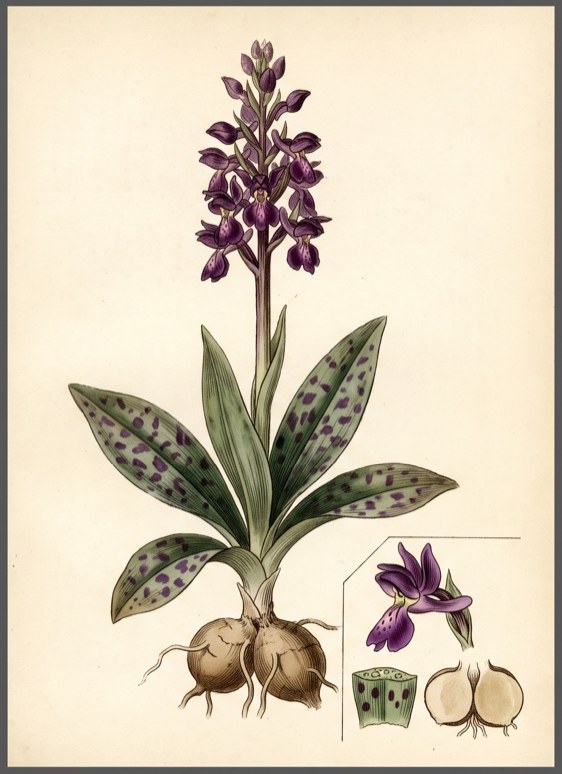 SalepOrchis mascula
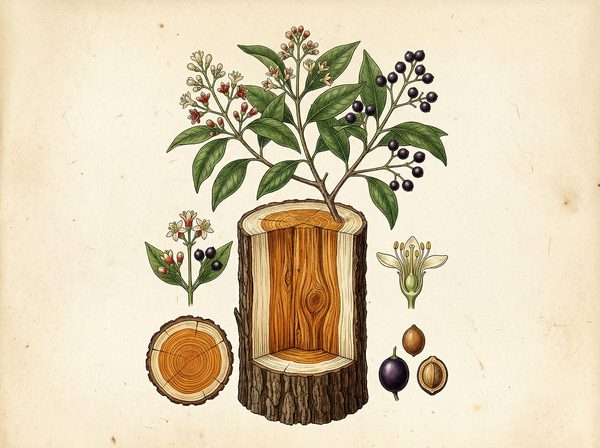 SandalwoodSantalum album
 Sangre de DragoCroton lechleri
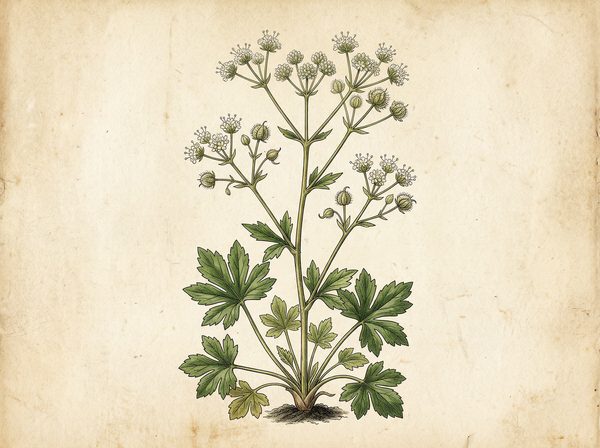 SanicleSanicula europaea
 SanicleSanicula marilandica
The whole plate is in the library. The compass, Compare, the Sky of eleven hundred plants and the formulary open with an email address and a password, free, with the formula builder and its safety engine. Herbert without limit, his formulating, clients, the handouts and the labels are the paid room.
Open the library, free