Western and Ayurvedic herbalism
Salep
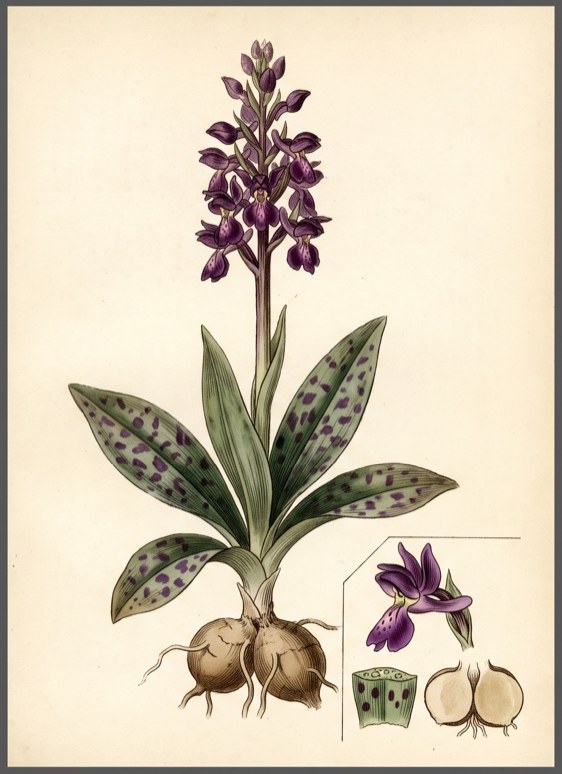
Orchis mascula
Also known as salep orchid, early purple orchid, male orchis, Salop, Sahlep, Munjataka, Salabmisri, Suvarnakanda.
Orchis mascula is the early purple orchid, a terrestrial orchid of European and West Asian meadows and open woods that reaches the western Himalayan ranges, where its paired egg-shaped tubers are dug for salep. In the Indian trade the name Salab misri covers this species together with the palmate-tubered Dactylorhiza hatagirea of Nepal, Kashmir and Himachal, which is the usual Himalayan source. Ayurveda calls the drug Munjataka and classes it among the sweet, heavy, unctuous vajikarana tonics; Unani medicine, which shaped most of its Indian use, treats it as a premier restorative for sexual and nervous debility. The dried tuber powder is the only part used.

Ask Herbert about Salep. Herbert is the master herbalist inside Bountiful Herbs: he answers from this plate and eleven hundred others, with dosing, pairing and cautions. Your first ten questions are free.
Ask HerbertActions
Indications what the tradition reached for it in
- Sexual debility and premature ejaculation
- Low sperm count and thin semen
- Convalescence after wasting illness
- Chronic diarrhea and dysentery, especially in children
- Irritable bowel with loose stool and weight loss
- Nervous exhaustion with weakness of the limbs
- Underweight, dry, elderly patients who need building
- Dry cough and hoarseness (demulcent, traditional)
- Poor appetite and weakness after fever
- Postpartum weakness (traditional)
- Irritated sore throat
- Dry cough
- Gastritis with irritation
- Diarrhea in convalescents
- Debility during recovery from illness
- Infant feeding when milk is not tolerated
- Mild dyspepsia with mucosal irritation
- Dehydration and fluid loss in weak patients
Specific indications
A thin, dry, anxious man with weak erections, early ejaculation and thin semen who is depleted rather than congested
A child with lingering watery diarrhea after an infection who is losing weight and needs a soothing, binding food rather than a bitter astringent
An elderly patient wasting after illness, with dry mouth, trembling and poor sleep, who tolerates a warm salep milk at bedtime when heavier tonics upset digestion
A vata patient with nervous weakness of the legs and low libido who does not have the heat that would call for a cooling herb like Shatavari alone
Safety
The record lists 6 contraindications; open the plate in the library to read them in full.
In practice
Salab misri is the Ayurvedic and Unani answer to depletion: a sweet, heavy, slimy tonic for the dry vata patient whose tissues, especially shukra dhatu, have run down. The classical way to give it is as a gruel or thick drink, the tuber powder stirred into boiling milk with sugar or honey and a pinch of cardamom, taken at bedtime; the mucilage thickens the milk and carries the nourishing quality into the tissues.
In Ayurveda
Rasa: madhura (sweet). Virya: sheeta (cooling) in most nighantu descriptions; some Unani-influenced sources call it mildly heating. Vipaka: madhura (sweet). Guna: guru (heavy), snigdha (unctuous), pichchhila (slimy). Dosha: pacifies vata and pitta; increases kapha in excess. Karma: vajikarana (aphrodisiac); balya (strengthening); brimhana (nourishing, builds tissue); shukrala (increases semen); jivaniya (promotes vitality); rasayana (rejuvenative); grahi (binds loose stool); dhatuvardhana (builds the tissues); vatapittahara (reduces vata and pitta). Classical indications: klaibya (impotence); shukrakshaya (low semen); daurbalya (weakness); kshaya (wasting); atisara (diarrhea, especially in children); pravahika (dysentery); grahani (chronic malabsorption); vatavyadhi (nervous debility); shukrameha (spermatorrhea). The dried, boiled and hardened tubers are ground to a fine powder and cooked into milk as a thick sweet drink or gruel, or taken as churna with milk and sugar; the powder also enters vajikarana avalehas and confections. It is not a decoction herb because the mucilage sets into a jelly. Classical formulations: Salab misri churna, Musli pak (some recipes), Vajikarana avalehas containing Salab misri, Salep milk (sahlab). Described in: Bhavaprakasha Nighantu, Raja Nighantu.
Dosing as the sources wrote it
| Preparation | As written | Metric |
|---|---|---|
| Churna | 3-6 g powdered tuber once or twice daily in warm milk with sugar | 3000-6000 mg |
| Salep milk (gruel) | 5-10 g powdered tuber cooked in 200 mL milk at bedtime | 5000-10000 mg |
| Avaleha (vajikarana confection) | 10-20 g daily with milk | 10000-20000 mg |
| Action, Medical Uses, and Dosage: Salep is nutrient and demulcent. Administered in milk, water, broth, or jelly, it is useful in the summer diarrhoeas of infants and children, and in the chronic diarrhoea of adults, particularly that form associated with tuberculosis. A good mucilage may be prepared by macerating 40 grains of salep in some cold water, and subsequently adding boiling water until 8 fluid ounces of water have been used. The jelly may be prepared by rubbing 30 grains of salep with water until the powder has swollen fourfold, and gradually adding, with continual stirring, 8 fluid ounces of boiling water | 2592 mg | |
| boil until but | boil until but 4 ounces remain. Like tapioca and similar products, it may be freely administered. | 124414-124414 mg |
| Mucilage (traditional preparation) | 5-10 g powdered salep made into mucilage with water, taken as needed | 5000-10000 mg |
Doses are reproduced from the sources for practitioners and are not a recommendation for any person.
From the sources
Overview. Orchis mascula is the early purple orchid, a terrestrial orchid of European and West Asian meadows and open woods that reaches the western Himalayan ranges, where its paired egg-shaped tubers are dug for salep. In the Indian trade the name Salab misri covers this species together with the palmate-tubered Dactylorhiza hatagirea of Nepal, Kashmir and Himachal, which is the usual Himalayan source. Ayurveda calls the drug Munjataka and classes it among the sweet, heavy, unctuous vajikarana tonics; Unani medicine, which shaped most of its Indian use, treats it as a premier restorative for sexual and nervous debility. The dried tuber powder is the only part used.
Overview. Salep is the name given to the dried, prepared tubers of several terrestrial orchids of the genus Orchis (and related genera such as Dactylorhiza), native to the Mediterranean region, the Middle East, and parts of Asia.
Clinical Notes. Salab misri is the Ayurvedic and Unani answer to depletion: a sweet, heavy, slimy tonic for the dry vata patient whose tissues, especially shukra dhatu, have run down. The classical way to give it is as a gruel or thick drink, the tuber powder stirred into boiling milk with sugar or honey and a pinch of cardamom, taken at bedtime; the mucilage thickens the milk and carries the nourishing quality into the tissues.
Clinical Notes. Salep mucilage was reached for in nineteenth century eclectic and regular practice chiefly as a bland, soothing food and vehicle rather than a potent remedy in its own right. Its principal virtue is its high mucilage content, which forms a smooth, protective gel when hydrated, making it useful for irritated throats, dry coughs, and inflamed gastrointestinal mucosa, and as a substitute for milk in infants who could not tolerate dairy.
Drawn from King's American Dispensatory, 18th edition (Felter and Lloyd), and the Bountiful Herbs editorial.
Nearby on the shelf
 SaffronCrocus sativus
 SageSalvia officinalis
 SagoSago
 Sal treeShorea robusta
 Sand-spurreySpergularia
 SandalwoodSantalum album
 Sangre de DragoCroton lechleri
 SanicleSanicula europaea
The whole plate is in the library. The compass, Compare, the Sky of eleven hundred plants and the formulary open with an email address and a password, free, with the formula builder and its safety engine. Herbert without limit, his formulating, clients, the handouts and the labels are the paid room.
Open the library, free