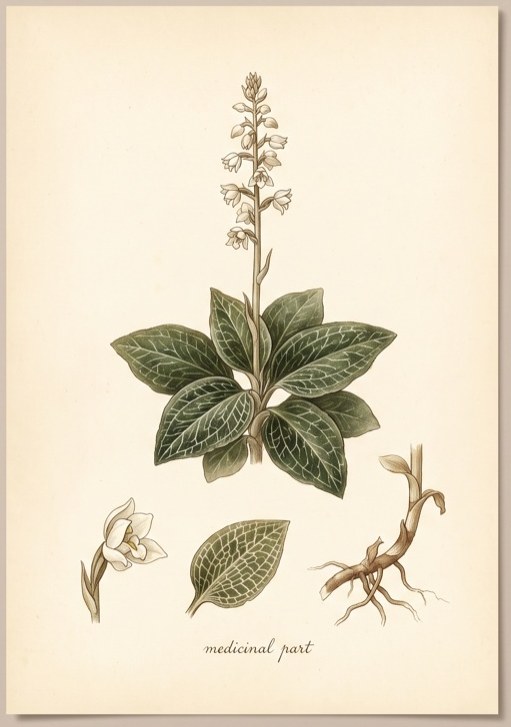
Western Herbalism
Net-leaf plantain
Goodyera
Also known as Scrofula weed, Adder's viola, Rattlesnake-leaf, Downy rattlesnake plantain, Rattlesnake plantain.
Goodyera pubescens, downy rattlesnake plantain, is a small evergreen woodland orchid native to eastern North America, prized for its net-veined variegated leaf rosette rather than its inconspicuous white flower spike. The fresh or dried leaves were the part used by nineteenth century American Eclectic physicians, who regarded the plant chiefly as a mild alterative and topical vulnerary. It never entered mainstream pharmacopoeias and remains a minor, largely historical remedy known mostly through Eclectic and folk sources.

Ask Herbert about Net-leaf plantain. Herbert is the master herbalist inside Bountiful Herbs: he answers from this plate and eleven hundred others, with dosing, pairing and cautions. Your first ten questions are free.
Ask HerbertActions
Indications what the tradition reached for it in
- Scrofula (tuberculous cervical lymphadenopathy, historical use)
- Chronic indolent skin eruptions
- Weeping eczema
- Slow-healing wounds and ulcers
- Sore or inflamed eyes (as a wash)
- Sore throat (as a gargle)
- Insect and snake bites (folk poultice)
- Scald head and scalp eruptions in children
- Chronic glandular swellings
Specific indications
Chronic, boggy, indolent swelling of the cervical lymph nodes with little heat or acute pain, the classic picture called scrofula by the Eclectics
A weeping, sluggish skin ulcer or eruption that refuses to close, calling for the leaf applied fresh or as a poultice
Safety
Pregnancy: Avoid in pregnancy in the absence of any modern safety data for internal use.
Breastfeeding: Avoid in lactation in the absence of any modern safety data.
The record lists 3 contraindications; open the plate in the library to read them in full.
In practice
This is a quiet, low-key remedy rather than a dramatic one. The Eclectics reached for it in cases of chronic, cold, boggy glandular swelling of the neck (what they called scrofula, often overlapping with what we would now recognize as tuberculous or chronic reactive lymphadenopathy), giving it internally as an infusion alongside other alteratives such as figwort or burdock, and applying the fresh bruised leaf or a poultice of the dried leaf directly over the swelling.
Dosing as the sources wrote it
| Preparation | As written | Metric |
|---|---|---|
| Infusion (dried leaf) | 1-2 g dried leaf as an infusion, up to three times daily | 1000-2000 mg |
| Tincture (1:5, 40%) | 1-2 mL three times daily | 1-2 mL |
| Topical poultice or wash | fresh bruised leaf or strong infusion applied externally as needed | |
| Action, Medical Uses, and Dosage: Net-leaf plantain is anti-scrofulous, and is reputed to have cured severe cases of scrofula. The fresh leaves are steeped in milk and applied as a poultice to scrofulous ulcers, or the bruised leaves may be laid on them, and in either case they must be renewed every 3 hours |
Doses are reproduced from the sources for practitioners and are not a recommendation for any person.
From the sources
Overview. Goodyera pubescens, downy rattlesnake plantain, is a small evergreen woodland orchid native to eastern North America, prized for its net-veined variegated leaf rosette rather than its inconspicuous white flower spike. The fresh or dried leaves were the part used by nineteenth century American Eclectic physicians, who regarded the plant chiefly as a mild alterative and topical vulnerary. It never entered mainstream pharmacopoeias and remains a minor, largely historical remedy known mostly through Eclectic and folk sources.
Clinical Notes. This is a quiet, low-key remedy rather than a dramatic one. The Eclectics reached for it in cases of chronic, cold, boggy glandular swelling of the neck (what they called scrofula, often overlapping with what we would now recognize as tuberculous or chronic reactive lymphadenopathy), giving it internally as an infusion alongside other alteratives such as figwort or burdock, and applying the fresh bruised leaf or a poultice of the dried leaf directly over the swelling.
Conservation. Goodyera pubescens is a slow-growing terrestrial orchid dependent on specific mycorrhizal partners, and wild populations can be sensitive to overharvesting and habitat disturbance, so material should be sourced from cultivated or sustainably managed stock rather than wild-collected where possible.
Drawn from King's American Dispensatory, 18th edition (Felter and Lloyd), and the Bountiful Herbs editorial.
Nearby on the shelf
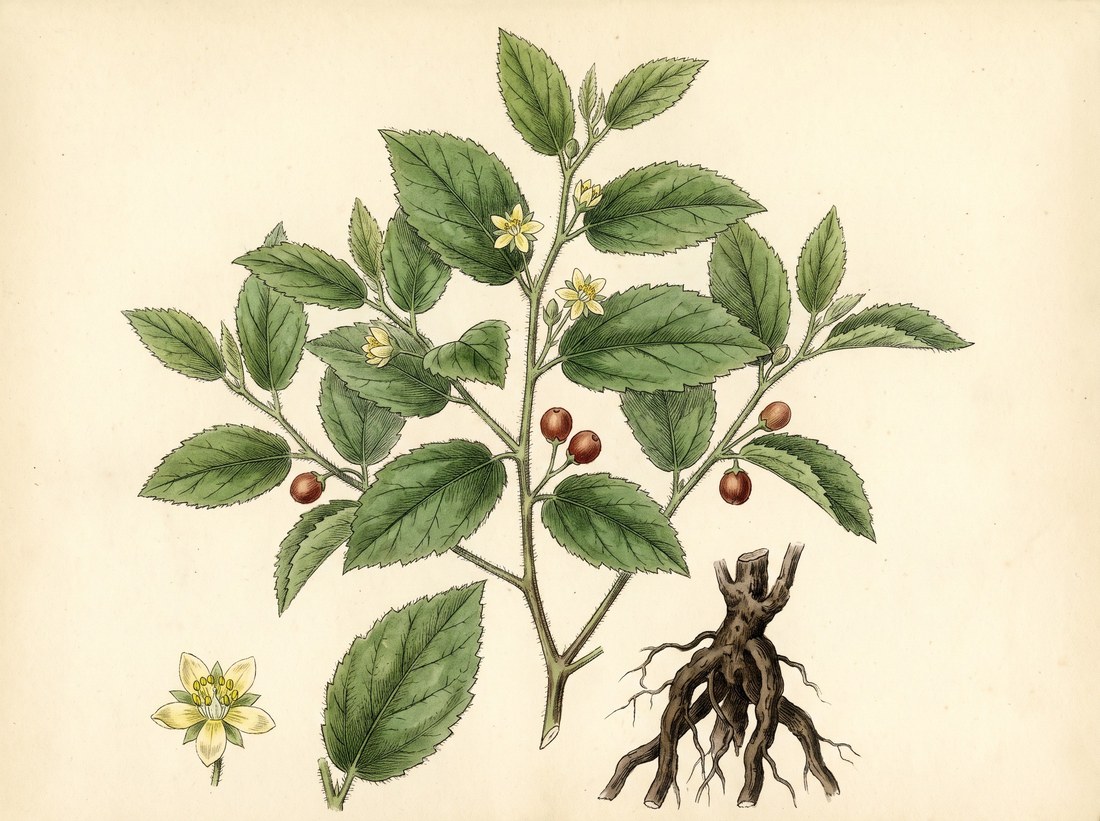 NagabalaGrewia hirsuta
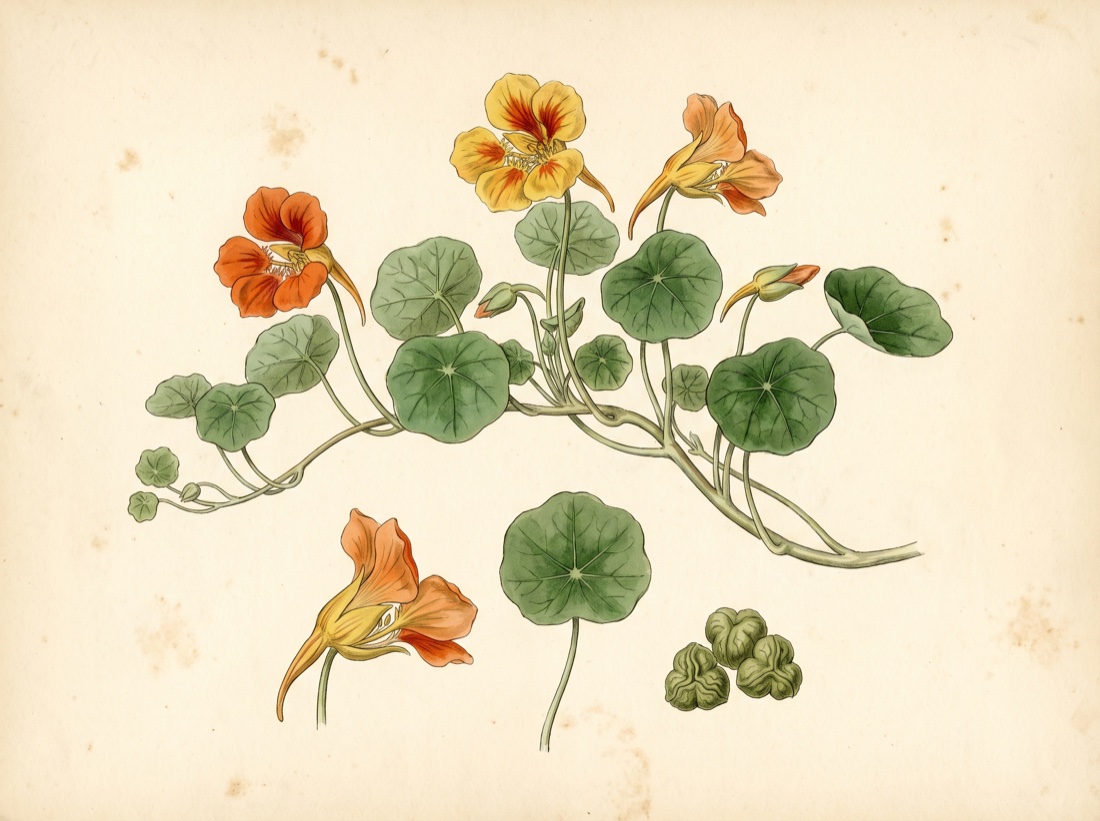 NasturtiumTropaeolum majus
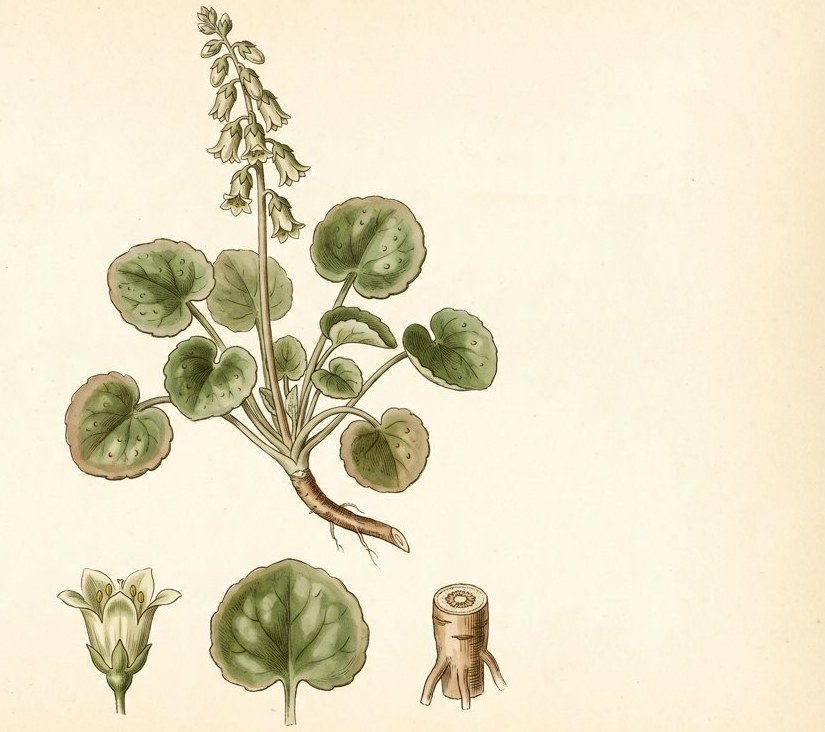 NavelwortCotyledon
 NeemAzadirachta indica
 NettlesUrtica dioica
 Night-blooming cereusSelenicereus grandiflorus
 NirgundiVitex negundo
 Niu XiAchyranthes bidentata
The whole plate is in the library. The compass, Compare, the Sky of eleven hundred plants and the formulary open with an email address and a password, free, with the formula builder and its safety engine. Herbert without limit, his formulating, clients, the handouts and the labels are the paid room.
Open the library, free