Western Herbalism
Nasturtium
Tropaeolum majus
Also known as garden nasturtium, Indian cress, monks cress, large-flowered nasturtium.
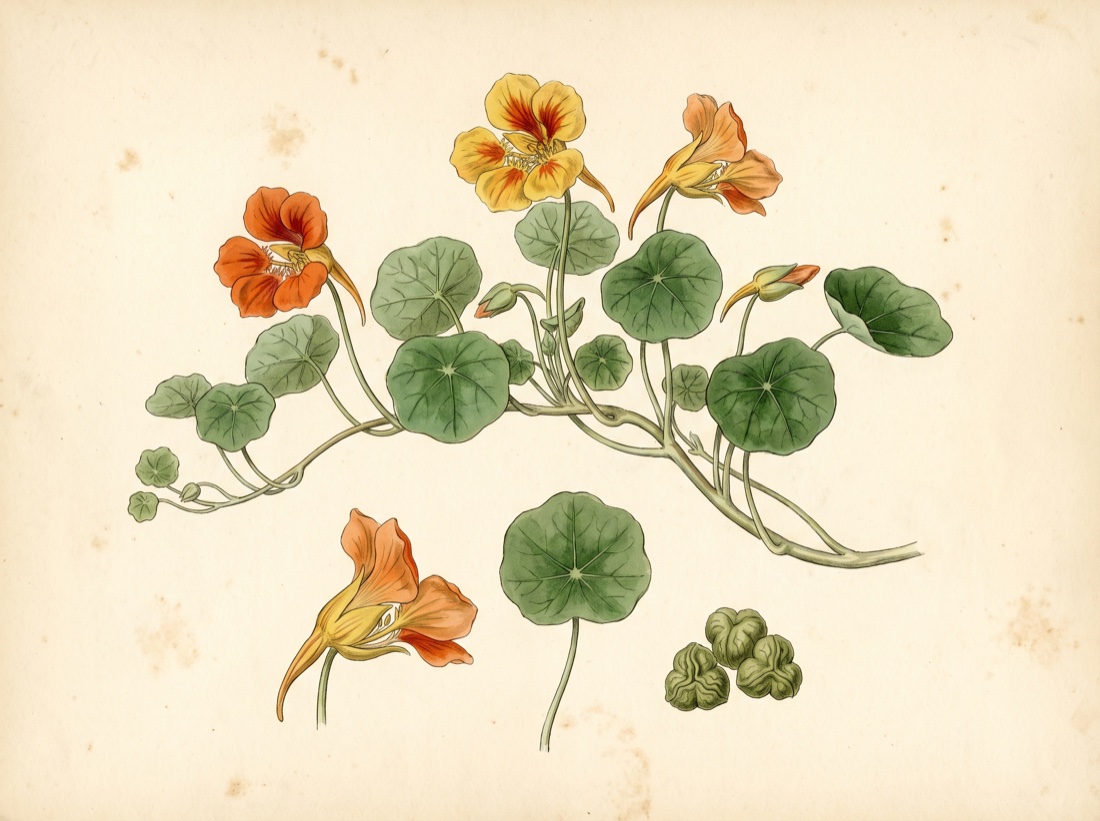
Nasturtium is the trailing, round-leaved garden annual with orange, red and yellow flowers, native to the Andes and grown worldwide since the seventeenth century. The fresh leaves and flowers are the medicine. In modern European phytotherapy it is a licensed remedy, usually combined with horseradish, for infections of the urinary and respiratory tracts, and one of the few herbal antimicrobials with reasonable clinical data behind it.

Ask Herbert about Nasturtium. Herbert is the master herbalist inside Bountiful Herbs: he answers from this plate and eleven hundred others, with dosing, pairing and cautions. Your first ten questions are free.
Ask HerbertActions
Indications what the tradition reached for it in
- Uncomplicated urinary tract infection (with horseradish root)
- Prevention of recurrent cystitis
- Acute bronchitis
- Acute sinusitis
- Upper respiratory catarrh with thick discharge
- Convalescence after respiratory infection
- Minor skin infections and slow wounds (topical)
- Scalp problems and hair loss (topical, traditional)
- Mild hypertension (experimental)
- Fungal skin and nail infections (topical, experimental)
Specific indications
Recurrent cystitis in a patient who wants to avoid repeated antibiotic courses, taken fresh or as the standardized nasturtium and horseradish combination
Sinusitis or bronchitis with thick yellow discharge that lingers after a cold, in someone who tolerates pungent, mustard-like remedies
A run-down patient in late winter who needs a fresh green, vitamin-rich food herb as much as a medicine
Safety
The record lists 7 contraindications; open the plate in the library to read them in full.
In practice
Nasturtium is a food herb with a genuine antimicrobial action, easy to use and easy to underestimate. The glucosinolate glucotropaeolin is split on crushing or chewing into benzyl isothiocyanate, which is absorbed, excreted in the urine and exhaled through the lungs, so the herb reaches exactly the two tissues where it is used.
Dosing as the sources wrote it
| Preparation | As written | Metric |
|---|---|---|
| Fresh herb (leaf and flower) | 20-30 g fresh herb daily | 20000-30000 mg |
| Fresh plant juice | 10-15 mL three times daily | 10-15 mL |
| Fresh plant tincture (1:2, 45%) | 2-4 mL three times daily | 2-4 mL |
| Nasturtium 200 mg and horseradish 80 mg tablets | 4 tablets three times daily with meals |
Doses are reproduced from the sources for practitioners and are not a recommendation for any person.
From the sources
Overview. Nasturtium is the trailing, round-leaved garden annual with orange, red and yellow flowers, native to the Andes and grown worldwide since the seventeenth century. The fresh leaves and flowers are the medicine. In modern European phytotherapy it is a licensed remedy, usually combined with horseradish, for infections of the urinary and respiratory tracts, and one of the few herbal antimicrobials with reasonable clinical data behind it.
Clinical Notes. Nasturtium is a food herb with a genuine antimicrobial action, easy to use and easy to underestimate. The glucosinolate glucotropaeolin is split on crushing or chewing into benzyl isothiocyanate, which is absorbed, excreted in the urine and exhaled through the lungs, so the herb reaches exactly the two tissues where it is used.
Nearby on the shelf
 MyrrhCommiphora molmol
 MyrtleMyrtus communis
 NagabalaGrewia hirsuta
 NavelwortCotyledon
 NeemAzadirachta indica
 Net-leaf plantainGoodyera
 NettlesUrtica dioica
The whole plate is in the library. The compass, Compare, the Sky of eleven hundred plants and the formulary open with an email address and a password, free, with the formula builder and its safety engine. Herbert without limit, his formulating, clients, the handouts and the labels are the paid room.
Open the library, free