Western Herbalism
Navelwort
Cotyledon
Also known as Pennywort, Wall Pennywort, Cotylet, Kidneywort, Penny Pies.
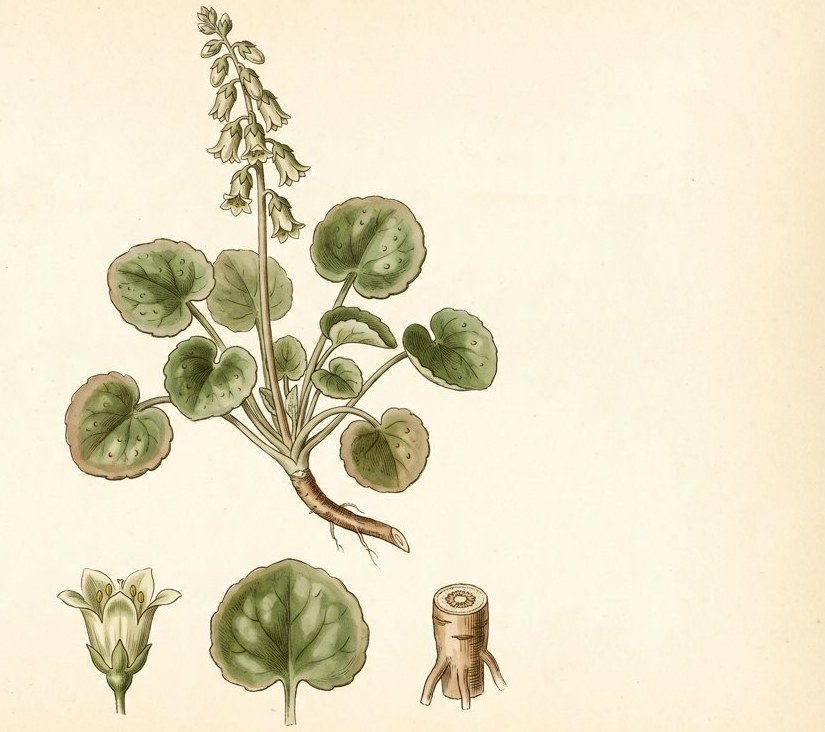
Navelwort, also called Pennywort, is a small succulent perennial of the stonecrop family, native to western Europe including Britain, Ireland, and the Mediterranean fringe, where it grows characteristically from crevices in old walls and rocky banks. The rounded, peltate leaf with its central navel-like depression gives the plant both its common name and its old Latin epithet umbilicus-veneris. In eclectic and older British domestic herbal practice, the fresh, cool, mucilaginous leaf and its juice were the parts used, chiefly applied externally.

Ask Herbert about Navelwort. Herbert is the master herbalist inside Bountiful Herbs: he answers from this plate and eleven hundred others, with dosing, pairing and cautions. Your first ten questions are free.
Ask HerbertActions
Indications what the tradition reached for it in
- Hemorrhoids
- Chilblains
- Minor burns and scalds
- Inflamed or irritated skin
- Earache (topical folk use)
- Kidney and bladder gravel (traditional)
- Epilepsy (historical folk use, unsubstantiated)
- Sunburn and minor skin abrasions
Specific indications
Piles that are hot, swollen, and tender, soothed by a fresh leaf or its expressed juice applied locally
Chilblains on the fingers or toes, itchy and inflamed, relieved by fresh juice dabbed on the affected part
Safety
Pregnancy: No safety data exist; avoid internal use in pregnancy as a precaution, topical use on intact skin is considered low risk.
Breastfeeding: No safety data exist; avoid internal use during lactation as a precaution.
The record lists 3 contraindications; open the plate in the library to read them in full.
In practice
This is very much a cottage remedy rather than a heroic one: the appeal of navelwort has always been its simplicity, a fresh succulent leaf crushed or split and laid directly on a sore, a chilblain, or a hemorrhoid for its cooling, softening effect.
Dosing as the sources wrote it
| Preparation | As written | Metric |
|---|---|---|
| Fresh leaf, topical | one fresh leaf, split or crushed, applied directly to the affected area two to three times daily | |
| Fresh juice, topical | expressed juice dabbed onto chilblains, piles, or minor burns two to three times daily | |
| Infusion (traditional, internal) | 5-10 g fresh leaf steeped as an infusion, taken once daily, traditional use only | 5000-10000 mg |
| The fresh juice may be administered in doses of from ½ to 1 fluid ounce, 3 times a day. | 14.79-29.57 mL |
Doses are reproduced from the sources for practitioners and are not a recommendation for any person.
From the sources
Overview. Navelwort, also called Pennywort, is a small succulent perennial of the stonecrop family, native to western Europe including Britain, Ireland, and the Mediterranean fringe, where it grows characteristically from crevices in old walls and rocky banks. The rounded, peltate leaf with its central navel-like depression gives the plant both its common name and its old Latin epithet umbilicus-veneris. In eclectic and older British domestic herbal practice, the fresh, cool, mucilaginous leaf and its juice were the parts used, chiefly applied externally.
Clinical Notes. This is very much a cottage remedy rather than a heroic one: the appeal of navelwort has always been its simplicity, a fresh succulent leaf crushed or split and laid directly on a sore, a chilblain, or a hemorrhoid for its cooling, softening effect.
Drawn from King's American Dispensatory, 18th edition (Felter and Lloyd), and the Bountiful Herbs editorial.
Nearby on the shelf
 MyrrhMyrrha
 MyrtleMyrtus communis
 NagabalaGrewia hirsuta
 NasturtiumTropaeolum majus
 NeemAzadirachta indica
 Net-leaf plantainGoodyera
 NettlesUrtica dioica
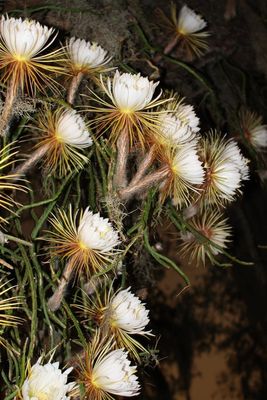 Night-blooming cereusSelenicereus grandiflorus
The whole plate is in the library. The compass, Compare, the Sky of eleven hundred plants and the formulary open with an email address and a password, free, with the formula builder and its safety engine. Herbert without limit, his formulating, clients, the handouts and the labels are the paid room.
Open the library, free