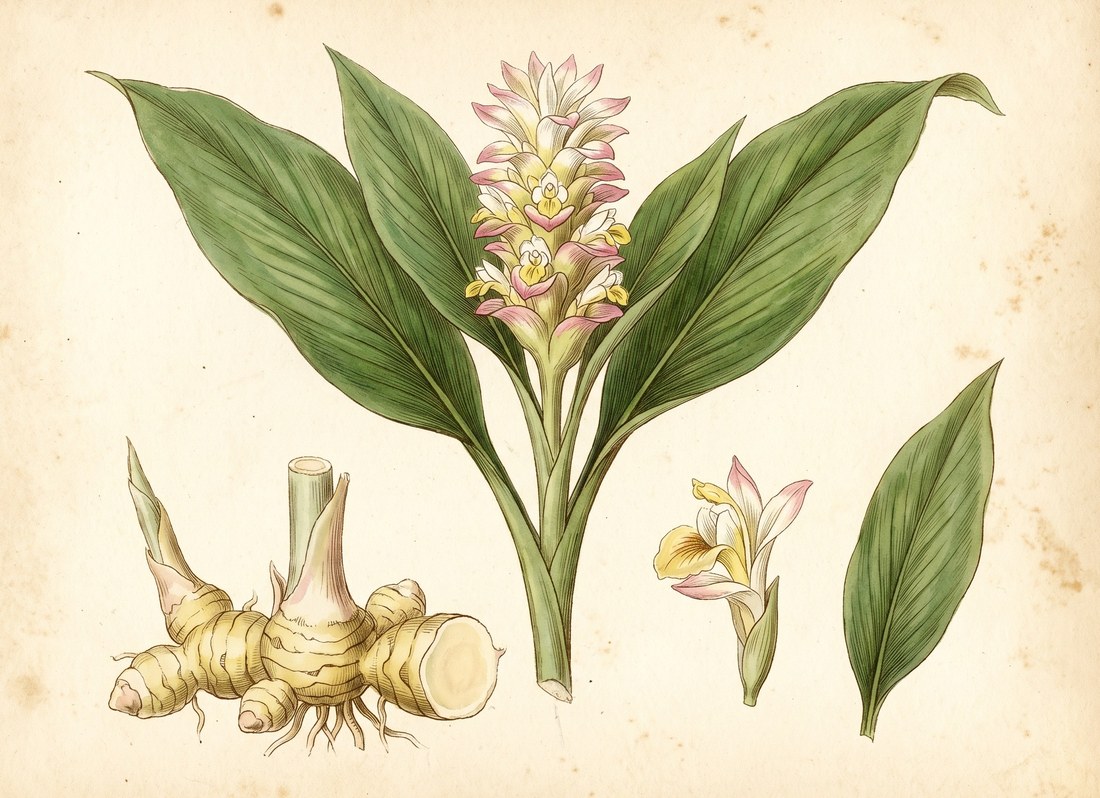
Ayurvedic Herbalism
Mango ginger
Curcuma amada
Also known as amba haldi, Amragandhi haridra, Amragandha, Karpura haridra.
Curcuma amada is a rhizomatous herb of the ginger family, cultivated and semi-wild across the humid districts of West Bengal, Odisha, the northeast, Kerala, Karnataka and Tamil Nadu, distinguished from turmeric by its pale yellow flesh and its unmistakable scent of raw green mango. Ayurveda names it Amragandhi haridra, the mango-scented turmeric, and uses it as the cooling member of the turmeric group: a light, bitter, aromatic rhizome that pacifies pitta and kapha, kindles appetite, relieves itching and burning skin, and dresses bruises and sprains. It is as much a pickle and relish as a medicine.

Ask Herbert about Mango ginger. Herbert is the master herbalist inside Bountiful Herbs: he answers from this plate and eleven hundred others, with dosing, pairing and cautions. Your first ten questions are free.
Ask HerbertActions
Indications what the tradition reached for it in
- Bruises, sprains and soft tissue swelling (paste, topical)
- Itching skin eruptions of pitta type
- Acne, blemishes and uneven pigmentation (cosmetic paste)
- Poor appetite and indigestion in hot weather
- Fever with burning and thirst (traditional)
- Insect bites and minor stings (paste)
- Minor cuts and wounds (topical)
- Hyperacidity with nausea (traditional)
- Fungal skin infection (topical, adjunct)
- Cough with sore throat of pitta type (traditional)
Specific indications
A fresh sprain or bruise that is hot, swollen and tender, dressed with a paste of the fresh rhizome and a little salt
Itchy, red, burning skin eruptions in a hot-tempered pitta patient for whom ordinary turmeric feels too heating
Summer loss of appetite with a bitter taste in the mouth, relieved by a mango-scented relish before meals
A young person with oily skin, blemishes and patchy pigmentation who wants a cooling cosmetic paste
Safety
The record lists 4 contraindications; open the plate in the library to read them in full.
In practice
The Ayurvedic practitioner uses Amragandhi haridra where turmeric's heat is unwanted. Its most common use is external: the fresh rhizome is pounded with a little salt or lime and bound on sprains, bruises, swollen joints and insect bites, where it cools and reduces swelling, and the dried powder is mixed with sandalwood, Manjishtha and rose water into a cosmetic paste for acne, blemishes and pigmentation.
In Ayurveda
Rasa: tikta (bitter), madhura (sweet), with a mild katu (pungent) aftertaste. Virya: sheeta (cooling). Vipaka: katu (pungent). Guna: laghu (light), ruksha (dry). Dosha: pacifies kapha and pitta; may aggravate vata in excess. Karma: deepana (kindles digestion); ruchya (improves taste and appetite); kandughna (relieves itching); kushthaghna (relieves skin disease); jvaraghna (relieves fever); dahaprashamana (relieves burning); vishaghna (counters poisons); pittahara (pacifies pitta); varnya (improves complexion); shothahara (reduces swelling); vranaropana (heals wounds). Classical indications: kandu (itching); kushtha (skin disease); jvara (fever); daha (burning sensation); aruchi (loss of appetite); ajirna (indigestion); shotha (swelling, as a paste); vrana (wounds and bruises); pittaja vikara (disorders of pitta); visha (poisoning, insect bites); twagdosha (skin blemishes). The fresh rhizome, smelling of raw mango, is eaten as a pickle and relish, taken as fresh juice or fine churna, and pounded into a paste that is applied to bruises, sprains, swellings, itching skin and blemishes; the dried rhizome is used like turmeric in cooling skin pastes and in a few compound powders. Classical formulations: Amragandhi haridra lepa, Amragandhi haridra churna, Amragandhi haridra swarasa, Amba haldi ubtan (cosmetic paste), Amba haldi pickle (dietary). Described in: Bhavaprakasha Nighantu, Dhanvantari Nighantu, Raja Nighantu, Kaiyadeva Nighantu, Madanapala Nighantu.
Dosing as the sources wrote it
| Preparation | As written | Metric |
|---|---|---|
| Churna | 1-3 g powdered rhizome daily with honey or warm water | 1000-3000 mg |
| Swarasa | 10-20 mL fresh rhizome juice daily | 10-20 mL |
| Kalka, topical | 5-10 g fresh rhizome paste applied to bruises and swellings | 5000-10000 mg |
| Fresh rhizome (dietary) | 5-10 g grated fresh rhizome as a relish with meals | 5000-10000 mg |
Doses are reproduced from the sources for practitioners and are not a recommendation for any person.
From the sources
Overview. Curcuma amada is a rhizomatous herb of the ginger family, cultivated and semi-wild across the humid districts of West Bengal, Odisha, the northeast, Kerala, Karnataka and Tamil Nadu, distinguished from turmeric by its pale yellow flesh and its unmistakable scent of raw green mango. Ayurveda names it Amragandhi haridra, the mango-scented turmeric, and uses it as the cooling member of the turmeric group: a light, bitter, aromatic rhizome that pacifies pitta and kapha, kindles appetite, relieves itching and burning skin, and dresses bruises and sprains. It is as much a pickle and relish as a medicine.
Clinical Notes. The Ayurvedic practitioner uses Amragandhi haridra where turmeric's heat is unwanted. Its most common use is external: the fresh rhizome is pounded with a little salt or lime and bound on sprains, bruises, swollen joints and insect bites, where it cools and reduces swelling, and the dried powder is mixed with sandalwood, Manjishtha and rose water into a cosmetic paste for acne, blemishes and pigmentation.
Ayurvedic Profile. Rasa: tikta (bitter), madhura (sweet), with a mild katu (pungent) aftertaste. Virya: sheeta (cooling). Vipaka: katu (pungent). Guna: laghu (light), ruksha (dry). Dosha: pacifies kapha and pitta; may aggravate vata in excess.
Nearby on the shelf
 MaltMaltum
 ManacaFranciscea uniflora
 MandrakeMandragora officinarum
 MangoMangifera indica
 MangosteenGarcinia mangostana
 Manna ashFraxinus ornus
 MarijuanaCannabis sativa
 MarjoramOriganum majorana
The whole plate is in the library. The compass, Compare, the Sky of eleven hundred plants and the formulary open with an email address and a password, free, with the formula builder and its safety engine. Herbert without limit, his formulating, clients, the handouts and the labels are the paid room.
Open the library, free