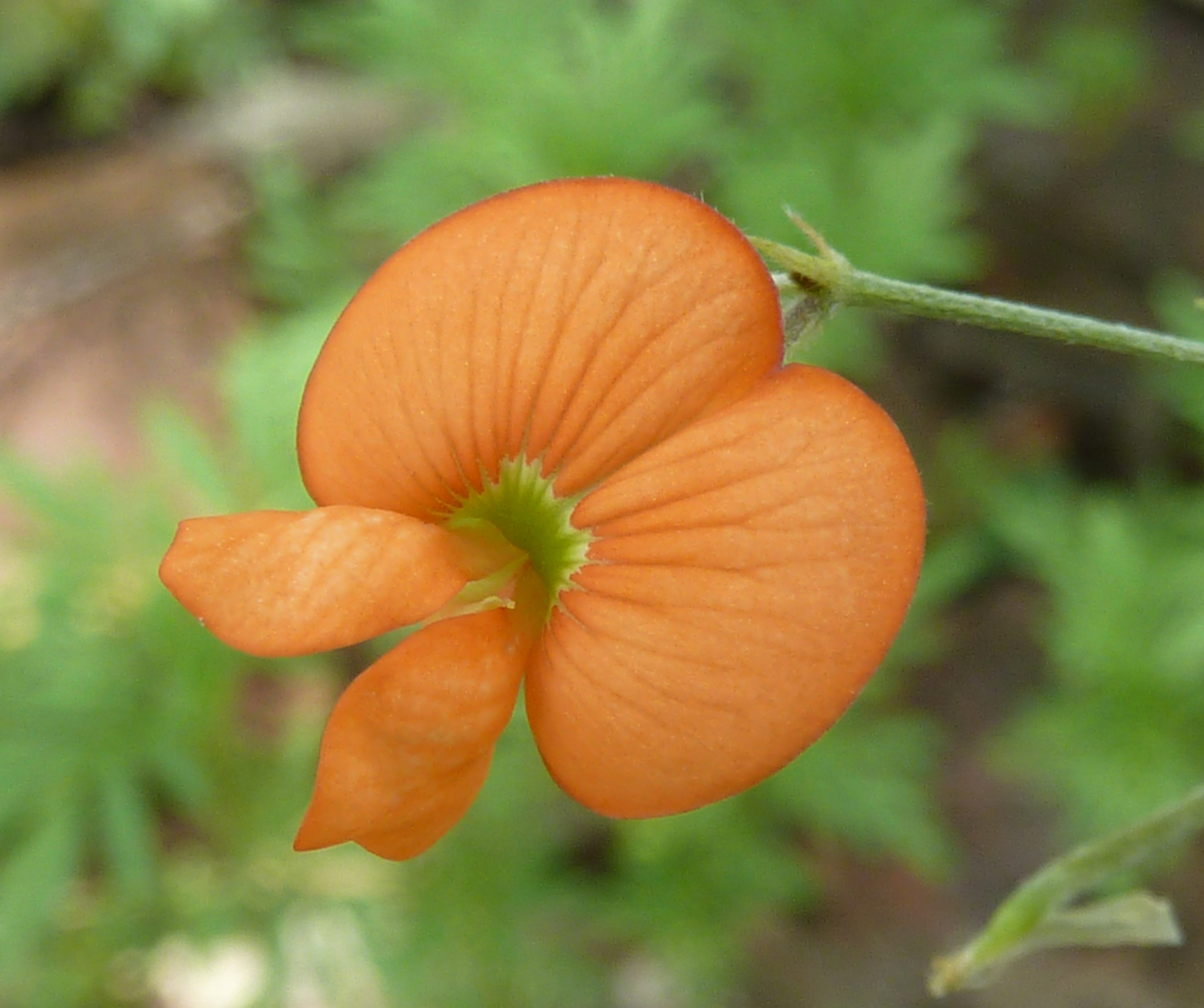
Western Herbalism
Hoary Pea
Tephrosia
Also known as Turkey pea, Devil's shoestring, Goat's rue, Cat gut, Catgut.
Tephrosia virginiana is a low, hairy perennial legume native to dry sandy soils, open woods, and barrens across eastern and central North America. The root was the part used by Indigenous peoples and later adopted by nineteenth century Eclectic physicians, who valued it chiefly as a vermifuge and tonic. It is a minor, largely historical remedy today, overshadowed by safer anthelmintics and constrained by its content of rotenone, a compound now better known as a fish and insect poison than a human medicine.

Ask Herbert about Hoary Pea. Herbert is the master herbalist inside Bountiful Herbs: he answers from this plate and eleven hundred others, with dosing, pairing and cautions. Your first ten questions are free.
Ask HerbertActions
Indications what the tradition reached for it in
- Intestinal worm infestation
- Tapeworm
- General debility with poor appetite
- Convalescence after illness
- Skin parasite infestation (topical)
- Scabies (historical topical use)
- Lice infestation (historical topical use)
- Chronic sluggishness attributed to worm burden
Specific indications
Persistent intestinal worm infestation, especially tapeworm, unresponsive to gentler vermifuges
General tonic debility with weakness and poor appetite, as reached for by Eclectic physicians when a stimulating tonic vermifuge was wanted
Safety
Low dose botanical. Used in drop doses in the classical practice; not a plant to dose freely.
Pregnancy: Limited safety data in pregnancy
The record lists 7 contraindications; open the plate in the library to read them in full.
In practice
This root belongs to the older American Eclectic tradition rather than to current practice. It was given as a decoction or fluid extract for intestinal worms, particularly tapeworm, sometimes combined with a purgative to hasten expulsion, and was also used as a general bitter tonic for convalescent weakness with poor appetite. Externally, root preparations were rubbed on the skin for lice and mange. Because the plant's anthelmintic and insecticidal activity is attributable largely to rotenone and related rotenoids, which are mitochondrial poisons, this is not a remedy to reach for casually or in anything but modest, short courses. Most modern herbalists have set it aside in favor of better characterized and safer vermifuges. If it is used at all, it should be at conservative traditional doses, for a limited time, and with attention to gastrointestinal tolerance.
Dosing as the sources wrote it
| Preparation | As written | Metric |
|---|---|---|
| Root decoction (historical Eclectic dosing) | 1-4 g dried root as a short course, not exceeding a few days | 1000-4000 mg |
| Fluid extract (1:1) | 1-2 mL up to twice daily, short course only | 1-2 mL |
| The dose is from ½ to 1 fluid ounce, 2, 3, or 4 times a day (Amer. | 14.79-29.57 mL |
Doses are reproduced from the sources for practitioners and are not a recommendation for any person.
From the sources
Overview. Tephrosia virginiana is a low, hairy perennial legume native to dry sandy soils, open woods, and barrens across eastern and central North America. The root was the part used by Indigenous peoples and later adopted by nineteenth century Eclectic physicians, who valued it chiefly as a vermifuge and tonic. It is a minor, largely historical remedy today, overshadowed by safer anthelmintics and constrained by its content of rotenone, a compound now better known as a fish and insect poison than a human medicine.
Clinical Notes. This root belongs to the older American Eclectic tradition rather than to current practice. It was given as a decoction or fluid extract for intestinal worms, particularly tapeworm, sometimes combined with a purgative to hasten expulsion, and was also used as a general bitter tonic for convalescent weakness with poor appetite.
Drawn from King's American Dispensatory, 18th edition (Felter and Lloyd), and the Bountiful Herbs editorial.
Nearby on the shelf
 Himalayan cedarCedrus deodara
 Himalayan silver firAbies webbiana
 Himalayan white lilyLilium polyphyllum
 Himalayan wild cherryPrunus cerasoides
 HollyhockAlthea rosea
 Holy basilOcimum tenuiflorum
 Honduras barkCascara Amarga
 HoneysuckleLonicera japonica
The whole plate is in the library. The compass, Compare, the Sky of eleven hundred plants and the formulary open with an email address and a password, free, with the formula builder and its safety engine. Herbert without limit, his formulating, clients, the handouts and the labels are the paid room.
Open the library, free