Ayurvedic Herbalism
Gojihva
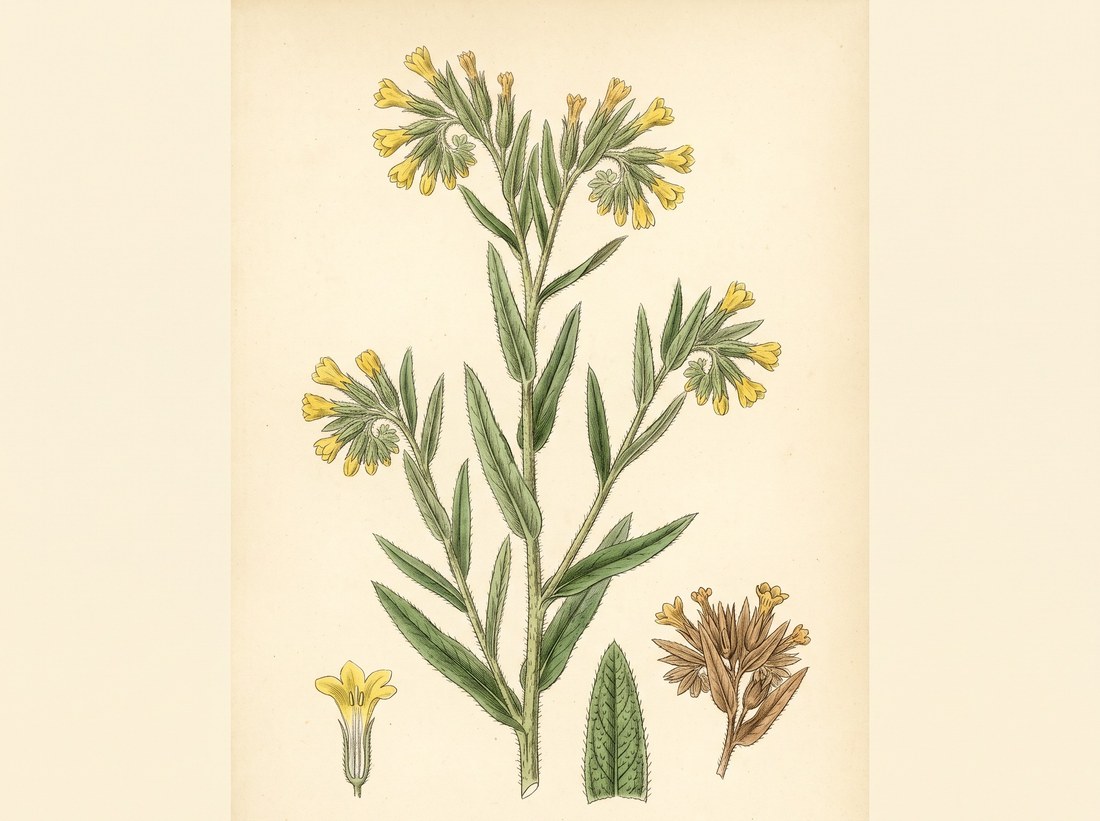
Onosma bracteatum
Also known as gaozaban, ox tongue, sedge-leaved onosma, Gojihva, Gojihvika, Gobhi.
Onosma bracteatum is a rough-haired perennial of the borage family from the drier inner ranges of the western Himalaya, Kashmir, Himachal, Afghanistan and Iran, with narrow tongue-shaped leaves that give it the Sanskrit name Gojihva, ox tongue. The dried leaves and flowering tops are the gaozaban of the Indian bazaar, a cooling demulcent for cough, fever, burning urination and an agitated heart that Ayurveda uses chiefly as the head of Gojihvadi kwatha and that Unani medicine prizes as a nervine and cardiac tonic.

Ask Herbert about Gojihva. Herbert is the master herbalist inside Bountiful Herbs: he answers from this plate and eleven hundred others, with dosing, pairing and cautions. Your first ten questions are free.
Ask HerbertActions
Indications what the tradition reached for it in
- Dry, irritating cough with scanty sticky phlegm
- Allergic and asthmatic cough with wheeze (adjunct)
- Fever with thirst and burning
- Painful, burning urination and cystitis
- Palpitations with anxiety and restlessness
- Nervous exhaustion with low mood
- Chronic bronchitis with heat
- Rheumatic joint pain with heat (adjunct)
- Bleeding from the nose or gums in pitta states
- Hot, itchy skin eruptions
Specific indications
A pitta patient with a dry, tickling, persistent cough, a hot chest, thirst and a faint wheeze at night, where a cooling mucilaginous expectorant is wanted
The anxious, overheated, sleepless patient with a fluttering heart and a dry mouth for whom a cooling nervine rather than a heating one is right
Burning, frequent urination in a hot season or a pitta constitution, with a low-grade fever and no bacterial cause found
Safety
Low dose botanical. Used in drop doses in the classical practice; not a plant to dose freely.
Pregnancy: Avoid in pregnancy: no published safety class is known to us, but the genus is reported to contain pyrrolizidine alkaloids and the tradition offers no specific reassurance.
Breastfeeding: Avoid while nursing because pyrrolizidine alkaloids can pass into milk; a single dose of the traditional decoction is unlikely to matter, but courses should wait.
The record lists 7 contraindications; open the plate in the library to read them in full.
In practice
Gojihva earns its place for the hot dry cough. Gojihvadi kwatha, a decoction of Gojihva with Kantakari, Bharangi, Vasa, Pippali and other pectoral herbs, is a standard dispensary answer to kasa and shvasa with pitta and kapha, allergic bronchitis and cough after fever, given warm twice daily with honey.
In Ayurveda
Rasa: madhura (sweet), tikta (bitter), kashaya (astringent). Virya: sheeta (cooling). Vipaka: madhura (sweet). Guna: laghu (light), snigdha (unctuous), picchila (slimy). Dosha: pacifies pitta and kapha; the mucilage soothes vata in the chest and bladder. Karma: kasahara (relieves cough); shvasahara (relieves dyspnea); jvaraghna (relieves fever); mutrala (diuretic); hridya (cardiac tonic); medhya (supports mind and intellect); dahaprashamana (relieves burning); raktashodhaka (purifies blood); kaphanissaraka (expectorant); balya (strengthening). Classical indications: kasa (cough); shvasa (dyspnea, asthma); jvara (fever); mutrakricchra (painful urination); daha (burning sensation); hridroga (heart disease); unmada (mental disturbance); raktapitta (bleeding disorders); kushtha (skin disease); trishna (thirst). The dried leaf and flowering top are used, as a cold infusion or kwatha, as churna with honey, and as the leading herb of Gojihvadi kwatha; in the allied Unani tradition the same drug, gaozaban, is made into syrups, khamira confections and distilled waters for the heart and nerves. Classical formulations: Gojihvadi kwatha, Gojihvadi kashaya churna, Gojihva sharbat, Khamira gaozaban (Unani, widely dispensed), Arq gaozaban (Unani distillate). Described in: Charaka Samhita, Sushruta Samhita, Bhavaprakasha Nighantu, Raja Nighantu, Kaiyadeva Nighantu.
Dosing as the sources wrote it
| Preparation | As written | Metric |
|---|---|---|
| Churna | 3-6 g powdered leaf twice daily with honey | 3000-6000 mg |
| Kwatha | 50-100 mL decoction twice daily | 50-100 mL |
| Hima (cold infusion) | 50-100 mL cold infusion twice daily | 50-100 mL |
| Gojihvadi kwatha | 50-100 mL compound decoction twice daily after food | 50-100 mL |
Doses are reproduced from the sources for practitioners and are not a recommendation for any person.
From the sources
Overview. Onosma bracteatum is a rough-haired perennial of the borage family from the drier inner ranges of the western Himalaya, Kashmir, Himachal, Afghanistan and Iran, with narrow tongue-shaped leaves that give it the Sanskrit name Gojihva, ox tongue. The dried leaves and flowering tops are the gaozaban of the Indian bazaar, a cooling demulcent for cough, fever, burning urination and an agitated heart that Ayurveda uses chiefly as the head of Gojihvadi kwatha and that Unani medicine prizes as a nervine and cardiac tonic.
Clinical Notes. Gojihva earns its place for the hot dry cough. Gojihvadi kwatha, a decoction of Gojihva with Kantakari, Bharangi, Vasa, Pippali and other pectoral herbs, is a standard dispensary answer to kasa and shvasa with pitta and kapha, allergic bronchitis and cough after fever, given warm twice daily with honey.
Ayurvedic Profile. Rasa: madhura (sweet), tikta (bitter), kashaya (astringent). Virya: sheeta (cooling). Vipaka: madhura (sweet). Guna: laghu (light), snigdha (unctuous), picchila (slimy). Dosha: pacifies pitta and kapha; the mucilage soothes vata in the chest and bladder.
Conservation. Wild populations in the western Himalaya are under harvest pressure and the plant is listed as vulnerable in parts of its Indian range; prefer cultivated material where available.
Nearby on the shelf
 GmelinaGmelina arborea
 Goa PowderAraroba
 Goat's RueGalega officinalis
 Goji berryLycium barbarum
 Golden RagwortSenecio aureus
 Golden shower treeCassia fistula
 GoldenrodSolidago spp.
 GoldensealHydrastis canadensis
The whole plate is in the library. The compass, Compare, the Sky of eleven hundred plants and the formulary open with an email address and a password, free, with the formula builder and its safety engine. Herbert without limit, his formulating, clients, the handouts and the labels are the paid room.
Open the library, free