Western Herbalism
Goat's Rue
Galega officinalis
Also known as French lilac.
Galega has a disagreeably bitter taste, and upon being chewed, imparts a dark-yellowish color to the saliva. Various properties were attributed to it in former times, in which it was considerably employed as a vermifuge, as a stimulant to the nervous system, as a diuretic and tonic in typhoid conditions, and is also stated to have been of service in the plague, as well as to stimulate the lactiferous vessels to an increased secretion during the period of lactation. It is, seldom, if ever, prescribed in practice.

Ask Herbert about Goat's Rue. Herbert is the master herbalist inside Bountiful Herbs: he answers from this plate and eleven hundred others, with dosing, pairing and cautions. Your first ten questions are free.
Ask HerbertActions
Indications what the tradition reached for it in
- Dyspepsia
- Insufficient breast milk production
- Fever
- Diabetes mellitus
- Hyperglycemia
- Edema
- Fluid retention
- Insufficient lactation
- Urinary disorders
- Diabetes
- Digestive complaints
- Low milk supply
- Common cold
Safety
Pregnancy: Not safe. Galega may be contraindicated during pregnancy.
Pregnancy, our record's flag: Caution. Use with care in pregnancy (our record's flag)
Pregnancy, our record's flag: Not safe. Not for use in pregnancy (our record's flag)
Pregnancy, published rating: Limited data. No increase in harm from limited human use; animal studies show no fetal damage (Mills & Bone B1)
Breastfeeding: No concern. Compatible with breastfeeding (Mills & Bone C)
The record lists 4 contraindications; open the plate in the library to read them in full.
Dosing as the sources wrote it
| Preparation | As written |
|---|---|
| Aqueous extract of fresh plant: 8-15 grains (0.5-1g) 3-5x/day | |
| Infusion | Infusion: 1.5 tsp. / cup; 1 cup TID (1 tsp. = 1.3 gm) |
| 1:5 tincture | 1:5 tincture - 2 ml TID; 40 ml = weekly maximum |
Doses are reproduced from the sources for practitioners and are not a recommendation for any person.
From the sources
Action, Medical Uses, and Dosage. Galega has a disagreeably bitter taste, and upon being chewed, imparts a dark-yellowish color to the saliva. Various properties were attributed to it in former times, in which it was considerably employed as a vermifuge, as a stimulant to the nervous system, as a diuretic and tonic in typhoid conditions, and is also stated to have been of service in the plague, as well as to stimulate the lactiferous vessels to an increased secretion during the period of lactation. It is, seldom, if ever, prescribed in practice.
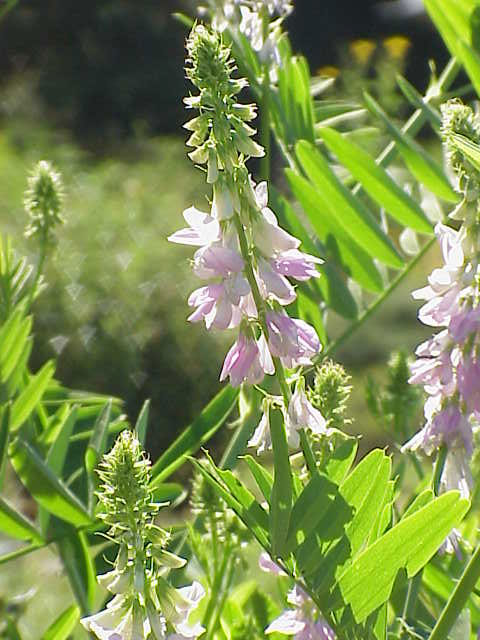
Botanical Source and History. This is an herbaceous plant, native of southern Europe. It has an erect, perennial, glabrous stem, about 3 feet high, and is found growing mostly in sandy soil. The leaves are alternate, oddly pinnate, and furnished at the base with lanceolate stipules.
indications. Goat's Rue is traditionally indicated for: Dyspepsia, Insufficient breast milk production, Fever, Diabetes mellitus, Hyperglycemia, Edema, Fluid retention, Insufficient lactation, Urinary disorders, Diabetes, Digestive complaints, Low milk supply, Common cold.
dose-reference. Reference preparation/dosing for Goat's Rue: Aqueous extract of fresh plant: 8-15 grains (0.5-1g) 3-5x/day; Fluid extract of dried flowering tops; Infusion of leaves
Drawn from King's American Dispensatory, 18th edition (Felter and Lloyd), and the Bountiful Herbs editorial.
Nearby on the shelf
 Globe artichokeCynara scolymus
 Glory lilyGloriosa superba
 GmelinaGmelina arborea
 Goa PowderVataireopsis araroba
 Goji berryLycium barbarum
 GojihvaOnosma bracteatum
 Golden RagwortSenecio aureus
 Golden shower treeCassia fistula
The whole plate is in the library. The compass, Compare, the Sky of eleven hundred plants and the formulary open with an email address and a password, free, with the formula builder and its safety engine. Herbert in full, his formulating, clients, the handouts and the labels are the paid room.
Open the library, free