Western Herbalism
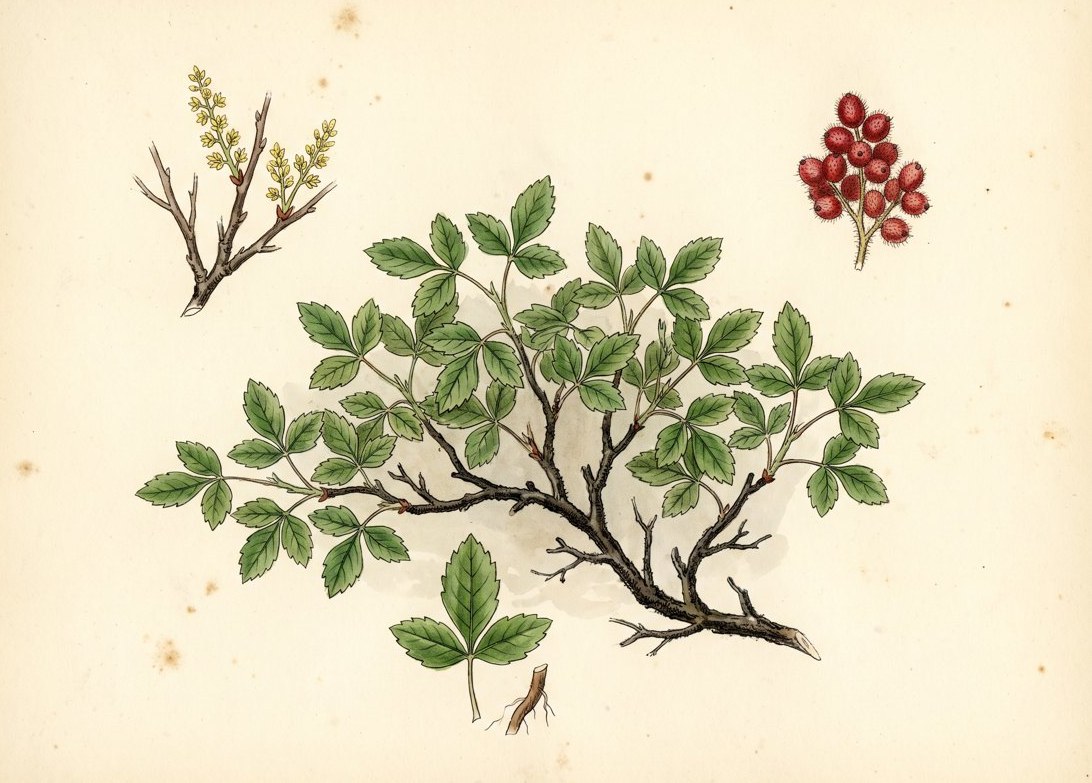
Fragrant sumac
Rhus Aromatica
Also known as Fragrant sumach, Sweet sumac, Sweet sumach, Skunkbush.
Rhus aromatica is a low, spreading shrub native to eastern and central North America, valued by the eclectic physicians for its astringent root bark. The fresh or dried root bark, prepared as a fluid extract or specific tincture, was a mainstay of nineteenth century American practice for lax, atonic states of the urinary and gastrointestinal tract. It has largely fallen out of mainstream use but retains a following among herbalists treating enuresis and passive bleeding.

Ask Herbert about Fragrant sumac. Herbert is the master herbalist inside Bountiful Herbs: he answers from this plate and eleven hundred others, with dosing, pairing and cautions. Your first ten questions are free.
Ask HerbertActions
Indications what the tradition reached for it in
- Nocturnal enuresis in children
- Stress and urge urinary incontinence
- Polyuria
- Chronic non-inflammatory diarrhea
- Passive hemorrhage
- Night sweats of chronic illness
- Hematuria
- Menorrhagia
- Diabetic polyuria (adjunctive)
- Uterine atony with bleeding
Specific indications
Bedwetting in a child where the bladder seems weak and lax rather than irritated or infected, with a large volume of pale urine passed at night
Profuse, painless, watery diarrhea without cramping or heat signs
Passive, oozing hemorrhage from relaxed, atonic tissue rather than active bleeding from inflammation
Safety
Pregnancy: Avoid in pregnancy: traditional use as a uterine hemostatic and lack of modern safety data make it unsuitable for routine use in pregnancy.
Breastfeeding: Insufficient data; avoid or use only under experienced supervision during lactation.
The record lists 4 contraindications; open the plate in the library to read them in full.
In practice
Fragrant sumac root bark is reached for when the underlying picture is one of tissue laxity and weak sphincteric tone rather than infection or irritation. The classic case is a child who wets the bed because the bladder neck simply does not hold, passing a large volume of pale urine at night without dysuria, urgency, or a history of urinary tract infection; in that setting it can succeed where other astringents and bladder tonics fail, though eclectic writers were candid that results were inconsistent and depended on correctly identifying the atonic, non-irritable pattern.
Dosing as the sources wrote it
| Preparation | As written | Metric |
|---|---|---|
| Fluid extract | 0.5-2 mL (approx. 10-30 minims historical) up to three times daily | 0.5-2 mL |
| Tincture (1:5) | 1-3 mL three times daily | 1-3 mL |
| Decoction of dried root bark | 2-4 g dried root bark daily in decoction | 2000-4000 mg |
| Extractum Rhus Aromaticae fluidum , fluid extract of Rhus Aromatica | Dose, from ten to thirty minims. | 0.62-1.85 mL |
| Specific Medicine Fragrant Sumach | Dose, from five to thirty minims. | 0.31-1.85 mL |
| If satisfactory results are not obtained from small doses it may be pushed until sixty-drops are given to an adult. |
Doses are reproduced from the sources for practitioners and are not a recommendation for any person.
From the sources
Overview. Rhus aromatica is a low, spreading shrub native to eastern and central North America, valued by the eclectic physicians for its astringent root bark. The fresh or dried root bark, prepared as a fluid extract or specific tincture, was a mainstay of nineteenth century American practice for lax, atonic states of the urinary and gastrointestinal tract. It has largely fallen out of mainstream use but retains a following among herbalists treating enuresis and passive bleeding.
Clinical Notes. Fragrant sumac root bark is reached for when the underlying picture is one of tissue laxity and weak sphincteric tone rather than infection or irritation. The classic case is a child who wets the bed because the bladder neck simply does not hold, passing a large volume of pale urine at night without dysuria, urgency, or a history of urinary tract infection; in that setting it can succeed where other astringents and bladder tonics fail, though eclectic writers were candid that results were inconsistent and depended on correctly identifying the atonic, non-irritable pattern.
Action and Therapy. Rhus aromatica is a remedy for excessive discharges of urine and painless but profuse forms of diarrhoea. It is also serviceable in some forms of passive hemorrhage, particularly malarial hematuria, a disorder quite prevalent in the Southern States.
Therapy. The direct influence of this agent is exerted in certain cases of polyuria. It is said to be specific also to nocturnal enuresis in children, and yet our knowledge is not sufficient to define the exact cases, consequently its use is more or less empirical.
Drawn from King's American Dispensatory, 18th edition (Felter and Lloyd); Ellingwood's American Materia Medica, Therapeutics and Pharmacognosy; Felter's Eclectic Materia Medica, Pharmacology and Therapeutics, and the Bountiful Herbs editorial.
Often paired with
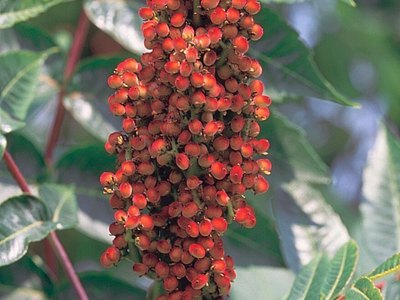 Rhus GlabraRhus Glabra
Nearby on the shelf
 Fo-TiPolygonum multiflorum
 Fortune's eupatoriumEupatorium fortunei
 FoxgloveDigitalis purpurea
 Fragrant padri treeStereospermum suaveolens
 FrangipaniPlumeria rubra
 FrankincenseBoswellia spp.
 Fringe treeChionanthus virginicus
 FrostweedHelianthemum canadense
The whole plate is in the library. The compass, Compare, the Sky of eleven hundred plants and the formulary open with an email address and a password, free, with the formula builder and its safety engine. Herbert without limit, his formulating, clients, the handouts and the labels are the paid room.
Open the library, free