Western Herbalism
False Aloe
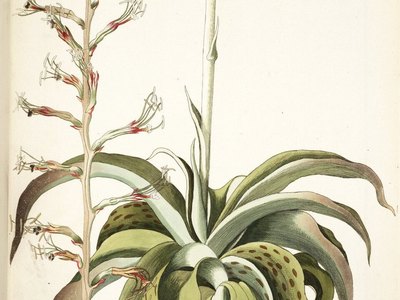
Agave Virginica
Also known as American Aloe, Rattlesnake's Master, Deer's Tongue, Virginia Agave, Rattlesnake master.
False aloe is a North American perennial of dry open woods, barrens, and prairies from the mid-Atlantic states west into the prairie states, unrelated botanically to true Aloe despite the common name and superficial resemblance of its basal rosette of fleshy, mottled leaves. The dried root was the part used by nineteenth-century American Eclectic physicians, who valued it chiefly as a diuretic and expectorant. Its place in practice was always minor compared to more widely used Eclectic diuretics, and it has almost entirely dropped out of contemporary herbal use.

Ask Herbert about False Aloe. Herbert is the master herbalist inside Bountiful Herbs: he answers from this plate and eleven hundred others, with dosing, pairing and cautions. Your first ten questions are free.
Ask HerbertActions
Indications what the tradition reached for it in
- Dependent edema with scanty urine
- Chronic bronchitis with copious mucus
- Urinary gravel and calculi
- Chronic cystitis with mucoid discharge
- Chronic catarrh of the respiratory tract
- Delayed or scanty menstruation
- Sluggish digestion with flatulence
- Folk use for snakebite (historical, unproven)
Specific indications
Puffy dependent edema with scanty urine in a patient with an underlying chronic bronchial catarrh
Dull aching low back pain from gravel, with sandy sediment noted in the urine
Safety
Low dose botanical. Used in drop doses in the classical practice; not a plant to dose freely.
Pregnancy: Avoid in pregnancy, as there is no reliable safety data and the plant contains steroidal saponins with unclear reproductive effects.
Breastfeeding: Avoid in lactation for the same reason of insufficient safety data.
The record lists 3 contraindications; open the plate in the library to read them in full.
In practice
Eclectic writers reached for false aloe root mainly in cases of dropsy (what we would now call edema of cardiac, renal, or venous origin) accompanied by scanty urine, often pairing it with other Eclectic diuretics and cardiac remedies of the period.
Dosing as the sources wrote it
| Preparation | As written | Metric |
|---|---|---|
| Decoction | 2-4 g dried root daily, simmered and taken in divided doses | 2000-4000 mg |
| Tincture (1:5, 40%) | 1-2 mL two to three times daily | 1-2 mL |
| Perrin considers it a superior remedy in scorbutus, preferring it to lime juice, in doses as high as 2 fluid ounces 3 times a day (N. | 59.15 mL |
Doses are reproduced from the sources for practitioners and are not a recommendation for any person.
From the sources
Overview. False aloe is a North American perennial of dry open woods, barrens, and prairies from the mid-Atlantic states west into the prairie states, unrelated botanically to true Aloe despite the common name and superficial resemblance of its basal rosette of fleshy, mottled leaves. The dried root was the part used by nineteenth-century American Eclectic physicians, who valued it chiefly as a diuretic and expectorant. Its place in practice was always minor compared to more widely used Eclectic diuretics, and it has almost entirely dropped out of contemporary herbal use.
Clinical Notes. Eclectic writers reached for false aloe root mainly in cases of dropsy (what we would now call edema of cardiac, renal, or venous origin) accompanied by scanty urine, often pairing it with other Eclectic diuretics and cardiac remedies of the period.
Properties and Uses. The root of this plant is fleshy and premorse. It is intensely bitter, and is pronounced laxative and carminative. Probably it is relaxing and stimulating. A tincture is used in flatulent colic; and in some parts of the South it is popularly reputed to be an antidote to the poison of serpents.
Description. Natural Order, Amaryllidaceae. Genus AGAVE: This splendid genus of the amaryllids is native to America, and several species are cultivated for their beauty. Perianth tubular-funnel-form, adherent to the ovary, six-parted.
Drawn from Cook's Physio-Medical Dispensatory; King's American Dispensatory, 18th edition (Felter and Lloyd), and the Bountiful Herbs editorial.
Nearby on the shelf
 Evening PrimroseOenothera biennis
 Evergreen linderaLindera aggregata
 EyebrightEuphrasia stricta
 Fadogia AgrestisFadogia agrestis
 False black pepperEmbelia ribes
 False daisyEclipta prostrata
 False GromwellOnosmodium
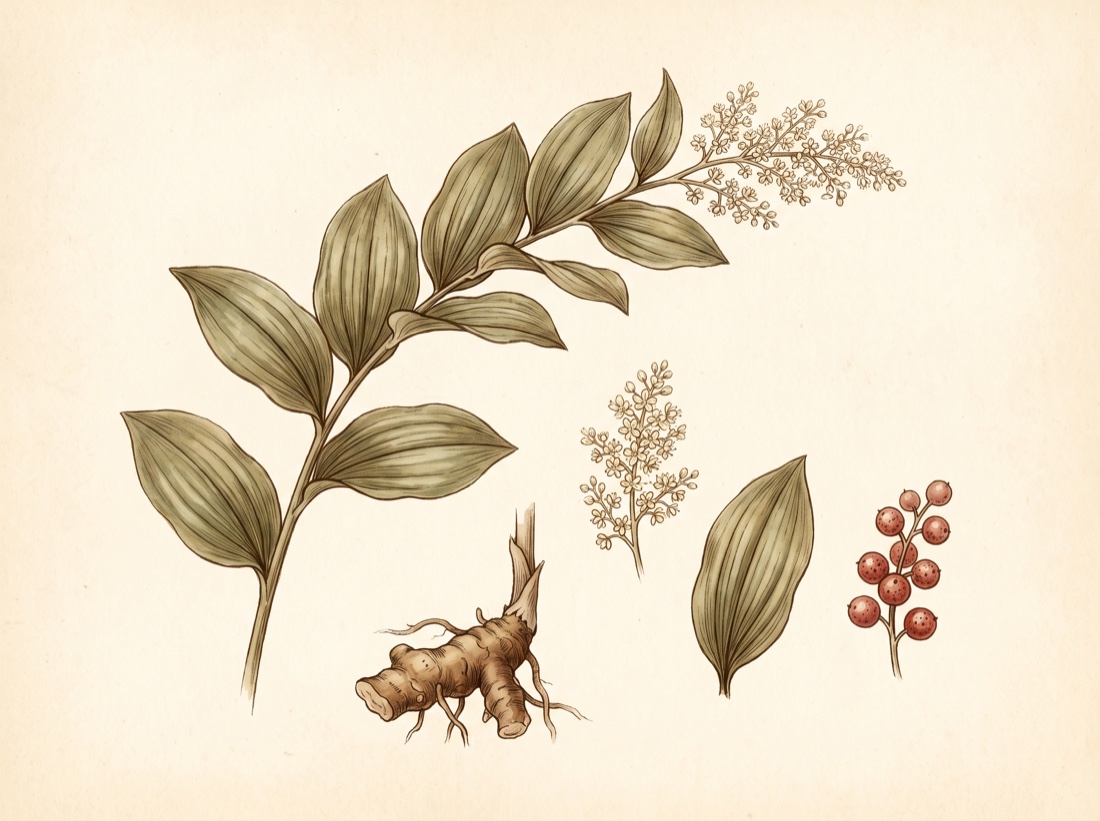 False Solomon's sealMaianthemum racemosum
The whole plate is in the library. The compass, Compare, the Sky of eleven hundred plants and the formulary open with an email address and a password, free, with the formula builder and its safety engine. Herbert without limit, his formulating, clients, the handouts and the labels are the paid room.
Open the library, free