Western Herbalism
False Solomon's seal
Maianthemum racemosum
Also known as Solomon's plume, feathery false lily of the valley, false spikenard, treacleberry.
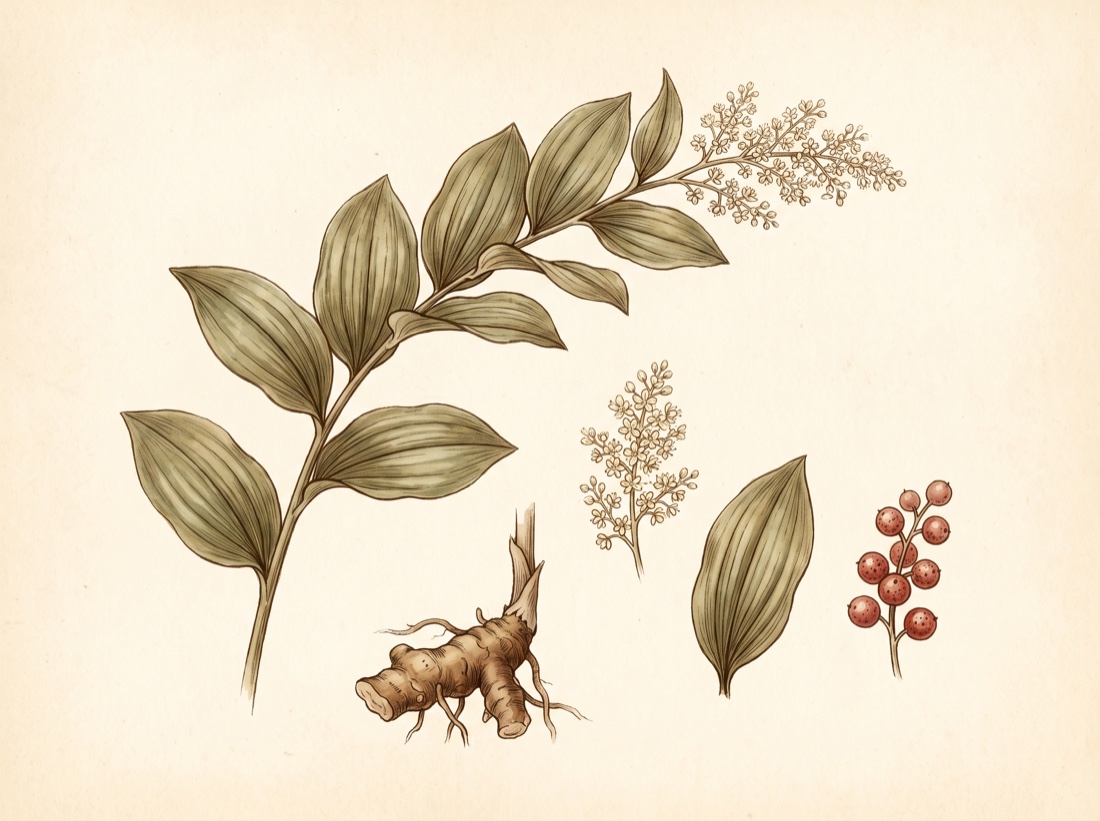
False Solomon's seal is a woodland perennial of North America, arching to knee height with alternate leaves and a feathery cream plume of flowers at the tip of the stem, followed by speckled red berries. It grows in moist forests from the Atlantic to the Pacific, with a broader-leaved western subspecies. The thick creeping rhizome is the medicine. Native nations across the continent used the root for coughs, sore throats, stomach upset, wounds and rheumatism, and modern Western herbalists treat it as a close working substitute for true Solomon's seal, valued for tendons, ligaments and dry irritated mucosa.

Ask Herbert about False Solomon's seal. Herbert is the master herbalist inside Bountiful Herbs: he answers from this plate and eleven hundred others, with dosing, pairing and cautions. Your first ten questions are free.
Ask HerbertActions
Indications what the tradition reached for it in
- Dry irritable cough
- Sore throat
- Bronchitis with thick sputum
- Tendon and ligament strain
- Joint stiffness and pain
- Sprains and bruises (topical)
- Wounds, boils and burns (topical poultice)
- Gastric irritation
- Rheumatic aches (traditional)
- Headache (traditional)
- Dry irritated skin (topical)
Specific indications
A dry, tickling cough with a raw throat that wants a sweet, soothing root rather than a stimulating expectorant
Overuse strain of tendons and ligaments with stiffness, in a patient who does well on Solomon's seal but needs a locally abundant substitute
Slow-healing scrapes and bruises on a hiker, where a fresh root poultice can be applied in the field
Safety
Pregnancy: No data; avoid routine internal use in pregnancy, although topical use is unlikely to be a concern.
The record lists 3 contraindications; open the plate in the library to read them in full.
In practice
Most practitioners meet this plant as the Solomon's seal of the forest: same soothing, restorative quality for connective tissue, the same sweet mucilaginous root, and often far more abundant in the local woods.
Dosing as the sources wrote it
| Preparation | As written | Metric |
|---|---|---|
| Decoction | 3-9 g dried rhizome daily | 3000-9000 mg |
| Tincture (1:5, 50%) | 1-3 mL three times daily | 1-3 mL |
| Topical poultice or salve | fresh or rehydrated root applied as needed |
Doses are reproduced from the sources for practitioners and are not a recommendation for any person.
From the sources
Overview. False Solomon's seal is a woodland perennial of North America, arching to knee height with alternate leaves and a feathery cream plume of flowers at the tip of the stem, followed by speckled red berries. It grows in moist forests from the Atlantic to the Pacific, with a broader-leaved western subspecies. The thick creeping rhizome is the medicine. Native nations across the continent used the root for coughs, sore throats, stomach upset, wounds and rheumatism, and modern Western herbalists treat it as a close working substitute for true Solomon's seal, valued for tendons, ligaments and dry irritated mucosa.
Clinical Notes. Most practitioners meet this plant as the Solomon's seal of the forest: same soothing, restorative quality for connective tissue, the same sweet mucilaginous root, and often far more abundant in the local woods.
Conservation. Widespread and locally common, but the rhizome is slow-growing; harvest sparingly from large colonies, leave the majority in place, and prefer cultivated stock where possible.
Nearby on the shelf
 False AloeAgave Virginica
 False black pepperEmbelia ribes
 False daisyEclipta prostrata
 False GromwellOnosmodium
 False unicornChamaelirium luteum
 Fang FengSaposhnikovia divaricata
 FennelFoeniculum vulgare
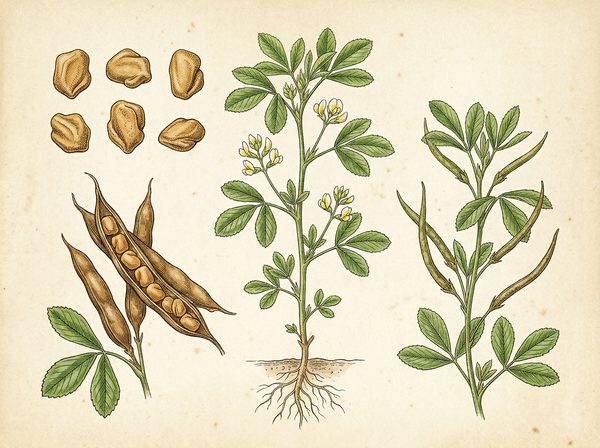 FenugreekTrigonella foenum-graecum
The whole plate is in the library. The compass, Compare, the Sky of eleven hundred plants and the formulary open with an email address and a password, free, with the formula builder and its safety engine. Herbert without limit, his formulating, clients, the handouts and the labels are the paid room.
Open the library, free