Western Herbalism
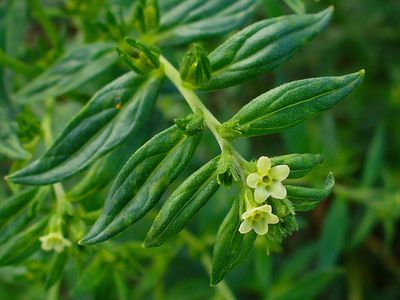
Common gromwell
Lithospermum officinale
Also known as Stoneseed, Lithospermum.
Inhibits GnRH release May be used as contraceptive by continuous use for past 6 months, but not 100% effective Inhibits TSH secretion, binding, and thyroid hormone secretion

Ask Herbert about Common gromwell. Herbert is the master herbalist inside Bountiful Herbs: he answers from this plate and eleven hundred others, with dosing, pairing and cautions. Your first ten questions are free.
Ask HerbertActions
Indications what the tradition reached for it in
- Hyperthyroidism
- Graves disease
Safety
Recognised toxicity. This plant carries a toxicity flag in the record; it is for trained practitioners only.
Pregnancy: Pregnancy Caution
Breastfeeding: Use with care while breastfeeding
The record lists 6 contraindications; open the plate in the library to read them in full.
Dosing as the sources wrote it
| Preparation | As written | Metric |
|---|---|---|
| Tincture (1:2-1:3) | 1-2 ml TID | 1-2 mL |
| A strong infusion of the dried root | A strong infusion of the dried root, 1 ounce to water 1 pint, may be given every 3 hours in tablespoonful doses. | 31103 mg |
| The seeds, in powder, are used in half-teaspoonful doses every 4 or 5 hours (King). | ||
| Infusion | Infusion: 1 tsp./cup water; 1 cup/day for contraception; 1 cup TID for hyperthyroidism and other estrogen and progesterone i mbalances. | |
| 1:5 Tincture | 1:5 Tincture: 1-5 ml TID | 1-5 mL |
Doses are reproduced from the sources for practitioners and are not a recommendation for any person.
From the sources
Clinical Notes. Inhibits GnRH release May be used as contraceptive by continuous use for past 6 months, but not 100% effective Inhibits TSH secretion, binding, and thyroid hormone secretion
Action, Medical Uses, and Dosage. Diuretic and tonic. Said to dissolve calculi. A strong infusion of the root and seeds, taken in doses of 4 fluid ounces, every 2 hours for about a day, or until it purges, is highly extolled as a cure for calculous affections. It occasions excessive urination, hence care must be taken that it be not employed too long, for fear of producing too great a flow of urine. It is worthy of a full investigation. Onosmodium carolinianum, De Candolle, and Onosmodium strigosum, possess similar properties (see also Lithospermum officinale).
History. This plant is found growing from New York to Florida, in dry, hilly grounds, flowering from June to September. The root and seeds are the parts employed, and yield their virtues to water. There are two other species of this genus which possess similar properties.
Botanical Source. This plant is a perennial herb, clothed all over with harsh and rigid appressed bristles. The stems are rather slender, 1 or 2 feet in height. The leaves are oblong, or oblong-lanceolate, often oval, and even ovate-lanceolate, sessile, minutely strigose, 3 to 5-veined; lower ones narrow at base, 1 inch to 2 ½ inches long, ½ or ¾ of an inch broad.
Drawn from King's American Dispensatory, 18th edition (Felter and Lloyd), and the Bountiful Herbs editorial.
In formulas
Common gromwell stands in 2 documented formulas in the library, among them rùn ji gão, ging dài sǎn.
Often paired with
 Dong QuaiAngelica sinensis
 Huang BaiPhellodendron amurense
 IndigoIndigo
Nearby on the shelf
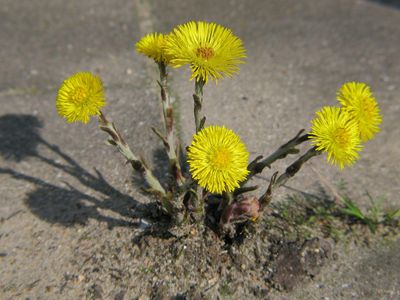 ColtsfootTussilago farfara
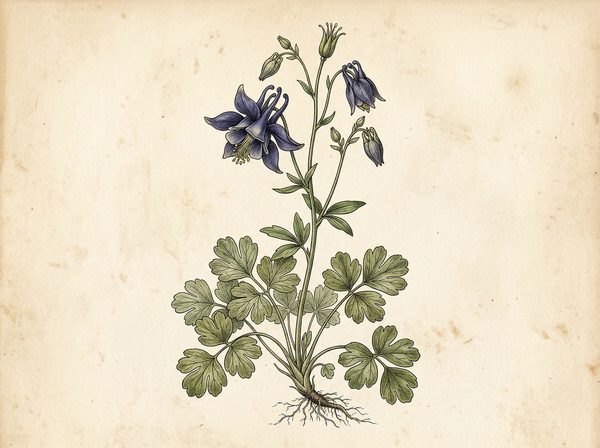 ColumbineAquilegia vulgaris
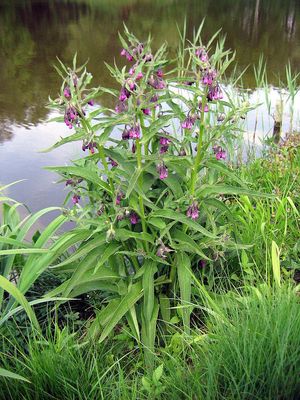 ComfreySymphytum officinale
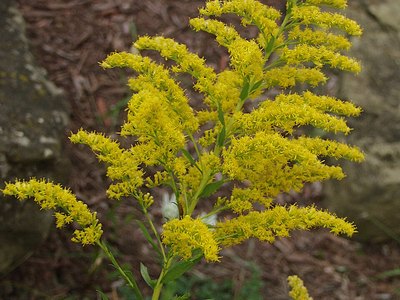 Common goldenrodSolidago altissima
 Common MallowMalva sylvestris
 Common wireweedSida acuta
 CondurangoMarsdenia cundurango
 ConeflowerEchinacea angustifolia
The whole plate is in the library. The compass, Compare, the Sky of eleven hundred plants and the formulary open with an email address and a password, free, with the formula builder and its safety engine. Herbert without limit, his formulating, clients, the handouts and the labels are the paid room.
Open the library, free