Western Herbalism
Brown's peony
Paeonia brownii
Also known as western peony, California peony, wild peony, native peony.
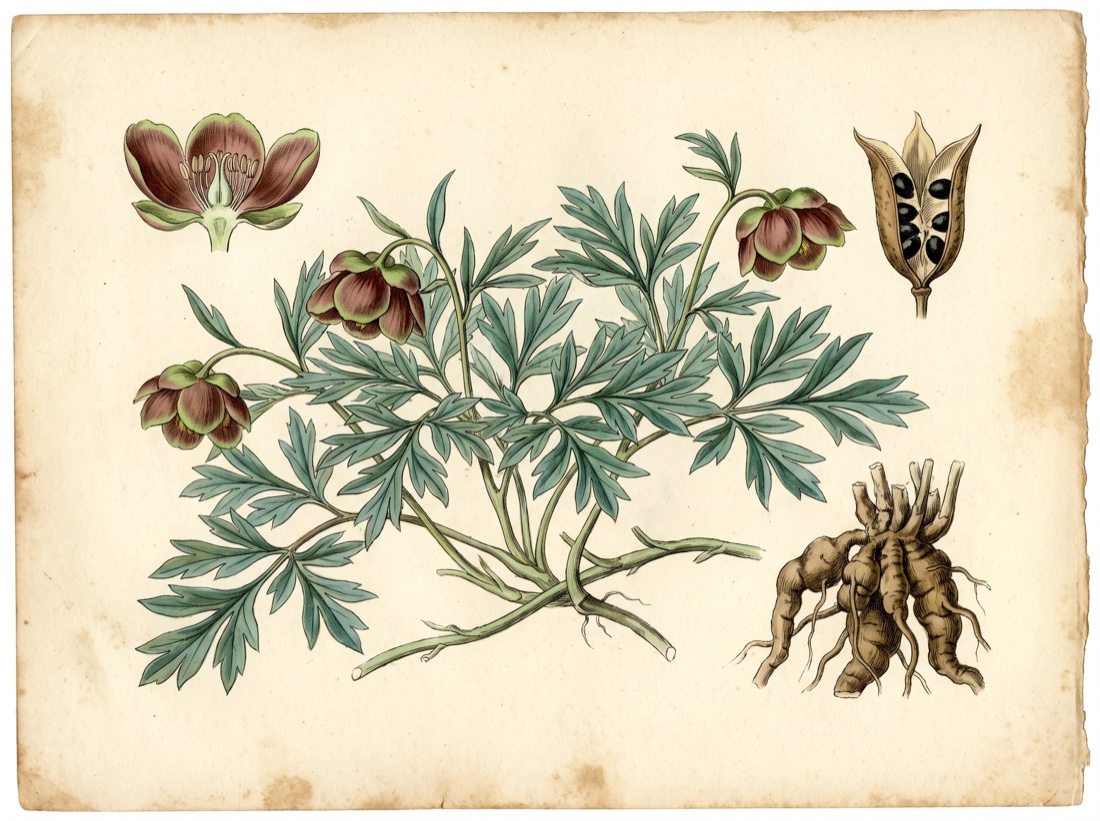
The western peonies are the only members of the genus native to the New World. Brown's peony grows in sagebrush and open pine country from British Columbia through the Great Basin to the Sierra Nevada, and the California peony replaces it in the chaparral of southern California and northern Baja; both are low, fleshy, blue-green plants with nodding maroon spring flowers and a stout, deeply buried root, which is the medicine. Native Californian and Great Basin peoples used it for stomach and lung complaints, women's cramping and wounds, and Western herbalists treat it as the regional counterpart of the Chinese white peony.

Ask Herbert about Brown's peony. Herbert is the master herbalist inside Bountiful Herbs: he answers from this plate and eleven hundred others, with dosing, pairing and cautions. Your first ten questions are free.
Ask HerbertActions
Indications what the tradition reached for it in
- Dysmenorrhea with cramping
- Premenstrual tension and irritability
- Threatened miscarriage with cramping (traditional, under supervision)
- Afterpains following childbirth
- Nausea with stomach cramps
- Intestinal colic
- Bronchial spasm with tight cough
- Muscle cramps and spasm
- Tension headache
- Rheumatic pain (traditional)
- Wounds and sores (topical, traditional)
Specific indications
Spasmodic menstrual cramps in a tense, irritable woman whose pain eases with warmth and relaxation, given from a few days before the period
Early-pregnancy cramping without bleeding, where a gentle uterine relaxant is wanted alongside proper obstetric assessment
Cramping nausea and a knotted stomach in an anxious patient, where a bitter, sour, cooling root settles both gut and nerves
Safety
The record lists 3 contraindications; open the plate in the library to read them in full.
In practice
Western peony root is a cramp remedy first. The Chumash used the California peony for dysmenorrhea and premenstrual distress, and that is still where it shines: sharp, spasmodic period pain in a tense, irritable woman, often with nausea.
Dosing as the sources wrote it
| Preparation | As written | Metric |
|---|---|---|
| Decoction | 2-6 g dried root daily | 2000-6000 mg |
| Tincture (1:5, 50%) | 1-3 mL three times daily | 1-3 mL |
| Topical wash | decoction applied to wounds and sores as needed |
Doses are reproduced from the sources for practitioners and are not a recommendation for any person.
From the sources
Overview. The western peonies are the only members of the genus native to the New World. Brown's peony grows in sagebrush and open pine country from British Columbia through the Great Basin to the Sierra Nevada, and the California peony replaces it in the chaparral of southern California and northern Baja; both are low, fleshy, blue-green plants with nodding maroon spring flowers and a stout, deeply buried root, which is the medicine. Native Californian and Great Basin peoples used it for stomach and lung complaints, women's cramping and wounds, and Western herbalists treat it as the regional counterpart of the Chinese white peony.
Clinical Notes. Western peony root is a cramp remedy first. The Chumash used the California peony for dysmenorrhea and premenstrual distress, and that is still where it shines: sharp, spasmodic period pain in a tense, irritable woman, often with nausea.
Conservation. Slow-growing perennials whose root is the medicine; Paeonia californica is restricted to southern California and northern Baja California and is vulnerable to overharvest and habitat loss, so use cultivated or ethically wildcrafted root and never strip a stand.
Nearby on the shelf
 BrahmiBacopa monnieri
 Bristly luffaLuffa echinata
 Brome grassBromus ciliatus
 Broom snakeweedGutierrezia sarothrae
 BuchuAgathosma betulina
 BuckbeanMenyanthes trifoliata
 BuckthornRhamnus cathartica
 BugleAjuga reptans
The whole plate is in the library. The compass, Compare, the Sky of eleven hundred plants and the formulary open with an email address and a password, free, with the formula builder and its safety engine. Herbert without limit, his formulating, clients, the handouts and the labels are the paid room.
Open the library, free