Ayurvedic Herbalism
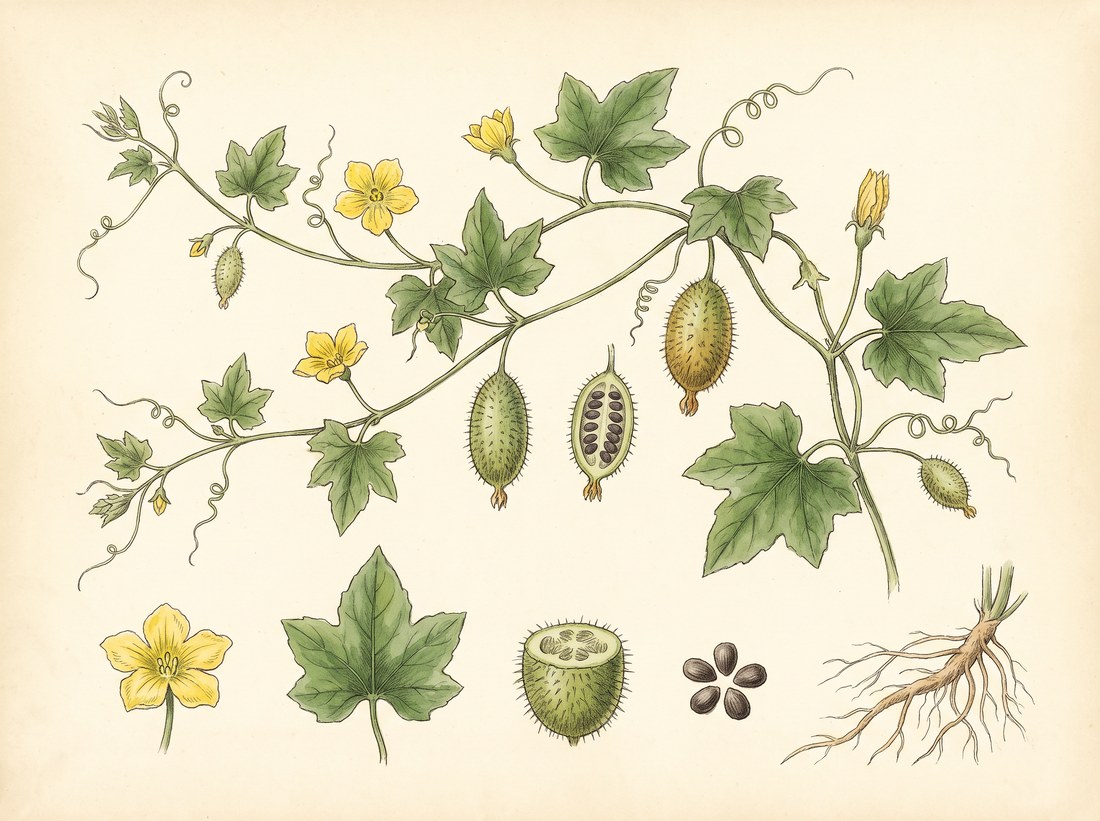
Bristly luffa
Luffa echinata
Also known as bitter sponge gourd, bindal, bristly gourd, Jimuta, Jimutaka, Devadali.
Luffa echinata is a slender annual climber of the gourd family with small, oval, bristly fruits that turn intensely bitter as they ripen, growing wild in hedges, ditches and along riverbanks across the Gangetic plain, Bengal, Bihar, Gujarat and Rajasthan and into Pakistan. Ayurveda knows it as Jimutaka or Devadali, one of the emetic drugs of the Charaka Samhita, which gives it a chapter of its own in the Kalpasthana; later practice uses the fruit for jaundice, splenic enlargement and hemorrhoids. It is a toxic plant with a narrow margin and belongs with the restricted drugs.

Ask Herbert about Bristly luffa. Herbert is the master herbalist inside Bountiful Herbs: he answers from this plate and eleven hundred others, with dosing, pairing and cautions. Your first ten questions are free.
Ask HerbertActions
Indications what the tradition reached for it in
- Jaundice with a heavy, congested liver (nasal drops, traditional)
- Splenomegaly and hepatosplenic congestion (traditional)
- Ascites and edema of kapha type (traditional emetic and purgative use)
- Therapeutic emesis (vamana karma) in kapha disorders, under supervision
- Chronic skin disease with kapha accumulation (traditional)
- Hemorrhoids, as a caustic topical paste in Ayurvedic proctology
- Poisoning, as an emetic (historical use)
- Intestinal worms (traditional)
- Chronic bronchial congestion cleared by emesis (traditional)
- Intermittent fever with a swollen spleen (traditional)
Specific indications
A strong, congested kapha patient with jaundice, a coated tongue and a swollen liver, for whom the classical Ayurvedic physician chooses Devadali nasal drops rather than an internal dose
Vamana karma in a robust kapha patient with heavy chest congestion or chronic skin disease, performed in a supervised panchakarma setting where Jimutaka is one of the emetics of choice
Second or third degree internal hemorrhoids in a patient declining surgery, where the caustic Jimutaka paste is applied by a trained Ayurvedic proctologist
Not for the frail, the pregnant, the pitta patient or anyone with a bleeding tendency
Safety
Recognised toxicity. This plant carries a toxicity flag in the record; it is for trained practitioners only.
Low dose botanical. Used in drop doses in the classical practice; not a plant to dose freely.
Pregnancy: Contraindicated in pregnancy: the fruit is a violent emetic and purgative with abortifacient potential, the tradition forbids it, and no published safety class is known to us.
Breastfeeding: Contraindicated while nursing: cucurbitacins are toxic and would reach the infant.
The record lists 13 contraindications; open the plate in the library to read them in full.
In practice
The Ayurvedic practitioner reserves Jimutaka for specific situations, most of them under supervision. In panchakarma it is one of the classical vamana dravyas, given as a fruit decoction with honey and rock salt to a prepared kapha patient to bring on controlled emesis for chest congestion, kushtha, asthma and poisoning, always in a clinic with the patient's strength assessed first.
In Ayurveda
Rasa: tikta (bitter), katu (pungent). Virya: ushna (heating). Vipaka: katu (pungent). Guna: laghu (light), ruksha (dry), tikshna (sharp). Dosha: pacifies kapha and vata by expulsion; aggravates pitta and depletes vata if overused. Prabhava: vamana (emesis; the fruit is one of the classical vamana drugs of the Charaka Samhita). Karma: vamaka (emetic); rechana (purgative in larger doses); kamalahara (relieves jaundice, as nasal drops); plihaghna (reduces splenic enlargement); shothahara (reduces swelling); kushthaghna (clears skin disease); krimighna (anthelmintic); jvaraghna (reduces fever); arshoghna (destroys hemorrhoids, topical); kaphavatahara (expels kapha and vata). Classical indications: kamala (jaundice); pandu (anemia); pliha vriddhi (splenomegaly); shotha (edema); kushtha (skin diseases); gulma (abdominal mass); arsha (hemorrhoids, topical paste); jvara (fever); krimi (worms); kasa and shvasa (cough and dyspnea, by emesis); mutrakrichhra (painful urination); visha (poisoning, as an emetic). The dried ripe fruit is the drug. The Charaka Samhita devotes a chapter of its Kalpasthana to Jimutaka as an emetic, given as fruit decoction, as juice pressed from the fresh fruit, and as a milk or ghee preparation. In later practice the fruit soaked overnight in water gives a liquid dropped into the nostrils for jaundice, the fruit powder is applied as a caustic paste to hemorrhoids, and the seeds and root are used sparingly for the same indications. Classical formulations: Jimutaka kalpa (emetic preparations of the Charaka Samhita), Devadali nasya (fruit-soaked water as nasal drops for jaundice), Jimutaka lepa (caustic paste for hemorrhoids), Devadali phala churna (purified). Described in: Charaka Samhita, Sushruta Samhita, Ashtanga Hridaya, Bhavaprakasha Nighantu, Dhanvantari Nighantu, Raja Nighantu, Kaiyadeva Nighantu.
Dosing as the sources wrote it
| Preparation | As written | Metric |
|---|---|---|
| Churna (purified fruit) | 125-250 mg purified fruit powder once daily with honey for a few days only, purified material only | 125-250 mg |
| Nasya (fruit-soaked water) | 2-4 drops of the strained soaking water into each nostril once daily under supervision, purified material only | 0.04-0.08 mL |
| Vamana (classical emetic use) | 50-100 mL fruit decoction as a single supervised emetic dose in panchakarma, purified material only | 50-100 mL |
| Lepa, topical (hemorrhoids) | 2-5 g fruit paste applied to the pile mass by a trained practitioner | 2000-5000 mg |
Doses are reproduced from the sources for practitioners and are not a recommendation for any person.
From the sources
Overview. Luffa echinata is a slender annual climber of the gourd family with small, oval, bristly fruits that turn intensely bitter as they ripen, growing wild in hedges, ditches and along riverbanks across the Gangetic plain, Bengal, Bihar, Gujarat and Rajasthan and into Pakistan. Ayurveda knows it as Jimutaka or Devadali, one of the emetic drugs of the Charaka Samhita, which gives it a chapter of its own in the Kalpasthana; later practice uses the fruit for jaundice, splenic enlargement and hemorrhoids. It is a toxic plant with a narrow margin and belongs with the restricted drugs.
Clinical Notes. The Ayurvedic practitioner reserves Jimutaka for specific situations, most of them under supervision. In panchakarma it is one of the classical vamana dravyas, given as a fruit decoction with honey and rock salt to a prepared kapha patient to bring on controlled emesis for chest congestion, kushtha, asthma and poisoning, always in a clinic with the patient's strength assessed first.
Ayurvedic Profile. Rasa: tikta (bitter), katu (pungent). Virya: ushna (heating). Vipaka: katu (pungent). Guna: laghu (light), ruksha (dry), tikshna (sharp). Dosha: pacifies kapha and vata by expulsion; aggravates pitta and depletes vata if overused.
Nearby on the shelf
 Box myrtleMyrica esculenta
 Bracken FernPteridium aquilinum
 BrahmadandiTricholepis glaberrima
 BrahmiBacopa monnieri
 Brome grassBromus ciliatus
 Broom snakeweedGutierrezia sarothrae
 Brown's peonyPaeonia brownii
 BuchuAgathosma betulina
The whole plate is in the library. The compass, Compare, the Sky of eleven hundred plants and the formulary open with an email address and a password, free, with the formula builder and its safety engine. Herbert without limit, his formulating, clients, the handouts and the labels are the paid room.
Open the library, free