Ayurvedic Herbalism
Brahmadandi
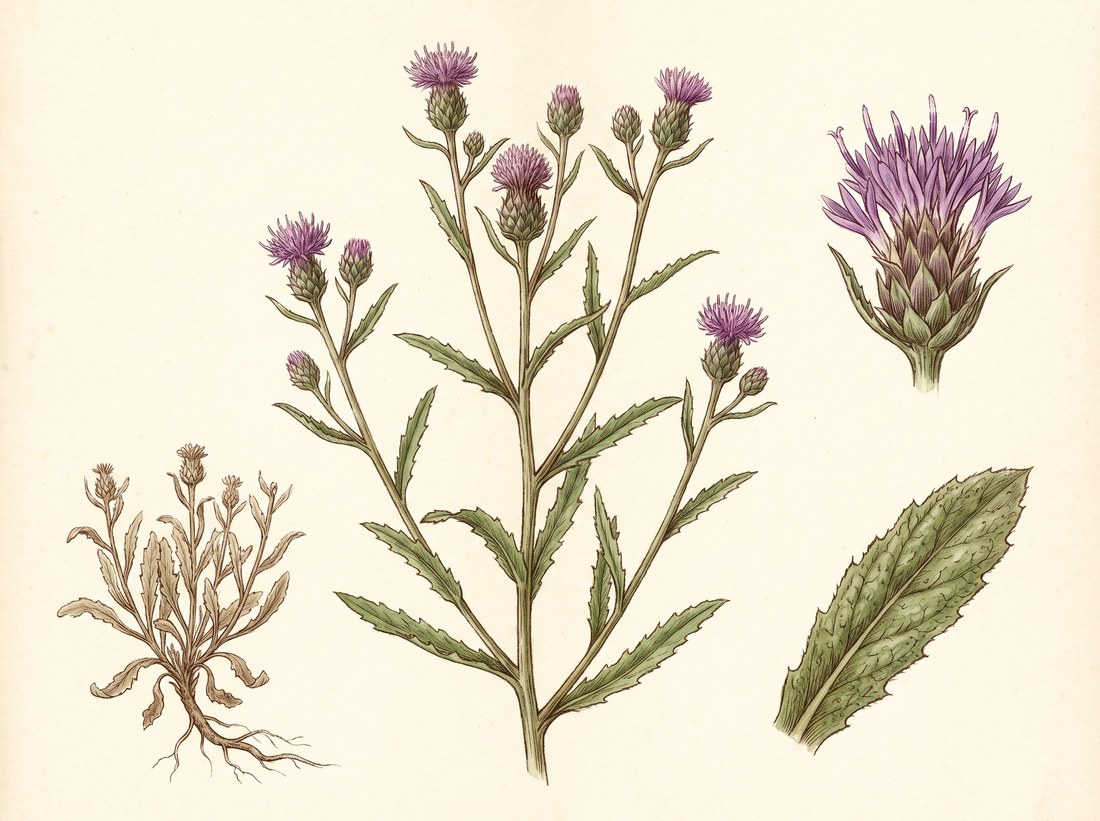
Tricholepis glaberrima
Also known as tricholepis, Brahmadandi, Ajadandi, Kantapatra.
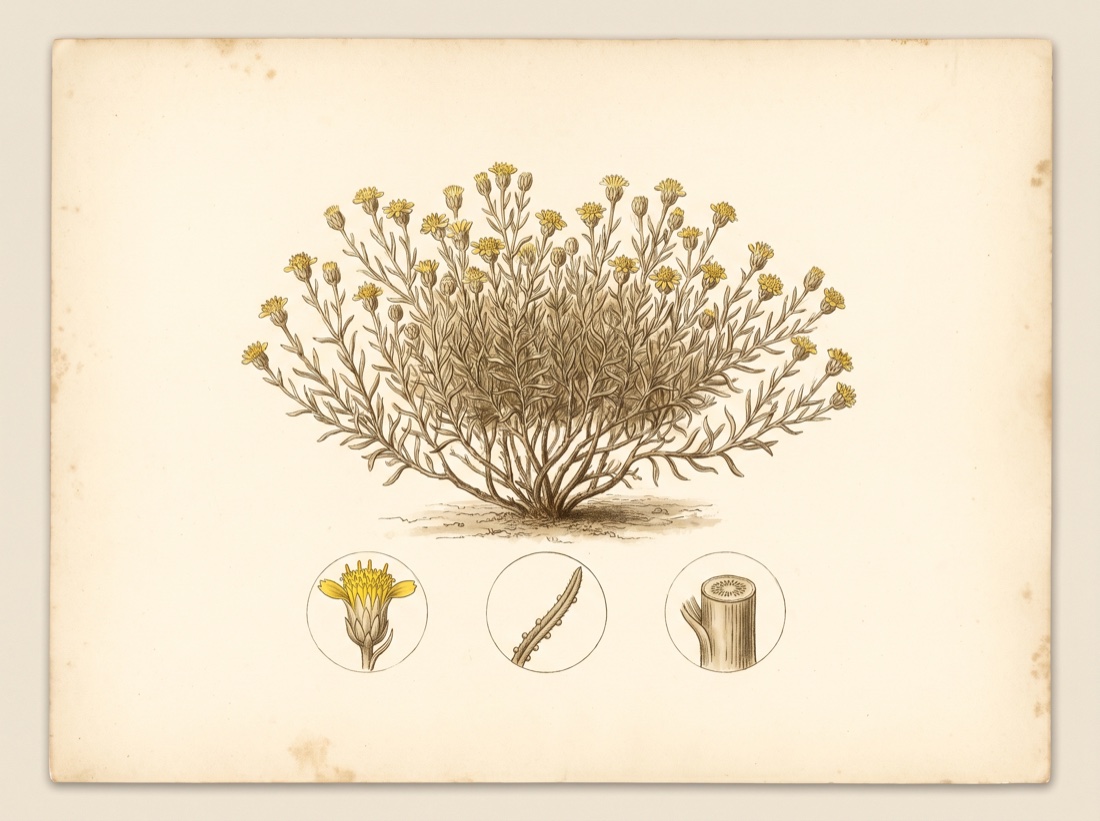
Tricholepis glaberrima is an erect, much-branched annual of the thistle tribe of the daisy family, with narrow rough leaves and purple flower heads, found on dry hillsides and wasteland across Maharashtra, Karnataka, Gujarat, Rajasthan and the central Deccan. Ayurveda knows it as Brahmadandi, a bitter, cooling herb used as a vrishya tonic for male sexual weakness, as an alterative for skin disease, and as a liver and urinary remedy. The whole plant is used, and it is largely a regional and folk drug rather than a herb of the great classical formulas.

Ask Herbert about Brahmadandi. Herbert is the master herbalist inside Bountiful Herbs: he answers from this plate and eleven hundred others, with dosing, pairing and cautions. Your first ten questions are free.
Ask HerbertActions
Indications what the tradition reached for it in
- Male sexual debility with heat and irritability
- Low sperm count with a pitta constitution
- Chronic skin eruptions with burning
- Fatty liver and sluggish liver with raised enzymes (adjunct)
- Drug-induced liver strain (adjunct, traditional)
- Burning urination and mild urinary infection
- Anxiety with heat and poor concentration
- Low-grade fever with liver involvement
- Adjunct in type 2 diabetes with skin complaints
Specific indications
A hot, irritable, overworked man with low libido and thin semen in whom warming aphrodisiacs like Ashwagandha or Kapikacchu bring out acne, heat or restlessness
A patient with raised liver enzymes on long-term medication who also has itchy, burning skin eruptions and a bitter taste
Burning urination with a heavy, sluggish digestion in a pitta-kapha patient who needs a cooling diuretic bitter rather than a warming one
Safety
Breastfeeding: No data; avoid or use only in short courses under supervision.
The record lists 5 contraindications; open the plate in the library to read them in full.
In practice
Brahmadandi fills a narrow but useful place: it is a cooling aphrodisiac and nervine, which is rare in a tradition where most vajikarana herbs are heating. Reach for it in the pitta man with sexual weakness, burning, acne or a short temper, where Ashwagandha would add heat.
In Ayurveda
Rasa: tikta (bitter), kashaya (astringent), madhura (sweet). Virya: sheeta (cooling). Vipaka: madhura (sweet). Guna: laghu (light), ruksha (dry). Dosha: pacifies pitta and kapha; neutral to vata in moderate doses. Karma: vrishya (aphrodisiac); balya (strengthening); medhya (supports the mind); yakrituttejaka (stimulates the liver); kushthaghna (relieves skin disease); mutrala (diuretic); raktashodhana (purifies the blood); jvarahara (reduces fever); shukrajanana (promotes semen). Classical indications: klaibya (impotence); shukrakshaya (low semen); kushtha (skin diseases); prameha (urinary disorders including diabetes); mutrakricchra (painful urination); yakrit vikara (liver disorders); vatavyadhi (nervous disorders); jvara (fever); unmada (mental disturbance, traditional). The whole plant, mostly the aerial parts, is dried and used as churna or kwatha; the fresh herb gives a swarasa. It is mainly a single-herb remedy in folk and regional practice and joins a few vajikarana and nervine compound powders. Classical formulations: Brahmadandi churna, Brahmadandi kwatha, Regional vajikarana churnas containing Brahmadandi. Described in: Raja Nighantu, Bhavaprakasha Nighantu, Ayurvedic Pharmacopoeia of India.
Dosing as the sources wrote it
| Preparation | As written | Metric |
|---|---|---|
| Churna | 3-6 g powdered whole plant twice daily with milk or warm water | 3000-6000 mg |
| Kwatha | 50-100 mL decoction twice daily | 50-100 mL |
| Swarasa | 10-20 mL fresh plant juice daily | 10-20 mL |
Doses are reproduced from the sources for practitioners and are not a recommendation for any person.
From the sources
Overview. Tricholepis glaberrima is an erect, much-branched annual of the thistle tribe of the daisy family, with narrow rough leaves and purple flower heads, found on dry hillsides and wasteland across Maharashtra, Karnataka, Gujarat, Rajasthan and the central Deccan. Ayurveda knows it as Brahmadandi, a bitter, cooling herb used as a vrishya tonic for male sexual weakness, as an alterative for skin disease, and as a liver and urinary remedy. The whole plant is used, and it is largely a regional and folk drug rather than a herb of the great classical formulas.
Clinical Notes. Brahmadandi fills a narrow but useful place: it is a cooling aphrodisiac and nervine, which is rare in a tradition where most vajikarana herbs are heating. Reach for it in the pitta man with sexual weakness, burning, acne or a short temper, where Ashwagandha would add heat.
Ayurvedic Profile. Rasa: tikta (bitter), kashaya (astringent), madhura (sweet). Virya: sheeta (cooling). Vipaka: madhura (sweet). Guna: laghu (light), ruksha (dry). Dosha: pacifies pitta and kapha; neutral to vata in moderate doses.
Nearby on the shelf
 Bottle gourdLagenaria siceraria
 BoxBuxus
 Box myrtleMyrica esculenta
 Bracken FernPteridium aquilinum
 BrahmiBacopa monnieri
 Bristly luffaLuffa echinata
 Brome grassBromus ciliatus
 Broom snakeweedGutierrezia sarothrae
The whole plate is in the library. The compass, Compare, the Sky of eleven hundred plants and the formulary open with an email address and a password, free, with the formula builder and its safety engine. Herbert without limit, his formulating, clients, the handouts and the labels are the paid room.
Open the library, free