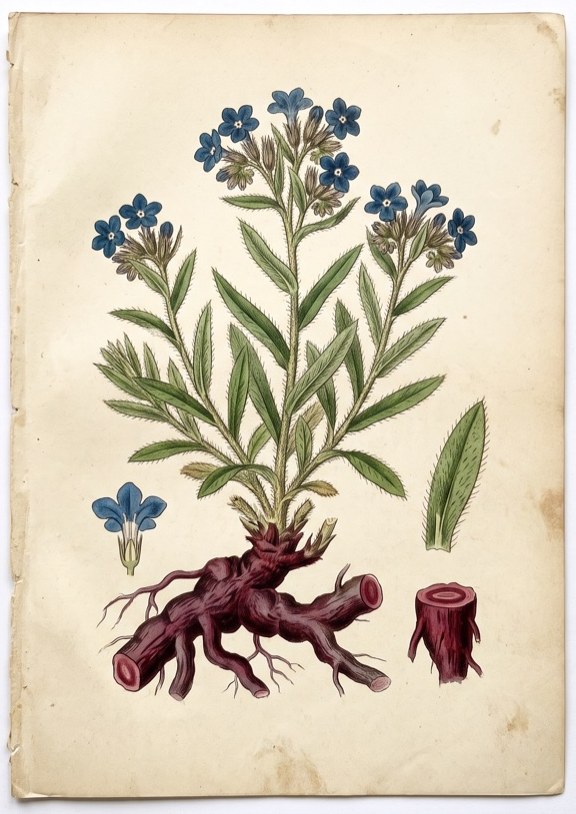
Western Herbalism
Alkanet
Alkanna
Also known as Dyer's Bugloss, Dyer's Alkanet, Spanish Bugloss.
Alkanna tinctoria is a low, bristly-leaved plant of the borage family native to the Mediterranean basin, cultivated and gathered chiefly for the deep red pigment in its root bark. In eclectic and older European herbal practice the root was infused in oil or fat and applied to wounds, ulcers, and burns, and the same red infused oil remains valued today mainly as a natural colorant in salves, lip balms, and cosmetic oils. Its clinical herbal use is now almost entirely external.

Ask Herbert about Alkanet. Herbert is the master herbalist inside Bountiful Herbs: he answers from this plate and eleven hundred others, with dosing, pairing and cautions. Your first ten questions are free.
Ask HerbertActions
Indications what the tradition reached for it in
- Slow-healing wounds
- Skin ulcers
- Minor burns
- Sunburn
- Bruises and contusions
- Chapped or cracked skin
- Hemorrhoids
- Diaper rash
- Eczema and dermatitis (adjunct topical care)
Specific indications
A slow-healing wound or ulcer on dry, cracked skin that benefits from a tinted, oil-based dressing
Superficial burns or sunburn where a soothing, coloring emollient is wanted alongside cooling care
Safety
Recognised toxicity. This plant carries a toxicity flag in the record; it is for trained practitioners only.
Low dose botanical. Used in drop doses in the classical practice; not a plant to dose freely.
Pregnancy: Use with care in pregnancy
Breastfeeding: Not for use while breastfeeding
The record lists 6 contraindications; open the plate in the library to read them in full.
In practice
Alkanet's practical place in the modern dispensary is as a base for tinted, soothing wound and burn ointments rather than as an internal remedy. The dried root is infused in a carrier oil (often warmed gently over several days or simmered briefly on very low heat) to draw out the naphthoquinone pigments, giving an oil that ranges from rose to deep burgundy depending on concentration; this infused oil is then worked into salves for cracked skin, minor burns, diaper rash, and hemorrhoids, frequently alongside calendula, comfrey leaf (not root), or plantain.
Dosing as the sources wrote it
| Preparation | As written | Metric |
|---|---|---|
| Infused oil (topical) | root infused in carrier oil at approximately 10% w/v, applied to skin as needed | |
| Salve or ointment (topical) | alkanet-infused oil incorporated at 5-15% into a beeswax salve base, applied 2-3 times daily to affected skin |
Doses are reproduced from the sources for practitioners and are not a recommendation for any person.
From the sources
Overview. Alkanna tinctoria is a low, bristly-leaved plant of the borage family native to the Mediterranean basin, cultivated and gathered chiefly for the deep red pigment in its root bark. In eclectic and older European herbal practice the root was infused in oil or fat and applied to wounds, ulcers, and burns, and the same red infused oil remains valued today mainly as a natural colorant in salves, lip balms, and cosmetic oils. Its clinical herbal use is now almost entirely external.
Clinical Notes. Alkanet's practical place in the modern dispensary is as a base for tinted, soothing wound and burn ointments rather than as an internal remedy. The dried root is infused in a carrier oil (often warmed gently over several days or simmered briefly on very low heat) to draw out the naphthoquinone pigments, giving an oil that ranges from rose to deep burgundy depending on concentration; this infused oil is then worked into salves for cracked skin, minor burns, diaper rash, and hemorrhoids, frequently alongside calendula, comfrey leaf (not root), or plantain.
Action, Medical Uses, and Dosage. Logwood is a tonic and unirritating astringent, less constipating than many other astringents, and is useful in hemorrhages from the uterus, lungs, and bowels, in old diarrhoeas and dysenteries, in summer complaint of children, and in night-sweats.
History and Description. This tree grows in Jamaica, on the eastern shore of the bay of Campeachy, and in many of the West India Islands. The wood consists of a yellowish alburnum, and a dingy cherry-red inner wood, which last is the part used in medicine and the arts; it forms a useful commercial commodity, and is extensively used as a dye-stuff.
Drawn from King's American Dispensatory, 18th edition (Felter and Lloyd), and the Bountiful Herbs editorial.
Nearby on the shelf
 AjwainTrachyspermum ammi
 AkebiaAkebia quinata
 Alder BuckthornFrangula alnus
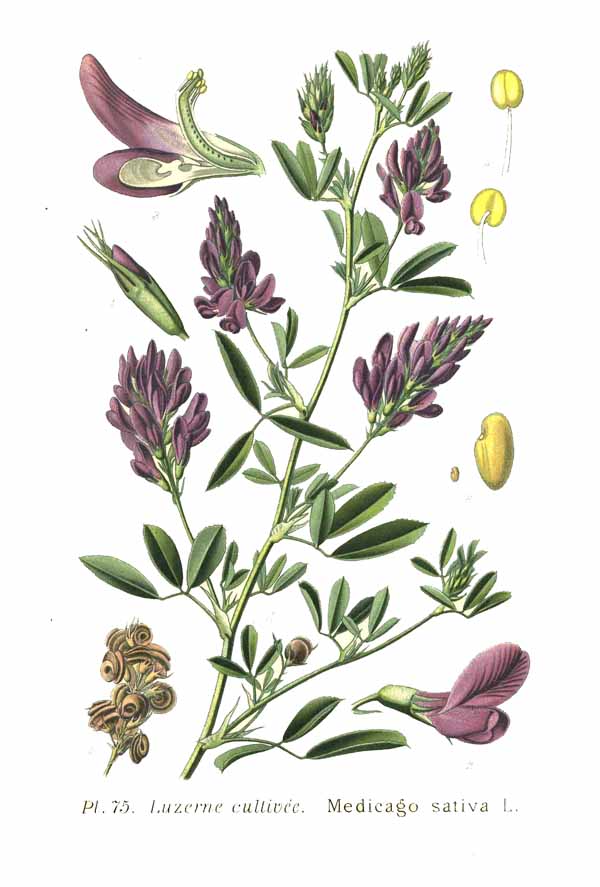 AlfalfaMedicago sativa
 AllspicePimenta dioica
 AlmondAmygdala
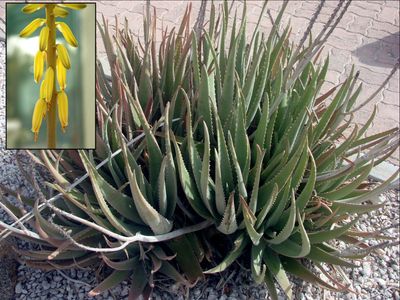 Aloe veraAloe vera
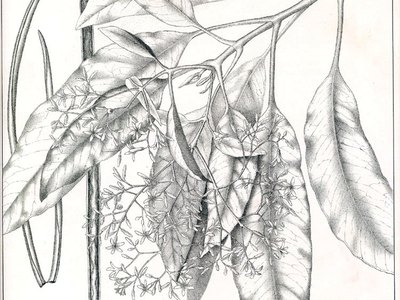 Alstonia barkAlstonia Constricta
The whole plate is in the library. The compass, Compare, the Sky of eleven hundred plants and the formulary open with an email address and a password, free, with the formula builder and its safety engine. Herbert without limit, his formulating, clients, the handouts and the labels are the paid room.
Open the library, free