Western Herbalism
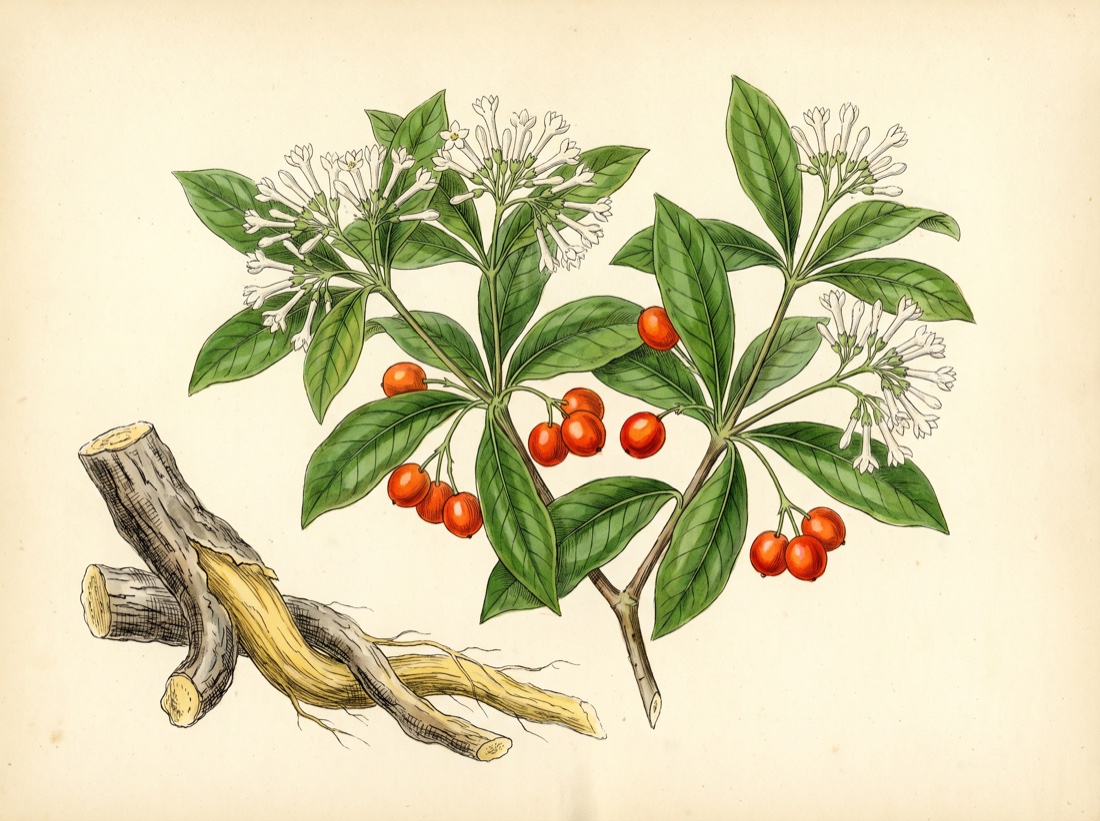
African serpentwood
Rauvolfia vomitoria
Also known as poison devil's pepper, devil's pepper, swizzle stick, African rauwolfia.
Rauvolfia vomitoria is a shrub or small tree of the dogbane family found across tropical West and Central Africa. The root and root bark are the medicine; the species name refers to the vomiting produced by the bark at high dose. The root has among the highest reserpine contents in the genus and was a major commercial source of reserpine in the twentieth century. In African traditional medicine it is the classical remedy for madness, agitation and high blood pressure, and in the Western materia medica it sits beside Rauvolfia serpentina as a restricted alkaloid plant.

Ask Herbert about African serpentwood. Herbert is the master herbalist inside Bountiful Herbs: he answers from this plate and eleven hundred others, with dosing, pairing and cautions. Your first ten questions are free.
Ask HerbertActions
Indications what the tradition reached for it in
- Essential hypertension (supervised, restricted)
- Agitation and acute psychosis in West African traditional psychiatry
- Insomnia with agitation
- Anxiety with raised blood pressure
- Convulsions (traditional)
- Fever and malaria (traditional)
- Jaundice (traditional)
- Snakebite and scorpion sting (traditional, topical)
- Scabies, skin infections and sores (traditional, topical)
- Benign prostatic hyperplasia (regional folk use, not recommended)
Specific indications
Hypertension in a tense, agitated, sleepless patient who does better with a sedating than a stimulating approach, with blood pressure and mood monitored
Restless agitation with insomnia and a pounding heart, where a small, supervised dose is chosen over a pharmaceutical tranquilizer
Safety
Recognised toxicity. This plant carries a toxicity flag in the record; it is for trained practitioners only.
Low dose botanical. Used in drop doses in the classical practice; not a plant to dose freely.
Pregnancy: Contraindicated: reserpine crosses the placenta and can cause neonatal bradycardia, lethargy, nasal congestion and respiratory depression, and high-dose extracts damaged fetal heart tissue in rats; the recorded traditional use as a first-trimester enema in eastern Côte d'Ivoire is an ethnographic fact, not evidence of safety.
Breastfeeding: Not for use while breastfeeding
The record lists 15 contraindications; open the plate in the library to read them in full.
In practice
This is a drug plant and should be prescribed with the same seriousness as reserpine itself. The alkaloids deplete norepinephrine, dopamine and serotonin from nerve terminals, so blood pressure, heart rate and mood all fall together.
Dosing as the sources wrote it
| Preparation | As written | Metric |
|---|---|---|
| Powdered root bark (supervised only) | 100-250 mg dried root bark once daily | 100-250 mg |
| Tincture (1:5, 45%) | 0.5-1 mL twice daily | 0.5-1 mL |
| Decoction (traditional, not advised) | 1-2 g dried root bark daily | 1000-2000 mg |
Doses are reproduced from the sources for practitioners and are not a recommendation for any person.
From the sources
Overview. Rauvolfia vomitoria is a shrub or small tree of the dogbane family found across tropical West and Central Africa. The root and root bark are the medicine; the species name refers to the vomiting produced by the bark at high dose. The root has among the highest reserpine contents in the genus and was a major commercial source of reserpine in the twentieth century. In African traditional medicine it is the classical remedy for madness, agitation and high blood pressure, and in the Western materia medica it sits beside Rauvolfia serpentina as a restricted alkaloid plant.
Clinical Notes. This is a drug plant and should be prescribed with the same seriousness as reserpine itself. The alkaloids deplete norepinephrine, dopamine and serotonin from nerve terminals, so blood pressure, heart rate and mood all fall together.
Conservation. Wild harvesting of roots for the reserpine trade has depleted some populations, and the species is protected or regulated in parts of its range; use cultivated or sustainably sourced material.
Nearby on the shelf
 Acanthopanax root barkEleutherococcus gracilistylus
 Adder's TongueErythronium
 AesculusAesculus glabra
 African basilOcimum gratissimum
 AgarwoodAquilaria sinensis
 AgatiSesbania grandiflora
 AgnimanthaPremna serratifolia
 AgrimonyAgrimonia eupatoria
The whole plate is in the library. The compass, Compare, the Sky of eleven hundred plants and the formulary open with an email address and a password, free, with the formula builder and its safety engine. Herbert without limit, his formulating, clients, the handouts and the labels are the paid room.
Open the library, free