Chinese Herbalism
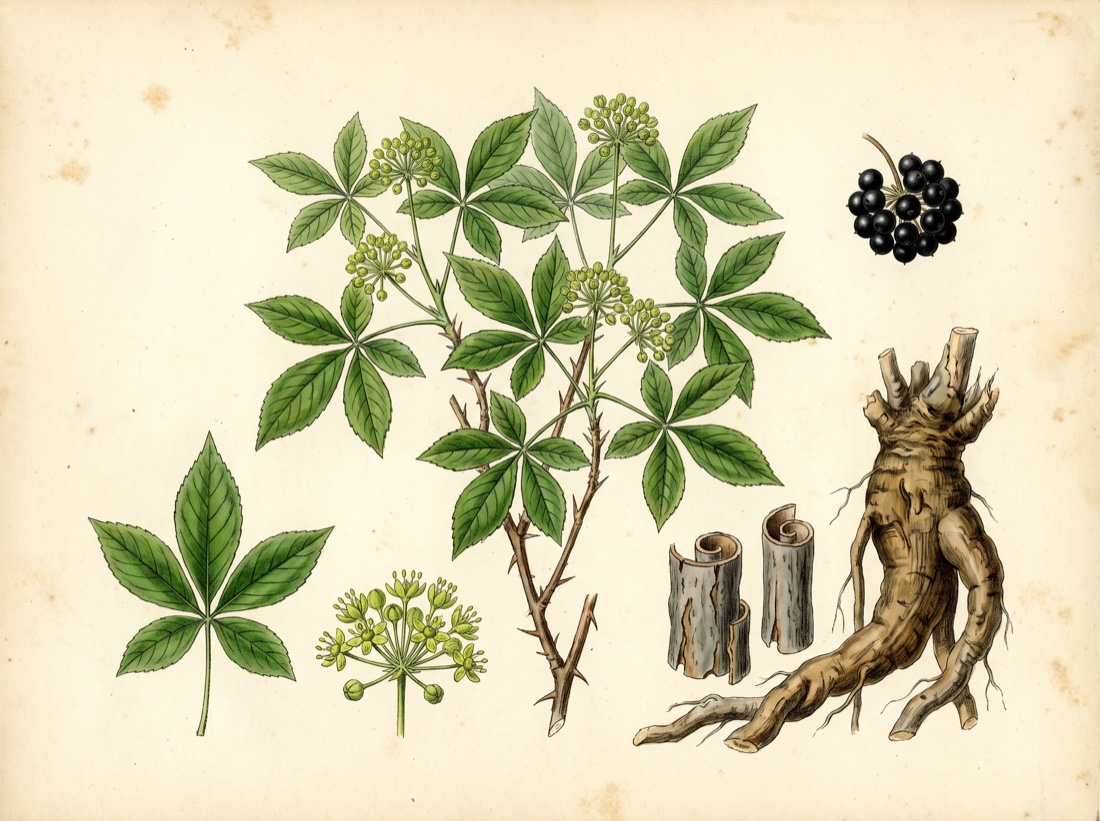
Acanthopanax root bark
Eleutherococcus gracilistylus
Also known as slender-styled acanthopanax, southern wu jia pi, five-leaf acanthopanax, wu jia pi, eleuthero bark (a loose trade name; 'eleuthero' properly means Eleutherococcus senticosus), wǔ jiā pí, nán wǔ jiā pí, wǔ jiā.
Wu jia pi is the root bark of a thorny, five-leaflet shrub of the ginseng family that grows on hillsides and along streams across central and southern China. The bark is stripped in summer and autumn and dried into short quills that are nearly odorless and faintly bitter. It is an old warming remedy for damp, cold joint pain, weak legs and swelling, and wu jia pi wine is a household tonic for the elderly. Botanists now place the species under Eleutherococcus nodiflorus, but the pharmacopoeia keeps the name Acanthopanax gracilistylus.

Ask Herbert about Acanthopanax root bark. Herbert is the master herbalist inside Bountiful Herbs: he answers from this plate and eleven hundred others, with dosing, pairing and cautions. Your first ten questions are free.
Ask HerbertActions
Indications what the tradition reached for it in
- Wind-damp painful obstruction with cold, aching joints
- Chronic arthritis worse in damp, cold weather
- Weakness and aching of the lower back and knees
- Weak legs and difficulty walking in the elderly
- Delayed walking and soft limbs in children (traditional, in formula)
- Contracture and stiffness of the sinews after injury
- Edema and swollen, heavy legs from damp
- Damp leg qi (beriberi-type swelling and weakness)
- Fatigue with cold limbs and a heavy body
Specific indications
Cold, stiff, aching knees and low back in an older person whose legs feel weak and heavy and who improves with warmth and a little wine
A patient with damp-type ankle swelling and joint ache after prolonged standing, where a warming diuretic that also strengthens the legs is wanted
Safety
The record lists 5 contraindications; open the plate in the library to read them in full.
In practice
This is a mild, dependable herb for the cold, damp, weak-legged patient. Combine it with du zhong, niu xi and mu gua for weak lower limbs, with du huo, qin jiao and sang ji sheng for wind-damp bi, and with fu ling pi, da fu pi and sheng jiang pi for damp edema.
In Chinese medicine
Temperature: warm. Taste: acrid, bitter. Channels: Liver, Kidney. Actions: Dispels wind-dampness and relieves painful obstruction, especially cold damp pain in the lower body; Tonifies the liver and kidney and strengthens the sinews and bones, the basis for its use in weak legs and slow walking in children; Promotes urination and reduces swelling in damp edema and heavy, swollen legs; Warms and moves in the manner of a gentle tonic wine, its most traditional vehicle.
Dosing as the sources wrote it
| Preparation | As written | Metric |
|---|---|---|
| Decoction | 5-10 g dried root bark daily | 5000-10000 mg |
| Medicinal wine (1:10 in rice wine) | 15-30 mL once or twice daily | 15-30 mL |
| Tincture (1:5, 45%) | 2-4 mL three times daily | 2-4 mL |
Doses are reproduced from the sources for practitioners and are not a recommendation for any person.
From the sources
Overview. Wu jia pi is the root bark of a thorny, five-leaflet shrub of the ginseng family that grows on hillsides and along streams across central and southern China. The bark is stripped in summer and autumn and dried into short quills that are nearly odorless and faintly bitter. It is an old warming remedy for damp, cold joint pain, weak legs and swelling, and wu jia pi wine is a household tonic for the elderly. Botanists now place the species under Eleutherococcus nodiflorus, but the pharmacopoeia keeps the name Acanthopanax gracilistylus.
Clinical Notes. This is a mild, dependable herb for the cold, damp, weak-legged patient. Combine it with du zhong, niu xi and mu gua for weak lower limbs, with du huo, qin jiao and sang ji sheng for wind-damp bi, and with fu ling pi, da fu pi and sheng jiang pi for damp edema.
Chinese Medicine Profile. Temperature: warm. Taste: acrid, bitter. Channels: Liver, Kidney. Actions: Dispels wind-dampness and relieves painful obstruction, especially cold damp pain in the lower body; Tonifies the liver and kidney and strengthens the sinews and bones, the basis for its use in weak legs and slow walking in children; Promotes urination and reduces swelling in damp edema and heavy, swollen legs; Warms and moves in the manner of a gentle tonic wine, its most traditional vehicle.
Nearby on the shelf
 AcaciaAcacia
 Adder's TongueErythronium
 AesculusAesculus glabra
 African basilOcimum gratissimum
 African serpentwoodRauvolfia vomitoria
The whole plate is in the library. The compass, Compare, the Sky of eleven hundred plants and the formulary open with an email address and a password, free, with the formula builder and its safety engine. Herbert without limit, his formulating, clients, the handouts and the labels are the paid room.
Open the library, free