Western Herbalism
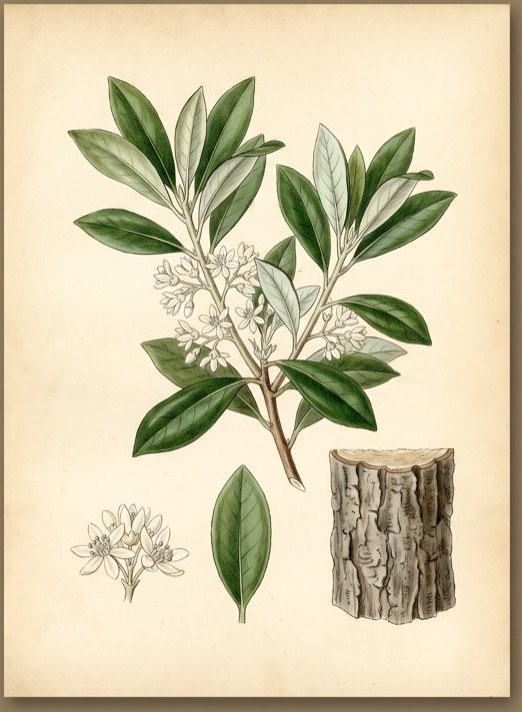
Winter's bark
Wintera
Also known as Winter's cinnamon, Magellan's bark, Canelo, Cortex winteri, Cortex magellanicus, Cortex winteranus.
Drimys winteri, known as Winter's bark, is an evergreen tree of the temperate rainforests of Chile and Argentina, ranging south into Tierra del Fuego and the Strait of Magellan region. Its aromatic, pungent inner bark was brought to European attention in the sixteenth century by the English captain John Winter, who reportedly used it to protect his crew from scurvy on a voyage through the Strait of Magellan. It became established in Western herbal practice as a warming aromatic bitter for weak digestion, though it has often been confused commercially with the unrelated West Indian tree Canella alba, which shares the common name wild cinnamon or false winter's bark.

Ask Herbert about Winter's bark. Herbert is the master herbalist inside Bountiful Herbs: he answers from this plate and eleven hundred others, with dosing, pairing and cautions. Your first ten questions are free.
Ask HerbertActions
Indications what the tradition reached for it in
- Atonic dyspepsia
- Sluggish digestion with cold constitution
- Flatulent colic
- Poor appetite in convalescence
- Chronic diarrhea with weak digestive fire
- Scurvy (historical, prior to vitamin C therapy)
- Debility after illness
- Toothache (bark chewed, folk use)
Specific indications
Cold, sluggish digestion with bloating, a pale tongue, and poor appetite calling for a warming aromatic bitter rather than a purely cooling one
Historical shipboard use to prevent scurvy on long voyages when fresh citrus was unavailable, the bark chewed or taken as an infusion
Safety
Pregnancy: Avoid in pregnancy, as it carries a traditional emmenagogue reputation and has not been adequately studied for safety.
Breastfeeding: Avoid during lactation due to lack of safety data.
The record lists 4 contraindications; open the plate in the library to read them in full.
In practice
Winter's bark is reached for when digestion is cold, sluggish, and weak rather than inflamed or hot. It works well as a warming aromatic bitter, taken shortly before meals to rouse appetite and ease flatulence, and pairs naturally with other carminatives such as ginger, cinnamon, or angelica in a compound bitters formula.
Dosing as the sources wrote it
| Preparation | As written | Metric |
|---|---|---|
| Decoction | 2-4 g dried bark in decoction, up to three times daily | 2000-4000 mg |
| Tincture (1:5, 45%) | 1-3 mL three times daily before meals | 1-3 mL |
| Thirty grains is the dose of the powdered bark. | ||
| A vinous tincture (bark, ℥i to sherry wine, ℥viij) may be employed in drachm doses. |
Doses are reproduced from the sources for practitioners and are not a recommendation for any person.
From the sources
Overview. Drimys winteri, known as Winter's bark, is an evergreen tree of the temperate rainforests of Chile and Argentina, ranging south into Tierra del Fuego and the Strait of Magellan region. Its aromatic, pungent inner bark was brought to European attention in the sixteenth century by the English captain John Winter, who reportedly used it to protect his crew from scurvy on a voyage through the Strait of Magellan. It became established in Western herbal practice as a warming aromatic bitter for weak digestion, though it has often been confused commercially with the unrelated West Indian tree Canella alba, which shares the common name wild cinnamon or false winter's bark.
Clinical Notes. Winter's bark is reached for when digestion is cold, sluggish, and weak rather than inflamed or hot. It works well as a warming aromatic bitter, taken shortly before meals to rouse appetite and ease flatulence, and pairs naturally with other carminatives such as ginger, cinnamon, or angelica in a compound bitters formula.
Action, Medical Uses, and Dosage. Canella bark is an aromatic stimulant and tonic, useful in enfeebled conditions of the stomach and alimentary canal. It is generally used in conjunction with other tonics. It is employed in the West Indies as a spice, and has been advised in scurvy, and in chlorotic, post partum, and carcinomatous menorrhagia. Some smokers add this bark to their smoking tobacco to remove the unpleasant odor from the tobacco, and to impart a degree of fragrance to their smoking-rooms. Dose, 10 to 40 grains.
Description. The bark is of a pale yellowish-white color (externally slightly yellowish-red with elongated scars disposed transversely), occurring in quills or hard, twisted pieces, with an acrid, peppery taste, an aromatic, clove-like, or cinnamon-like odor, and a short, white, granular fracture. On breaking the bark, numerous resin cells, appearing as orange-yellow specks, are scattered throughout the whiteness of the internal structure. Alcohol extracts its properties, the tincture being of a yellow color, and becoming white when water is added. It pulverizes readily, yielding a powder of a pale-yellow color.
Drawn from King's American Dispensatory, 18th edition (Felter and Lloyd), and the Bountiful Herbs editorial.
Nearby on the shelf
 Wilford's cranesbillGeranium wilfordii
 WillowSalix spp.
 Willowleaf swallowwortVincetoxicum stauntonii
 Winter melonBenincasa hispida
 WintergreenGaultheria procumbens
 Witch hazelHamamelis virginiana
 WoadIsatis tinctoria
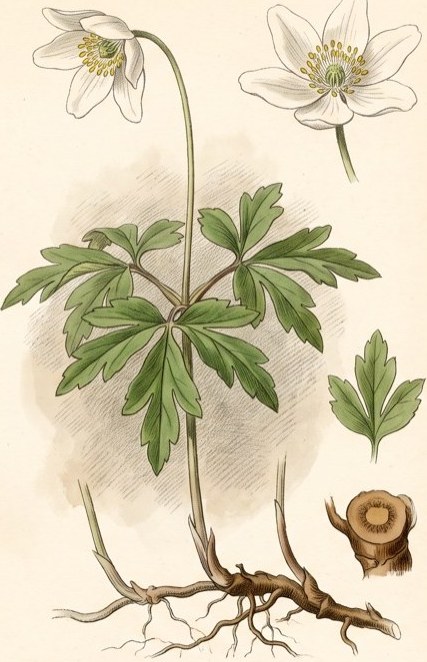 Wood AnemoneAnemone nemorosa
The whole plate is in the library. The compass, Compare, the Sky of eleven hundred plants and the formulary open with an email address and a password, free, with the formula builder and its safety engine. Herbert without limit, his formulating, clients, the handouts and the labels are the paid room.
Open the library, free