Western Herbalism
White Lettuce
Nabalus Albus
Also known as Lion's Foot, Rattlesnake Root, Wild Lettuce, Gall of the earth, Cancer weed.
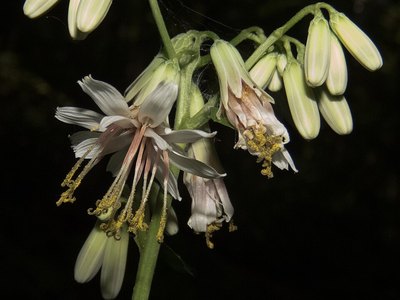
Nabalus albus, more commonly known today as Prenanthes alba, is a tall native North American woodland perennial in the daisy family, bearing nodding, dull cream to purplish flower heads and a bitter milky latex throughout its stems and leaves. Eclectic physicians of the nineteenth century used the fresh root and plant in tincture form, chiefly on the strength of a folk reputation as a remedy for rattlesnake bite, and secondarily as a mild astringent for bowel complaints and a topical application for poison ivy and insect stings. The remedy was never widely adopted and has largely fallen out of use in modern practice.

Ask Herbert about White Lettuce. Herbert is the master herbalist inside Bountiful Herbs: he answers from this plate and eleven hundred others, with dosing, pairing and cautions. Your first ten questions are free.
Ask HerbertActions
Indications what the tradition reached for it in
- Diarrhea
- Dysentery with mucous stool
- Poison ivy contact dermatitis
- Insect stings and bites
- Chronic indolent skin ulcers
- Aphthous mouth sores (as gargle)
- Snakebite (historical folk claim, unproven)
- Loose bowel with weak tone
Specific indications
Traditionally applied to rattlesnake bite as a folk remedy, though this claim was never validated and must never replace conventional antivenom treatment
Fresh milky latex or bruised leaf applied topically to poison ivy rash and stinging insect bites for its cooling, drawing effect
Safety
Pregnancy: Avoid in pregnancy: no safety data exist for this plant and its historical use is unverified.
Breastfeeding: Avoid in lactation: no safety data exist for this plant.
The record lists 3 contraindications; open the plate in the library to read them in full.
In practice
This is an obscure remedy today, rarely if ever dispensed, and its historical record is thin. John Scudder's Specific Medication school held that a remedy exactly matched to the case works in very small doses, so his dose figures for the fresh plant tincture (one to twenty drops) are far lower than the doses given for the same plant by other Eclectic authors of the period; the two schools of dosing are not interchangeable and this monograph should not be read as endorsing either scale over the other without further verification.
Dosing as the sources wrote it
| Preparation | As written | Metric |
|---|---|---|
| Fresh plant tincture (Scudder's Specific Medication dose) | 0.05-1 mL (1-20 drops) taken as directed, per the low-dose Specific Medication theory | 0.05-1 mL |
| Fresh plant tincture (1:2, general herbal use) | 1-2 mL up to three times daily | 1-2 mL |
| A strong tincture of the green plant (℥viii to alcohol, 76 per cent, Oj) should be employed in doses of from 1 to 20 drops in experimenting for its effects in nervous disorders. | 0.02-0.4 mL |
Doses are reproduced from the sources for practitioners and are not a recommendation for any person.
From the sources
Overview. Nabalus albus, more commonly known today as Prenanthes alba, is a tall native North American woodland perennial in the daisy family, bearing nodding, dull cream to purplish flower heads and a bitter milky latex throughout its stems and leaves. Eclectic physicians of the nineteenth century used the fresh root and plant in tincture form, chiefly on the strength of a folk reputation as a remedy for rattlesnake bite, and secondarily as a mild astringent for bowel complaints and a topical application for poison ivy and insect stings. The remedy was never widely adopted and has largely fallen out of use in modern practice.
Clinical Notes. This is an obscure remedy today, rarely if ever dispensed, and its historical record is thin. John Scudder's Specific Medication school held that a remedy exactly matched to the case works in very small doses, so his dose figures for the fresh plant tincture (one to twenty drops) are far lower than the doses given for the same plant by other Eclectic authors of the period; the two schools of dosing are not interchangeable and this monograph should not be read as endorsing either scale over the other without further verification.
Specific indications and reasoning. (LION's FOOT). Preparation: Prepare a tincture from the fresh plant, 5viij. to Alcohol 76° Oj. Dose from gtt. j. to gtts. xX. This remedy has been but little employed. It was claimed to be specific to the poison of the rat-
Drawn from Scudder's Specific Medication and Specific Medicines; King's American Dispensatory, 18th edition (Felter and Lloyd), and the Bountiful Herbs editorial.
Nearby on the shelf
 White bryonyBryonia alba
 White cohoshActaea Alba
 White figFicus lacor
 White HorehoundMarrubium vulgare
 White mugwortArtemisia lactiflora
 White mustardBrassica alba
 White Oak BarkQuercus alba
 White PeonyPaeonia lactiflora
The whole plate is in the library. The compass, Compare, the Sky of eleven hundred plants and the formulary open with an email address and a password, free, with the formula builder and its safety engine. Herbert without limit, his formulating, clients, the handouts and the labels are the paid room.
Open the library, free