Western Herbalism
Purple angelica
Archangelica Atropurpurea
Also known as American angelica, Masterwort, High angelica, Great angelica.
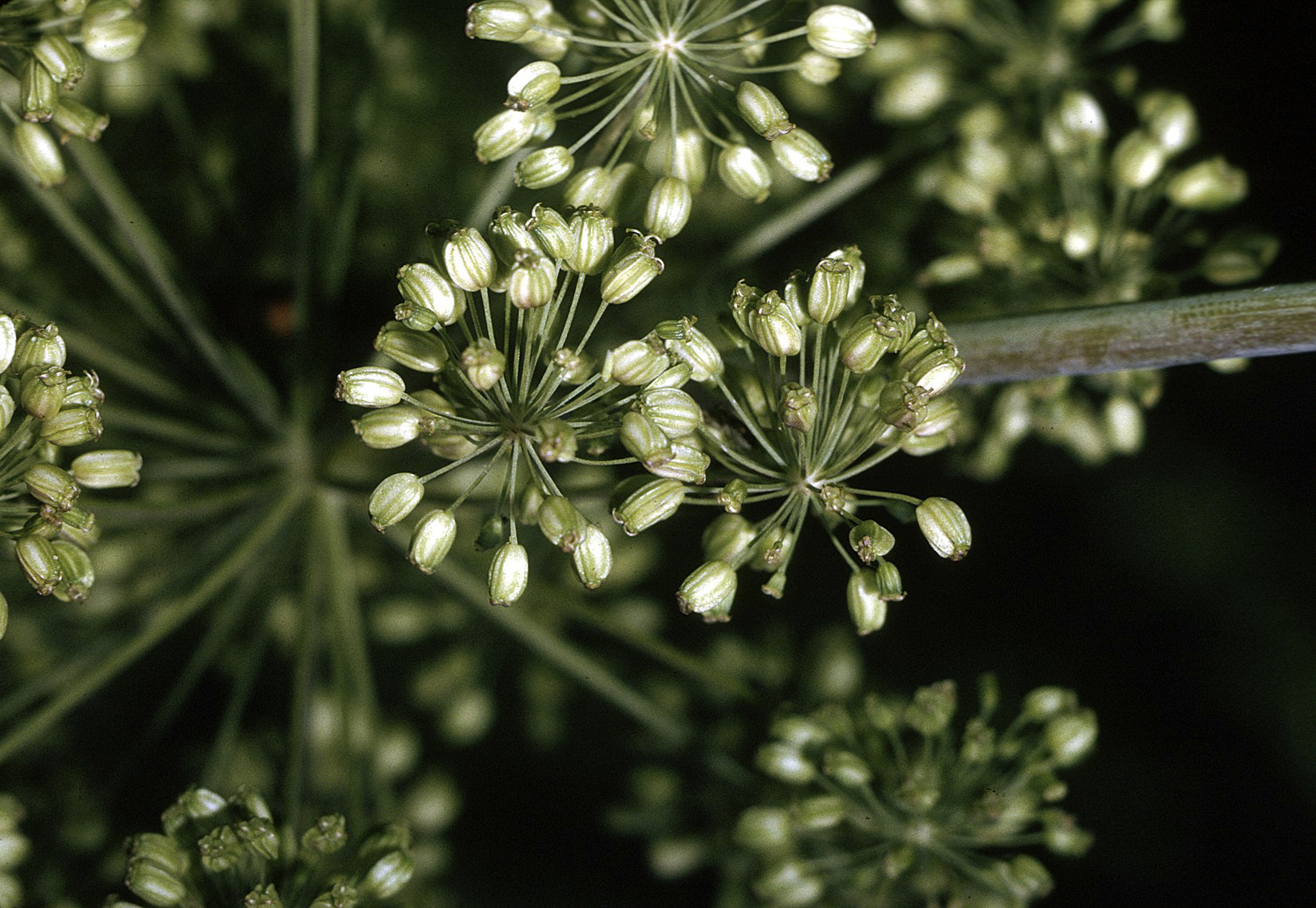
Purple angelica is a tall, robust perennial of the carrot family native to wet meadows, riverbanks, and swamps of eastern and northeastern North America, recognizable by its dark purple stems and large umbels of greenish white flowers. The aromatic root, and to a lesser extent the seed, was used extensively by nineteenth century American eclectic physicians as a warming digestive and diaphoretic, standing in for the closely related European angelica where the native plant was more readily at hand. It holds a modest but well established place in North American herbal practice as a carminative and circulatory stimulant for cold, sluggish constitutions.

Ask Herbert about Purple angelica. Herbert is the master herbalist inside Bountiful Herbs: he answers from this plate and eleven hundred others, with dosing, pairing and cautions. Your first ten questions are free.
Ask HerbertActions
Indications what the tradition reached for it in
- Dyspepsia with gas and bloating
- Sluggish digestion from cold or debility
- Feverish colds with poor sweating
- Bronchial catarrh with tight, unproductive cough
- Delayed or scanty menstruation
- Flatulent colic
- Poor appetite in convalescence
- Cold extremities with weak peripheral circulation
- Nervous digestive upset
Specific indications
Cold, damp constitution with pale tongue, weak digestion, and a tendency to bloat after meals
Early feverish cold with chilliness and dry skin, wanting to be warmed and to sweat
Safety
Low dose botanical. Used in drop doses in the classical practice; not a plant to dose freely.
Pregnancy: Avoid in pregnancy as the root has a traditional emmenagogue and uterine-stimulating reputation and safety data are lacking.
Breastfeeding: Insufficient data to confirm safety in lactation; avoid or use only with professional guidance.
The record lists 4 contraindications; open the plate in the library to read them in full.
In practice
Purple angelica root is reached for in the person whose digestion is slow and gassy in a cold, damp sort of way: bloating that comes on after eating, a tendency to feel chilled, and little appetite. A short infusion or small dose of tincture before meals often eases this picture better than a purely bitter tonic would, because the aromatic pungency here also moves stagnant gas and warms peripheral circulation.
Dosing as the sources wrote it
| Preparation | As written | Metric |
|---|---|---|
| Dried root infusion or decoction | 1-3 g dried root steeped or briefly simmered, up to three times daily | 1000-3000 mg |
| Tincture (1:5, 45%) | 2-4 mL three times daily | 2-4 mL |
| powder | Dose of the powder, 30 to 60 grains; of the decoction, 2 to 4 ounces, 3 or 4 times a day. | 1944-3888 mg |
Doses are reproduced from the sources for practitioners and are not a recommendation for any person.
From the sources
Overview. Purple angelica is a tall, robust perennial of the carrot family native to wet meadows, riverbanks, and swamps of eastern and northeastern North America, recognizable by its dark purple stems and large umbels of greenish white flowers. The aromatic root, and to a lesser extent the seed, was used extensively by nineteenth century American eclectic physicians as a warming digestive and diaphoretic, standing in for the closely related European angelica where the native plant was more readily at hand. It holds a modest but well established place in North American herbal practice as a carminative and circulatory stimulant for cold, sluggish constitutions.
Clinical Notes. Purple angelica root is reached for in the person whose digestion is slow and gassy in a cold, damp sort of way: bloating that comes on after eating, a tendency to feel chilled, and little appetite. A short infusion or small dose of tincture before meals often eases this picture better than a purely bitter tonic would, because the aromatic pungency here also moves stagnant gas and warms peripheral circulation.
Drawn from King's American Dispensatory, 18th edition (Felter and Lloyd), and the Bountiful Herbs editorial.
Nearby on the shelf
 PunarnavaBoerhavia diffusa
 Puncture vineTribulus terrestris
 Punting-pole bambooBambusa tuldoides
 Purging crotonCroton tiglium
 Purple cliff-brakePteris Atropurpurea
 Purple gromwellLithospermum erythrorhizon
 Purple loosestrifeLythrum
 PurslanePortulaca oleracea
The whole plate is in the library. The compass, Compare, the Sky of eleven hundred plants and the formulary open with an email address and a password, free, with the formula builder and its safety engine. Herbert without limit, his formulating, clients, the handouts and the labels are the paid room.
Open the library, free