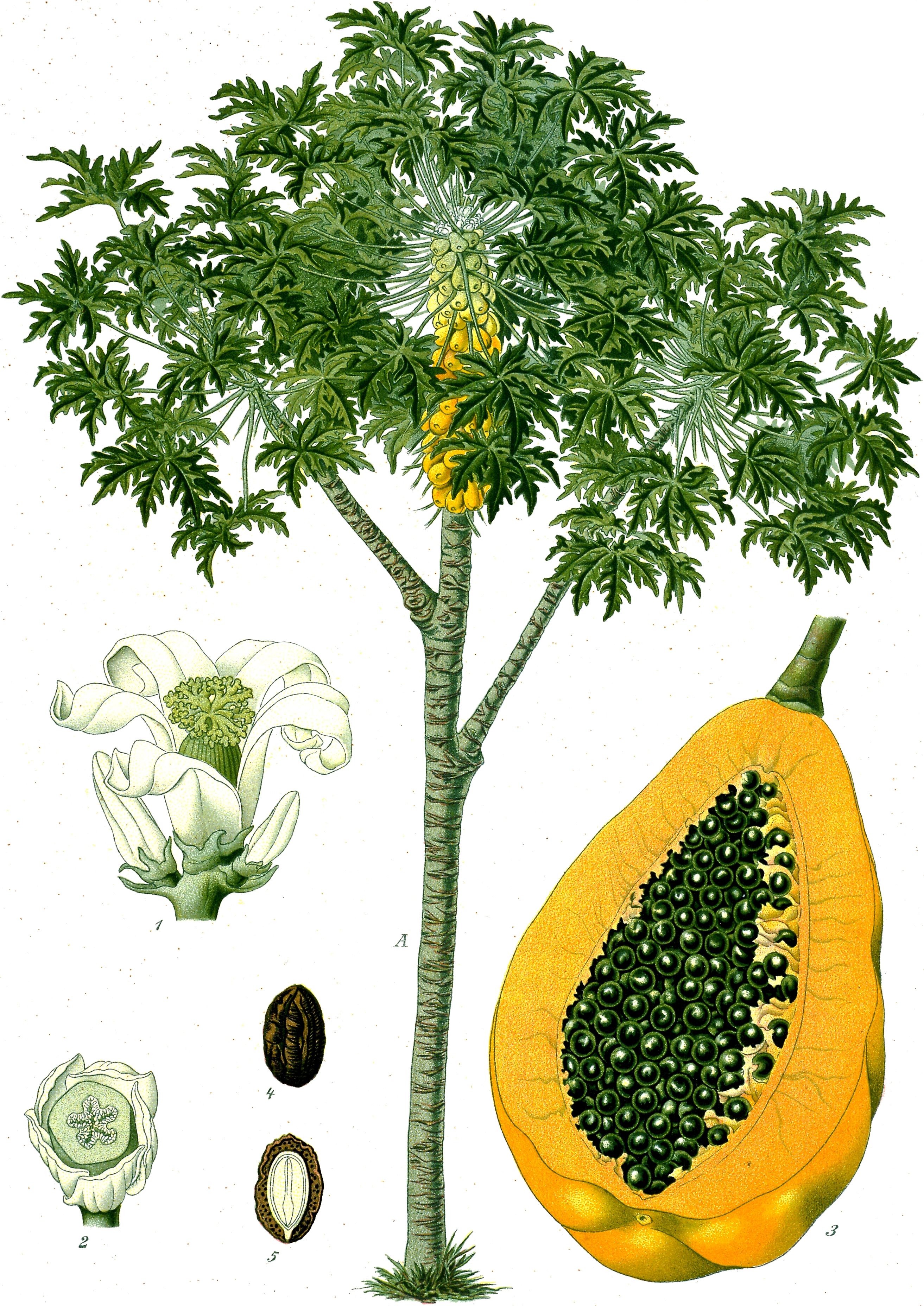
Western and Ayurvedic herbalism
Papaya
Carica papaya
Also known as papaw, pawpaw (Asia and Africa; not the North American Asimina), melon tree, tree melon, Pawpaw, Mamaeiro, Pawpaw (tropical), Papita, Erandakarkati, Erandaphala, Madhukarkati.
Carica papaya is a fast growing, short lived, soft stemmed tree of the Caricaceae, native to tropical America and carried by the Portuguese to India in the sixteenth century, where it is now grown in every warm district and is one of the most widely eaten fruits. Ayurveda has no classical monograph for it, but later physicians named it Erandakarkati, the castor-leaved cucumber, and absorbed it as a digestive and mildly laxative fruit, a sharp anthelmintic latex and seed, and, in recent decades, a leaf remedy for dengue fever with low platelets. The whole plant is rich in the protein splitting enzyme papain.

Ask Herbert about Papaya. Herbert is the master herbalist inside Bountiful Herbs: he answers from this plate and eleven hundred others, with dosing, pairing and cautions. Your first ten questions are free.
Ask HerbertActions
Indications what the tradition reached for it in
- Dyspepsia with heaviness after protein meals
- Sluggish digestion with constipation
- Bloating and gas from poor protein digestion
- Intestinal worms (seed, adjunct)
- Dengue fever with thrombocytopenia (leaf extract, adjunct to supportive care)
- Viral fever with low platelets (leaf, adjunct, unproven beyond dengue)
- Chronic wounds, ulcers and burns (ripe pulp or papain dressing)
- Warts, corns and ringworm (latex, topical)
- Acne and rough skin (ripe pulp mask)
- Post-surgical swelling and bruising (papain, traditional)
- Convalescence with poor appetite (ripe fruit)
- Chronic constipation in the elderly (ripe fruit)
- Dyspepsia and protein maldigestion
- Intestinal worms and parasites (seed, leaf)
- Dengue fever with thrombocytopenia (leaf extract, studied to raise platelets)
- Wounds, ulcers and burns (latex/poultice, topical)
- Constipation
- Inflammatory and digestive complaints
- Eczema and skin lesions (topical)
Specific indications
A patient with heaviness, fullness and belching after meat or dairy meals whose stool is slow, for whom ripe papaya after food does what a protease supplement does
A febrile dengue patient in the critical phase whose platelets are falling, where fresh leaf juice or a standardized leaf extract is added to hospital supportive care and monitored daily
A sluggish, constipated elder who tolerates few fruits and finds ripe papaya in the morning moves the bowel gently without cramping
A chronic leg ulcer with slough where mashed ripe papaya or a papain dressing debrides gently before healing herbs are applied
Safety
Pregnancy: Not for use in pregnancy
The record lists 8 contraindications; open the plate in the library to read them in full.
In practice
The Ayurvedic practitioner uses papaya as pathya, food that treats, and rarely as a drug. The ripe fruit is deepana and anulomana, a sweet fruit that kindles digestion instead of dulling it, given after meals for heaviness and in the morning for constipation, especially in the elderly and in kapha and vata patients.
In Ayurveda
Rasa: madhura (sweet) in the ripe fruit; tikta (bitter) and katu (pungent) in the leaf, seed and unripe fruit. Virya: ushna (heating), the ripe fruit mildly so. Vipaka: madhura (sweet) for the ripe fruit; katu (pungent) for leaf and seed. Guna: laghu (light), snigdha (unctuous) for the ripe fruit; ruksha (dry), tikshna (sharp) for the latex and seed. Dosha: the ripe fruit pacifies vata and kapha and is neutral to pitta in moderation; the unripe fruit, latex and seed are sharp and heating and aggravate pitta. Prabhava: Amapachana through the digestive enzyme of the fruit and latex; later authors describe the ripe fruit as one of the few sweet fruits that improves rather than slows digestion. Karma: deepana (kindles digestion); pachana (digestive, ripens ama); anulomana (normalizes downward movement, mild laxative); krimighna (anthelmintic; seed and latex); artavajanana (promotes menstruation; unripe fruit and latex); garbhapatana (abortifacient in excess; unripe fruit, latex, seed); yakrit uttejaka (stimulates the liver); pliha vikara hara (relieves splenic enlargement); kushthaghna (helps skin disease; latex topically); shothahara (reduces swelling); stanyajanana (promotes breast milk; ripe fruit and cooked unripe fruit, folk); vranaropana (heals wounds; ripe pulp and leaf topically). Classical indications: agnimandya (weak digestion); ajirna (indigestion); vibandha (constipation); krimi (worms); yakrit and pliha vriddhi (liver and spleen enlargement); kamala (jaundice, folk); arsha (hemorrhoids); kashtartava (painful or scanty menstruation; unripe fruit); kushtha and dadru (skin disease and ringworm; latex); vrana (wounds and ulcers; topical); jvara (fever; leaf, modern folk use in dengue). The ripe fruit is eaten fresh for digestion and constipation; the unripe fruit is cooked as a vegetable and its latex applied to warts, ringworm and ulcers or given in tiny doses for worms; the leaf is juiced fresh or decocted, now chiefly for viral fevers with low platelets; the seeds are chewed or powdered as an anthelmintic. None of these appear in the classical samhitas because the plant reached India in the sixteenth century. Classical formulations: Papaya leaf swarasa (modern), Papaya leaf kwatha (modern), Erandakarkati phala churna (unripe fruit powder, regional), Papain based digestive churnas (modern), Papaya latex lepa (topical, folk).
Dosing as the sources wrote it
| Preparation | As written | Metric |
|---|---|---|
| Swarasa (leaf) | 25-50 mL fresh leaf juice twice daily for five days in dengue, with medical monitoring | 25-50 mL |
| Standardized leaf extract | 1100-1500 mg leaf extract three times daily for five days in dengue | 1100-1500 mg |
| Ripe fruit, dietary | 100-200 g ripe fruit once or twice daily after food | 100000-200000 mg |
| Seed, anthelmintic | 5-10 g fresh or dried seed chewed or powdered once daily for three to five days | 5000-10000 mg |
| Ripe pulp or papain, topical | 10-20 g mashed ripe pulp applied to the wound daily | 10000-20000 mg |
| Dose, from one to three grains. | 64.8-194 mg |
Doses are reproduced from the sources for practitioners and are not a recommendation for any person.
From the sources
Overview. Carica papaya is a fast growing, short lived, soft stemmed tree of the Caricaceae, native to tropical America and carried by the Portuguese to India in the sixteenth century, where it is now grown in every warm district and is one of the most widely eaten fruits. Ayurveda has no classical monograph for it, but later physicians named it Erandakarkati, the castor-leaved cucumber, and absorbed it as a digestive and mildly laxative fruit, a sharp anthelmintic latex and seed, and, in recent decades, a leaf remedy for dengue fever with low platelets. The whole plant is rich in the protein splitting enzyme papain.
Clinical Notes. The Ayurvedic practitioner uses papaya as pathya, food that treats, and rarely as a drug. The ripe fruit is deepana and anulomana, a sweet fruit that kindles digestion instead of dulling it, given after meals for heaviness and in the morning for constipation, especially in the elderly and in kapha and vata patients.
Therapy. The indications for the use of papoid in treating digestive disorders may be summarized somewhat as follows: Actual and relative deficiency of the gastric juice or its constituents. (a) Diminished secretion of gastric juice as a whole; apepsia, anemia and deficient blood supply; wasting diseases.
Action, Uses, and Dosage. Emetic, for which purpose a saturated tincture of the bruised seeds is employed, in doses of from 10 to 60 drops. The bark is said to be a bitter tonic, and has been used as such in domestic practice. The medical properties of this agent have not been fully investigated.
Drawn from King's American Dispensatory, 18th edition (Felter and Lloyd); Ellingwood's American Materia Medica, Therapeutics and Pharmacognosy, and the Bountiful Herbs editorial.
Nearby on the shelf
 Pacific YewTaxus brevifolia
 PaiglePrimula veris
 PapawAsimina
 Paper mulberryBroussonetia papyrifera
 Para cressSpilanthes oleracea
 PareiraPareira brava
 Pareira bravaCissampelos pareira
The whole plate is in the library. The compass, Compare, the Sky of eleven hundred plants and the formulary open with an email address and a password, free, with the formula builder and its safety engine. Herbert without limit, his formulating, clients, the handouts and the labels are the paid room.
Open the library, free