Western Herbalism
Marsh rosemary
Statice caroliniana
Also known as Ink-root, Sea-lavender, American thrift, Inkroot.
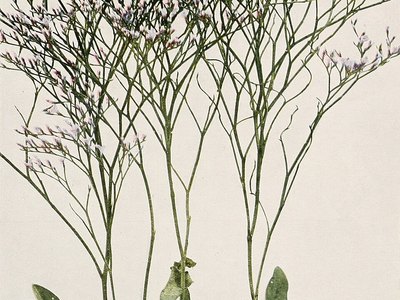
Marsh rosemary, botanically Limonium carolinianum, is a perennial salt-marsh plant of the eastern seaboard of North America, easily recognized by its basal rosette of thick spathulate leaves and its branched scapes of small lavender flowers. The thick, dark, intensely astringent root is the part used medicinally. It held a firm place in nineteenth century American folk and physiomedical practice as one of the strongest native astringents available, valued especially where tissue was described as relaxed or lacking tone.

Ask Herbert about Marsh rosemary. Herbert is the master herbalist inside Bountiful Herbs: he answers from this plate and eleven hundred others, with dosing, pairing and cautions. Your first ten questions are free.
Ask HerbertActions
Indications what the tradition reached for it in
- Chronic diarrhea
- Dysentery with mucoid or bloody stool
- Relaxed sore throat with visible congestion
- Aphthous ulcers and spongy gums
- Leucorrhea
- Uterine hemorrhage and menorrhagia
- Passive bleeding from mucous surfaces
- Prolapse with laxity of tissue
Specific indications
Chronic, watery diarrhea in a debilitated patient with lax, relaxed bowel tone rather than acute inflammation
A dark, relaxed, boggy throat or gum tissue that bleeds easily, calling for a strongly astringent gargle or mouthwash
Safety
Pregnancy: Not safe. Not recommended in pregnancy due to the absence of modern safety data and its traditional use as a strong uterine styptic, which could theoretically affect uterine tissue.
Breastfeeding: Not safe. Avoid during lactation given the lack of modern safety data.
The record lists 5 contraindications; open the plate in the library to read them in full.
In practice
Physiomedical writers reached for marsh rosemary root when the tissue picture was one of laxity and relaxation rather than acute heat or inflammation: a boggy, bleeding gum, a relaxed sore throat, a chronic watery diarrhea in a weakened constitution.
Dosing as the sources wrote it
| Preparation | As written | Metric |
|---|---|---|
| Decoction of dried root | 2-4 g dried root simmered in 250 mL water, taken in divided doses through the day | |
| Tincture (1:5, 40%) | 1-2 mL three times daily | 1-2 mL |
| Topical gargle or mouthwash | Strong decoction used undiluted, several times daily as needed | |
| Dose one to two grains | 64.8-130 mg | |
| From two to five drops are given as a dose, in some demulcent | ||
| A tincture of the fresh root (℥viii to alcohol, 98 per cent, Oj) may be given in doses of from 1 to 20 drops. |
Doses are reproduced from the sources for practitioners and are not a recommendation for any person.
From the sources
Clinical Notes. Physiomedical writers reached for marsh rosemary root when the tissue picture was one of laxity and relaxation rather than acute heat or inflammation: a boggy, bleeding gum, a relaxed sore throat, a chronic watery diarrhea in a weakened constitution.
Properties and Uses. The root is large, hard, and of a reddish-brown color, of an intensely astringent character, containing a large percentage of tannin. Its action much resembles that of geranium, but is more intense; and may be used in the same general classes of cases, as chronic dysentery and diarrhea, aphthous ulcerations, putrid sore throat, leucorrhea, local hemorrhages, etc.
Properties and Uses. This root is prominently and almost acridly stimulant, with a fair portion of relaxant influence, of much power, acting with much persistency. Large doses prove cathartic, and sometimes emetic, acting slowly, and leaving a burning sensation through the stomach and bowels.
Action, Medical Uses, and Dosage. Marsh rosemary is a strong astringent, and has long been used, in the form of infusion or decoction, as a domestic remedy in diarrhoea, chronic dysentery, etc. It is not indicated in the acute stages of these affections, but will be found very efficient as an astringent and tonic, after the active symptoms have subsided.
Drawn from Cook's Physio-Medical Dispensatory; King's American Dispensatory, 18th edition (Felter and Lloyd), and the Bountiful Herbs editorial.
Nearby on the shelf
 MarijuanaCannabis sativa
 MarjoramOriganum majorana
 Marking nutSemecarpus anacardium
 MarshmallowAlthaea officinalis
 MasticPistacia lentiscus
 MaticoArtanthe elongata
 May applePodophyllum peltatum
The whole plate is in the library. The compass, Compare, the Sky of eleven hundred plants and the formulary open with an email address and a password, free, with the formula builder and its safety engine. Herbert in full, his formulating, clients, the handouts and the labels are the paid room.
Open the library, free