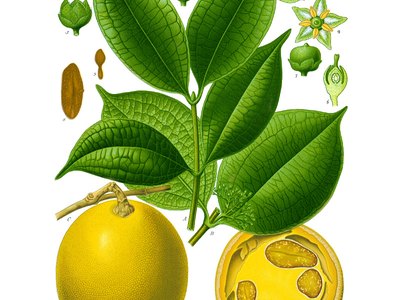
Western Herbalism
Ignatia Amara
Strychnos ignatia
Also known as Bean of St.
Some hysterical women are troubled with aphonia, others with amenorrhea and in others the menses are replaced by a severe leuchorrheal discharge. All these symptoms are benefited by ignatia. These patients are nearly all out of tone.

Ask Herbert about Ignatia Amara. Herbert is the master herbalist inside Bountiful Herbs: he answers from this plate and eleven hundred others, with dosing, pairing and cautions. Your first ten questions are free.
Ask HerbertSpecific indications
Ignatia is applicable if there is a tendency to mental disorder, with suffocative hysterical symptoms. Also where there is present the globus hystericus and nervous headache in feeble women with sleeplessness. It is applicable at the age of puberty during the establishment of the menses, also at the menopause, when the characteristic symptoms of nerve irritation are present. All the nervous symptoms are accompanied with weakness and general inappetence, where the patient considers her condition very serious, and her chances of recovery very slight. Further symptomatology is dragging pains in the lower bowels, colicky pains with the menstruation, sexual frigidity, sterility, and impotence. Muscular twitchings of the face and eyelids, dullness of hearing depending upon the general weakness, and burning in the bottoms of the feet. A prominent writer states that nux vomica and ignatia are not interchangeable, though chemically and botanically similar. Ignatia is primarily a spinal remedy. It seems to intensify the impressionability of all the senses. When the excitability is exhibited by anger, vehemence and irascibility, nux vomica is indicated. When there is melancholy, with a tendency to weep, ignatia is indicated, and with the melancholy the patient hides his or her grief and nurses their sorrows, trying to keep them covered up. The patients sigh and weep, when alone, are very sensitive and easily irritated, but do not disclose their irritation. They have but little appetite, have considerable pressure on the top of the head, and are inclined to renew their grief over causes long passed. In hysteria, these patients will alternately laugh and cry. The laughing becomes spasmodic, and there is cramping in the hands and chest. These cramps may be mistaken for convulsive paroxysms, especially as they may be followed by unconsciousness. But in these, it will be noticed that the spasms of the bands, will be readily relaxed on pressure or the patient will move the hand voluntarily. The patient recovers with long-drawn sighs. When the globus hystericus is alarming in this class of patients, give ignatia. While it relieves all the above symptoms, it will also relieve the hiccough, the flatulent distention and disorders of the stomach and intestinal tract that are often present, with the above phenomena. It overcomes the pain of intercostal neuralgia, and the acute pain in the head common to many of these patients. The remedy has a soothing effect in all cases.
Safety
Recognised toxicity. This plant carries a toxicity flag in the record; it is for trained practitioners only.
Dosing as the sources wrote it
| Preparation | As written | Metric |
|---|---|---|
| Specific Medicine Ignatia | Dose, from one-sixth to one half minim. | 0.01-0.03 mL |
| Fluid Extract of Ignatia | Dose, from one to ten minims. | 0.06-0.62 mL |
| Tincture of Ignatia | Dose, from five to twelve minims. | 0.31-0.74 mL |
| Usually twenty drops of specific ignatia, in four ounces of water, a teaspoonful from four to six times a day will be a sufficient dose. | 1 mL |
Doses are reproduced from the sources for practitioners and are not a recommendation for any person.
From the sources
Therapy. Some hysterical women are troubled with aphonia, others with amenorrhea and in others the menses are replaced by a severe leuchorrheal discharge. All these symptoms are benefited by ignatia. These patients are nearly all out of tone.
Physiological Action. The remedy presents the peculiarities of nux vomica to a great extent. In its therapeutic action it is prescribed under much the same conditions, but is a milder remedy. It seems to have less nerve irritating properties and an efficient nerve tonic influence.
Specific Symptomatology. Ignatia is applicable if there is a tendency to mental disorder, with suffocative hysterical symptoms. Also where there is present the globus hystericus and nervous headache in feeble women with sleeplessness.
Drawn from Ellingwood's American Materia Medica, Therapeutics and Pharmacognosy, and the Bountiful Herbs editorial.
Nearby on the shelf
 HyssopHyssopus officinalis
 Iceland mossCetaria islandica
 Iceland mossCetraria
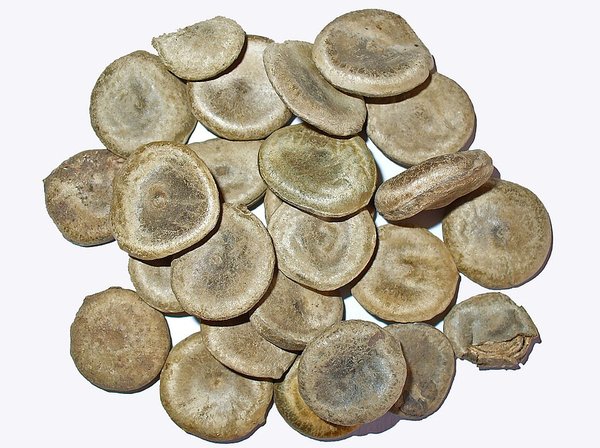 IgnatiaIgnatia
 ImmortelleHelichrysum italicum
 India-RubberElastica
 Indian aconiteAconitum ferox
 Indian ateesAconitum heterophyllum
The whole plate is in the library. The compass, Compare, the Sky of eleven hundred plants and the formulary open with an email address and a password, free, with the formula builder and its safety engine. Herbert without limit, his formulating, clients, the handouts and the labels are the paid room.
Open the library, free