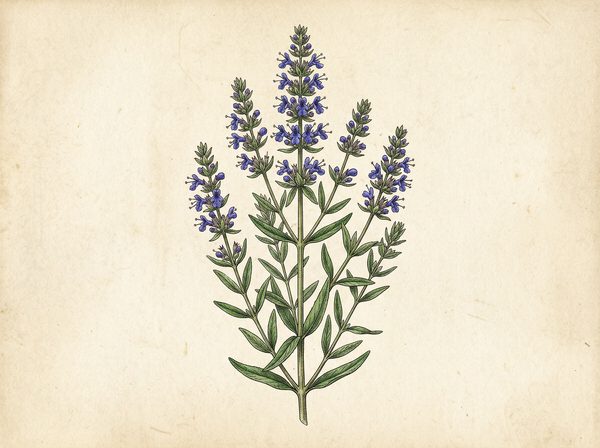
Western Herbalism
Hyssop
Hyssopus officinalis
Included in pharmacopoeias of France Portugal Romania Sweden Germany. Essential oil convulsant in high doses due to pinocamphone. Insufficient clinical evidence for most uses traditional expectorant and carminative. Chemotype variation affects composition.

Ask Herbert about Hyssop. Herbert is the master herbalist inside Bountiful Herbs: he answers from this plate and eleven hundred others, with dosing, pairing and cautions. Your first ten questions are free.
Ask HerbertActions
Indications what the tradition reached for it in
- Catarrh
- Bruises
- Colic
- Flatulence
- Pleurisy
- Neuroses
- Liver and gallbladder conditions
- Joint diseases
- Bronchitis
- Asthma
- Abdominal cramps
- Burns
- Diabetes
- Urinary tract infection
- Chronic gastritis
- Loss of appetite
- Skin rashes
- Menstrual cramps
- Cough
- Gas
- Wounds
- Frostbite
- Fever
- Common cold
- Poor circulation
- Intestinal pain
- Chronic colitis
- Sore throat
- Indigestion
- Abdominal distension
Safety
Pregnancy: Pregnancy Caution
Breastfeeding: Lactation (source flag notSafeInLactation)
The record lists 2 contraindications; open the plate in the library to read them in full.
Dosing as the sources wrote it
| Preparation | As written | Metric |
|---|---|---|
| Infusion: 1-2 tsp dried herb per cup boiling water | ||
| steep | steep 10-15 min | |
| 3x/day | ||
| Tincture: 1-4 mL 3x/day (1:1 or 1:5 ratio | 1-4 mL | |
| The infusion (herb, ʒiv to aqua Oj) may be given freely; the volatile oil, in doses of 1 or 2 drops. | 0.1-0.1 mL | |
| Infusion | Infusion: 1-2 tsp. herba/cup water; 1 cup TID |
Doses are reproduced from the sources for practitioners and are not a recommendation for any person.
From the sources
Clinical Notes. Included in pharmacopoeias of France Portugal Romania Sweden Germany. Essential oil convulsant in high doses due to pinocamphone. Insufficient clinical evidence for most uses traditional expectorant and carminative. Chemotype variation affects composition.
Properties and Uses. This is a diffusive aromatic, stimulating and relaxing, with mild tonic properties. It sustains capillary circulation gently, and also the nervous peripheries. It promotes expectoration, relieves asthmatic coughs, and may be employed in colds with soreness of the chest. It is often employed in gargles for quinsy and ordinary sore throat. Medical Herbalism journal and medherb.com The Physiomedical Dispensatory by William Cook, M.D., 1869
primary-actions. Hyssop acts primarily as: Expectorant, Carminative, Antispasmodic, Diaphoretic, Antiviral. Secondary actions include Anticatarrhal, Sedative, Nervine, Vulnerary, Cholagogue, Antibacterial.
Description. Natural Order, Labiatae. This plant is perennial, with the lower part of the stem woody, and the upper part of slender and wand-like branches. Two feet high. Leaves opposite, sessile, lance-linear, punctate. Flowers blue-purple, in small clusters upon crowded spikes; calyx tubular, fifteen nerved, two toothed; corolla two-lipped, upper lip erect and obscurely notched, lower lip three-cleft, with the middle lobe largest and two-cleft. Stamens four, diverging, exserted. Native to Europe, cultivated in gardens, now common along roadsides in some parts of America. Flowering in July. The whole plant has a pleasant odor, and contains a volatile oil.
Drawn from Cook's Physio-Medical Dispensatory; King's American Dispensatory, 18th edition (Felter and Lloyd), and the Bountiful Herbs editorial.
Nearby on the shelf
 Huang QiAstragalus propinquus
 Hyacinth beanLablab purpureus
 HygrophilaHygrophilia spinosa
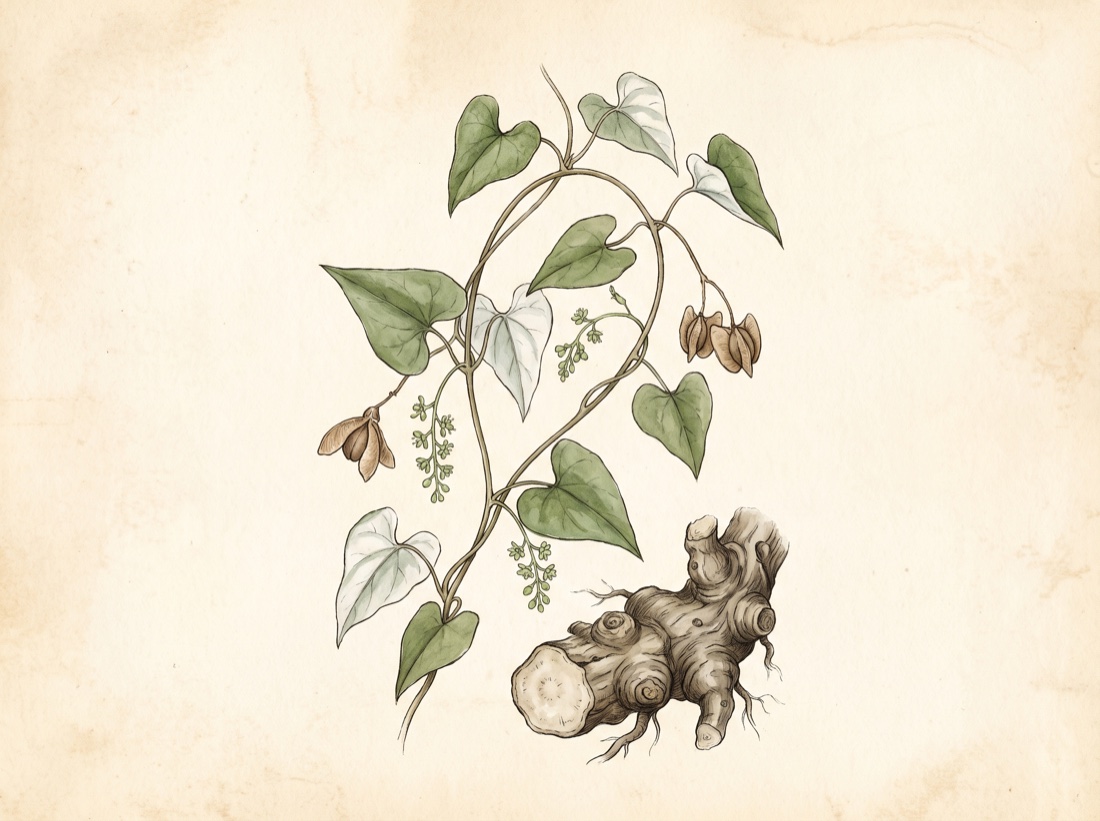 Hypoglaucous yamDioscorea hypoglauca
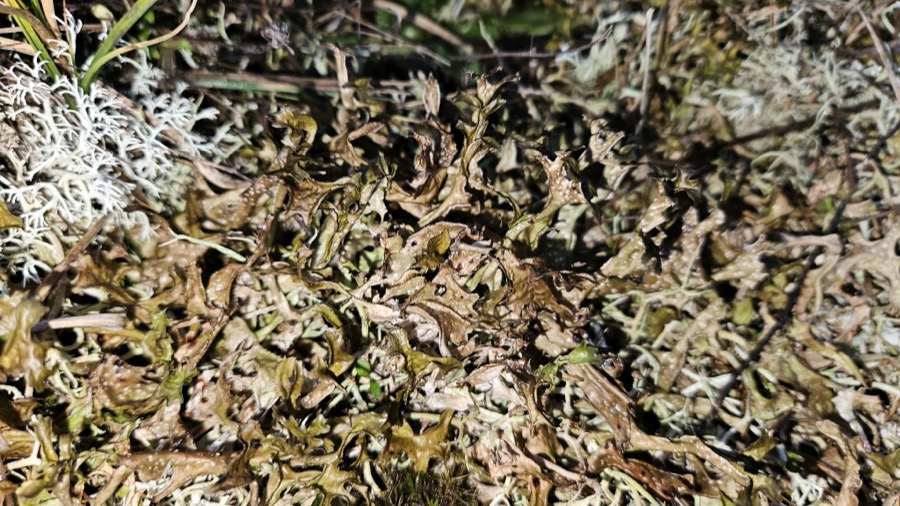 Iceland mossCetaria islandica
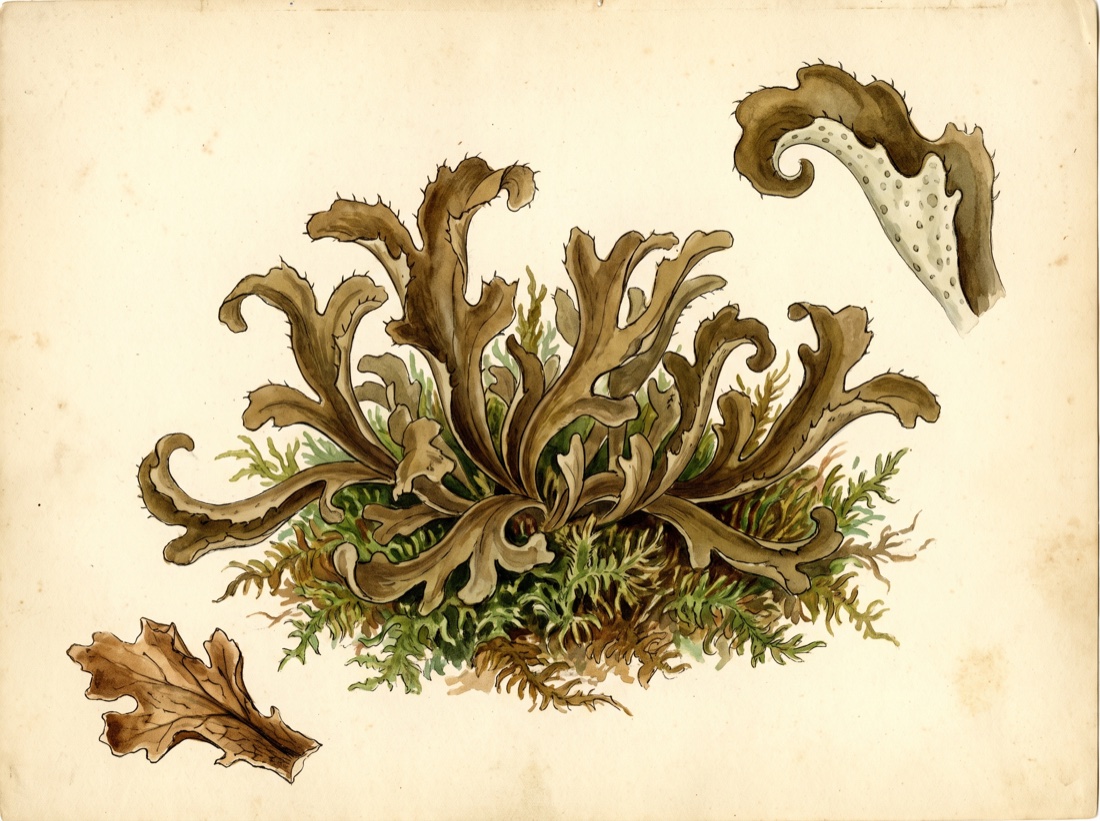 Iceland mossCetraria
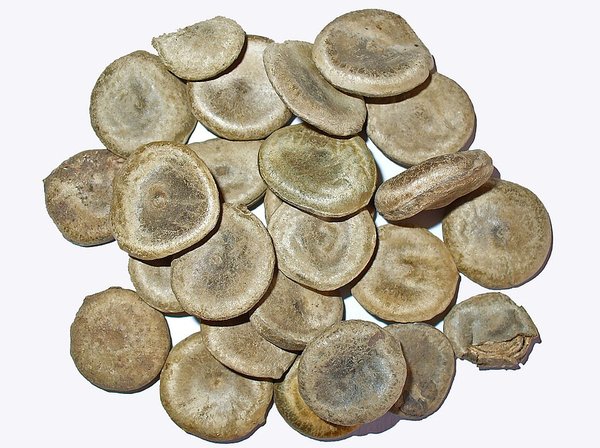 IgnatiaIgnatia
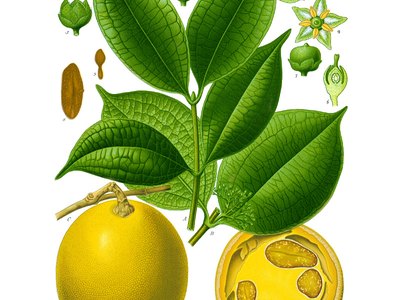 Ignatia AmaraStrychnos ignatia
The whole plate is in the library. The compass, Compare, the Sky of eleven hundred plants and the formulary open with an email address and a password, free, with the formula builder and its safety engine. Herbert without limit, his formulating, clients, the handouts and the labels are the paid room.
Open the library, free