Ayurvedic Herbalism
Garden cress
Lepidium sativum
Also known as pepperwort, halim, aliv, cress seed, Chandrashura, Chandrika, Charmahantri.
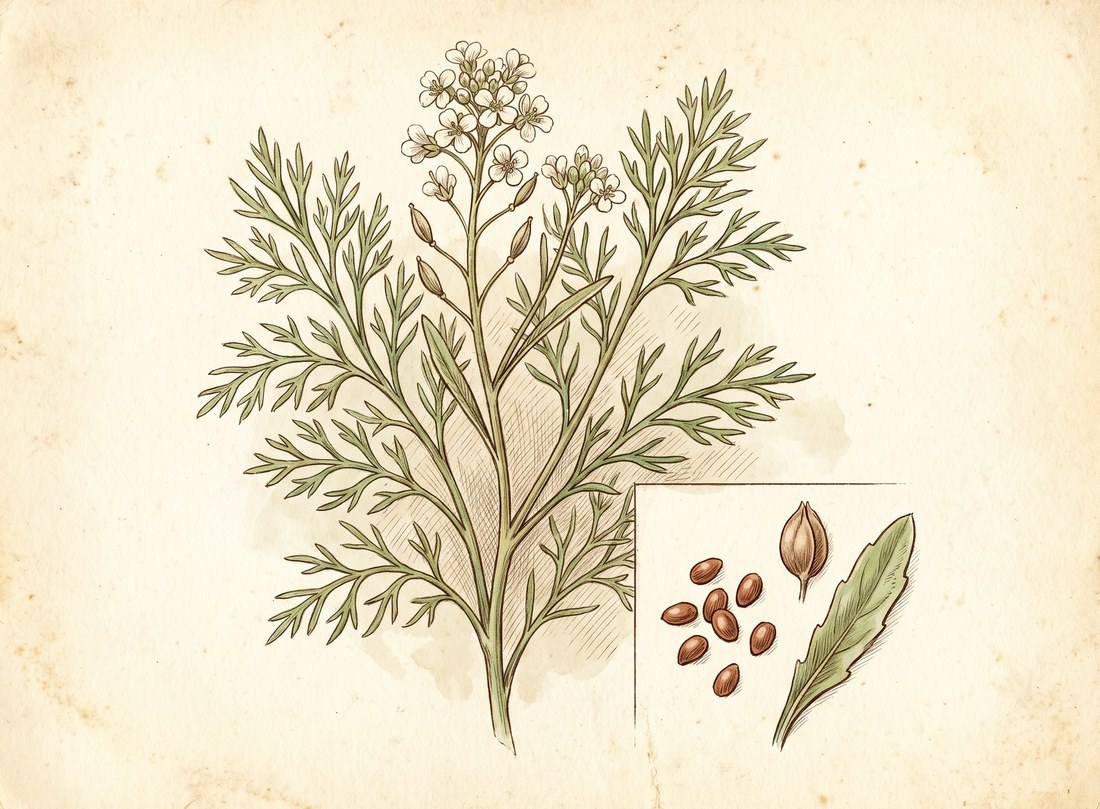
Lepidium sativum is a fast growing annual of the mustard family with finely divided leaves and small white flowers, native to Egypt and southwest Asia and cultivated across India as a salad green and, above all, for its small reddish seeds. In Ayurveda the seed is Chandrashura, a warming, unctuous, strengthening seed for lactation, bone, vata and the weakness that follows childbirth, and it is a familiar ingredient of the sweet postpartum preparations of western and northern India. The seeds swell into a mucilage in water, which gives them a demulcent quality alongside their pungent warmth.

Ask Herbert about Garden cress. Herbert is the master herbalist inside Bountiful Herbs: he answers from this plate and eleven hundred others, with dosing, pairing and cautions. Your first ten questions are free.
Ask HerbertActions
Indications what the tradition reached for it in
- Insufficient lactation
- Postpartum weakness and slow recovery
- Fracture healing and osteopenia (adjunct)
- Iron deficiency anemia (nutritional support)
- Low back pain and joint pain of vata type
- Chronic cough with sticky sputum
- Diarrhea and dysentery (soaked seed)
- Hiccup and flatulence
- Scanty or delayed menses in cold constitutions
- Constipation with dry stools (soaked seed as bulk)
- Swellings and sprains (paste, topical)
Specific indications
A new mother two weeks after delivery who is tired, cold, aching in the back and not producing enough milk, for the seed cooked in milk with jaggery
A slow healing fracture or a postmenopausal woman with thinning bone and vata dryness, for the seed balls with sesame and jaggery
A cold, phlegmatic patient with a lingering cough and poor appetite, for the warm decoction
Loose stools alternating with dryness in a vata patient, where the soaked mucilaginous seed both binds and soothes
Safety
Pregnancy: Avoid medicinal doses in pregnancy: the seed is a traditional emmenagogue and showed uterotonic activity in animal tissue, and no published safety class is known to us; the salad leaf as food is fine.
The record lists 7 contraindications; open the plate in the library to read them in full.
In practice
The Ayurvedic physician gives Chandrashura chiefly to women after childbirth and to anyone whose bones and back need strengthening. A spoon of seeds soaked and cooked in milk with jaggery, taken morning and evening, is the classical galactagogue and postpartum restorative, often combined with Shatavari, Methika (fenugreek) and Ashwagandha.
In Ayurveda
Rasa: katu (pungent), tikta (bitter). Virya: ushna (heating). Vipaka: katu (pungent). Guna: laghu (light), snigdha (unctuous), picchila (slimy when soaked). Dosha: pacifies vata and kapha; aggravates pitta in excess. Karma: balya (strengthening); stanyajanana (promotes lactation); asthisandhanakara (knits bone); vatahara (pacifies vata); kaphahara (reduces kapha); deepana (kindles digestion); shothahara (reduces swelling); artavajanana (promotes menstruation); vrishya (aphrodisiac); grahi (binds the bowel, the soaked seed); kasahara (relieves cough). Classical indications: stanyakshaya (insufficient breast milk); asthibhagna (fractures); vatavyadhi (vata disorders, low back and joint pain); daurbalya (weakness, especially postpartum); atisara (diarrhea); pravahika (dysentery); hikka (hiccup); kasa and shvasa (cough and dyspnea); artavakshaya (scanty menses); shotha (swelling); kushtha (skin diseases, topical). The small reddish brown seeds are the drug, soaked to a mucilaginous mass and cooked in milk (kshirapaka) for lactation and postpartum strength, powdered as churna with jaggery or made into sweet balls for bone healing and vata, decocted for cough and diarrhea, and pounded into a paste for swellings and skin. The leaves are eaten as a salad green. Classical formulations: Chandrashura churna, Chandrashura kshirapaka, Chandrashura laddu (postpartum sweet with jaggery and ghee), Chandrashura kwatha, Chandrashura lepa (topical paste). Described in: Bhavaprakasha Nighantu, Raja Nighantu, Dhanvantari Nighantu, Kaiyadeva Nighantu, Ayurvedic Pharmacopoeia of India.
Dosing as the sources wrote it
| Preparation | As written | Metric |
|---|---|---|
| Churna | 1-3 g powdered seed twice daily with jaggery or warm water | 1000-3000 mg |
| Kshirapaka | 50-100 mL milk decoction of 3-6 g seed once or twice daily | 50-100 mL |
| Soaked seed | 5-10 g seed soaked in water or milk taken once daily | 5000-10000 mg |
| Kwatha | 30-60 mL decoction twice daily | 30-60 mL |
| Lepa, topical | 10-20 g seed paste applied to swellings or sprains | 10000-20000 mg |
Doses are reproduced from the sources for practitioners and are not a recommendation for any person.
From the sources
Overview. Lepidium sativum is a fast growing annual of the mustard family with finely divided leaves and small white flowers, native to Egypt and southwest Asia and cultivated across India as a salad green and, above all, for its small reddish seeds. In Ayurveda the seed is Chandrashura, a warming, unctuous, strengthening seed for lactation, bone, vata and the weakness that follows childbirth, and it is a familiar ingredient of the sweet postpartum preparations of western and northern India. The seeds swell into a mucilage in water, which gives them a demulcent quality alongside their pungent warmth.
Clinical Notes. The Ayurvedic physician gives Chandrashura chiefly to women after childbirth and to anyone whose bones and back need strengthening. A spoon of seeds soaked and cooked in milk with jaggery, taken morning and evening, is the classical galactagogue and postpartum restorative, often combined with Shatavari, Methika (fenugreek) and Ashwagandha.
Ayurvedic Profile. Rasa: katu (pungent), tikta (bitter). Virya: ushna (heating). Vipaka: katu (pungent). Guna: laghu (light), snigdha (unctuous), picchila (slimy when soaked). Dosha: pacifies vata and kapha; aggravates pitta in excess.
Nearby on the shelf
 GambirUncaria gambir
 GambogeCambogia
 Garden AngelicaAngelica archangelica
 Garden BurnetSanguisorba officinalis
 Garden silkweedAsclepias currasavica
 GarlicAllium sativum
 Garlic MustardAlliaria petiolata
 GastrodiaGastrodia elata
The whole plate is in the library. The compass, Compare, the Sky of eleven hundred plants and the formulary open with an email address and a password, free, with the formula builder and its safety engine. Herbert without limit, his formulating, clients, the handouts and the labels are the paid room.
Open the library, free