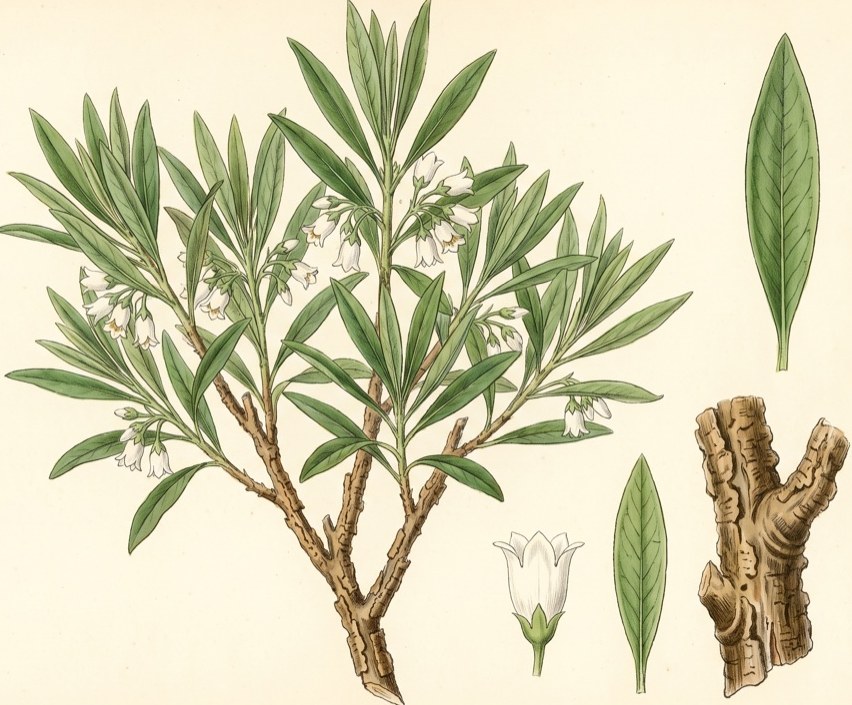
Western Herbalism
Duboisia
Duboisia myoporoides
Also known as Corkwood, Corkwood Elm, Pituri bush, Orungurabie, Ngmoo (native names).
Duboisia myoporoides is a small tree or shrub native to eastern Australia and parts of the South Pacific, long known to Aboriginal peoples as a component of pituri, a traditional chewed stimulant and narcotic preparation. The leaf contains tropane alkaloids closely related to those of belladonna, henbane and datura, and it was adopted briefly into eclectic and orthodox medicine in the late nineteenth and early twentieth centuries as a source of the alkaloid duboisine and as a commercial source of hyoscine (scopolamine) and hyoscyamine. Today the plant is grown industrially, chiefly in Australia, almost exclusively as a pharmaceutical feedstock for the extraction of scopolamine and related alkaloids rather than as a whole-plant herbal medicine.

Ask Herbert about Duboisia. Herbert is the master herbalist inside Bountiful Herbs: he answers from this plate and eleven hundred others, with dosing, pairing and cautions. Your first ten questions are free.
Ask HerbertActions
Indications what the tradition reached for it in
- Motion sickness (historical, extreme caution)
- Pupil dilation for ophthalmic examination (historical)
- Smooth muscle spasm (historical)
- Excess secretions (historical)
- Parkinsonian tremor (historical, obsolete)
- Asthma (historical, obsolete)
- Nausea and vomiting (historical, extreme caution)
- Nerve pain with spasm (historical, obsolete)
Specific indications
Historical use for severe unremitting nausea where atropine-like drying and central sedation were desired, always under close medical supervision
Historical ophthalmic use to produce prolonged mydriasis for examination or surgery
Safety
Recognised toxicity. This plant carries a toxicity flag in the record; it is for trained practitioners only.
Low dose botanical. Used in drop doses in the classical practice; not a plant to dose freely.
Pregnancy: Contraindicated in pregnancy: contains potent tropane alkaloids with a narrow margin of safety and no modern indication justifies the risk.
Breastfeeding: Contraindicated in lactation: anticholinergic tropane alkaloids pass into milk and can cause infant toxicity.
The record lists 9 contraindications; open the plate in the library to read them in full.
In practice
Duboisia has essentially no place in contemporary herbal practice as a crude preparation. Its historical eclectic use mirrored that of belladonna and hyoscyamus: it was given for conditions calling for anticholinergic drying and central sedation, such as intractable vomiting, excessive salivation or sweating, spasmodic asthma, and to dilate the pupil for ophthalmic work.
Dosing as the sources wrote it
| Preparation | As written | Metric |
|---|---|---|
| Historical fluid extract (obsolete, not recommended) | 0.1-0.6 mL (2-10 drops) as a single dose, historical eclectic use only | 0.1-0.6 mL |
| Historical solid extract (obsolete, not recommended) | 15-30 mg (1/4-1/2 grain) as a single dose, historical eclectic use only | 15-30 mg |
| Dose, 1/130 to 1/50 grain, usually administered hypodermically. | 0.5-1.3 mg | |
| Extractum Duboisiae, Extract of Duboisia | Dose, 1/4 to 1/2 grain. | 16.2-32.4 mg |
| Extractum Duboisiae Fluidum, Fluid Extract of Duboisia | Dose, from two to ten drops. | 0.04-0.2 mL |
| Duboisine is given in doses of from 1/120 to the 1/60 of a grain in these cases, and is said to be a valuable hypnotic. | 0.54-64.8 mg |
Doses are reproduced from the sources for practitioners and are not a recommendation for any person.
From the sources
Overview. Duboisia myoporoides is a small tree or shrub native to eastern Australia and parts of the South Pacific, long known to Aboriginal peoples as a component of pituri, a traditional chewed stimulant and narcotic preparation.
Clinical Notes. Duboisia has essentially no place in contemporary herbal practice as a crude preparation. Its historical eclectic use mirrored that of belladonna and hyoscyamus: it was given for conditions calling for anticholinergic drying and central sedation, such as intractable vomiting, excessive salivation or sweating, spasmodic asthma, and to dilate the pupil for ophthalmic work.
Therapy. The agent has not been extensively used for internal administration. It soothes the respiratory apparatus, increases the action of the heart, like belladonna in congestions, and is given to control excessive night sweats.
Physiological Action. Duboisia is similar in many respects in its influence, to stramonium, hyoscyamus and belladonna. It produces dryness in the mouth and constriction in the throat, with difficult deglutition. It increases the pulse rate and arterial tension, increases the capillary circulation in the skin, with flushed face like belladonna. The pupil dilates, there is a sensation of fullness in the head, with tinnitus aurium, vertigo, nervous excitement and muscular uncertainty. These conditions are followed by mental inactivity and stupor, with general quiet, although the patient may not sleep.
Drawn from King's American Dispensatory, 18th edition (Felter and Lloyd); Ellingwood's American Materia Medica, Therapeutics and Pharmacognosy, and the Bountiful Herbs editorial.
Nearby on the shelf
 DronapushpiLeucas cephalotes
 Drynaria rhizomeDrynaria roosii
 Du HuoAngelica pubescens
 Du ZhongEucommia ulmoides
 DulcamaraSolanum dulcamara
 DulsePalmaria palmata
 Dune wormwoodArtemisia monosperma
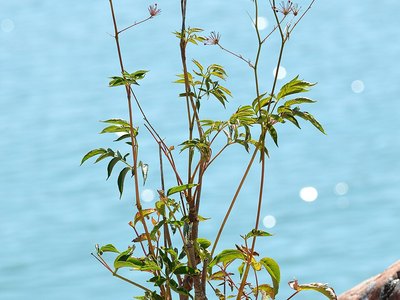 Dwarf ElderAralia Hispida
The whole plate is in the library. The compass, Compare, the Sky of eleven hundred plants and the formulary open with an email address and a password, free, with the formula builder and its safety engine. Herbert without limit, his formulating, clients, the handouts and the labels are the paid room.
Open the library, free