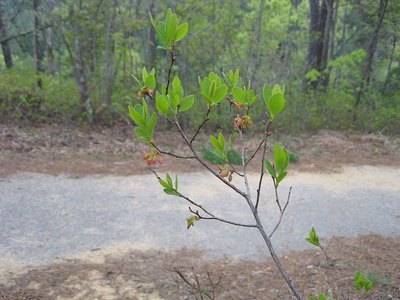
Western Herbalism
Black huckleberry
Vaccinium resinosum
Also known as huckleberry, black whortleberry.
Black huckleberry is a low, resinous-leaved shrub of the heath family, common in acidic woodland and moorland soils across northeastern North America. Its sweet blue-black berries have long been gathered as food, while the leaves and berries together found a place in nineteenth century American physiomedical and folk practice as a gentle astringent. Physiomedicalist writers such as Cook placed it among the mild astringent tonics used to firm relaxed, atonic tissue, particularly of the digestive and reproductive mucosa.

Ask Herbert about Black huckleberry. Herbert is the master herbalist inside Bountiful Herbs: he answers from this plate and eleven hundred others, with dosing, pairing and cautions. Your first ten questions are free.
Ask HerbertActions
Indications what the tradition reached for it in
- Diarrhea
- Mild dysentery
- Leukorrhea
- Atonic tissue laxity
- Sore throat
- Bleeding or spongy gums
- Mouth ulcers
- General debility with loose stools
- Mild urinary irritation
Specific indications
Loose, watery stools with a sense of relaxed, atonic bowel tissue rather than acute heat or inflammation.
Chronic mild leukorrhea in a person with generally lax, poorly toned tissue, used as a douche or internally alongside other tonics.
Safety
The record lists 2 contraindications; open the plate in the library to read them in full.
In practice
In the physiomedical framework this plant was reached for when tissue tone itself was the problem: a bowel that would not hold its contents, a vaginal mucosa that wept a thin discharge, a throat that stayed sore and boggy rather than acutely inflamed.
Dosing as the sources wrote it
| Preparation | As written | Metric |
|---|---|---|
| Leaf decoction | 2-4 g dried leaf per cup, three times daily | 2000-4000 mg |
| Tincture (1:5, 40%) | 2-4 mL three times daily | 2-4 mL |
| Fresh or dried berries | as a food, taken freely |
Doses are reproduced from the sources for practitioners and are not a recommendation for any person.
From the sources
Clinical Notes. In the physiomedical framework this plant was reached for when tissue tone itself was the problem: a bowel that would not hold its contents, a vaginal mucosa that wept a thin discharge, a throat that stayed sore and boggy rather than acutely inflamed.
Properties and Uses. The berries of these, and probably of other species of the vaccinium, act moderately upon the kidneys, and have been commended in dropsy; but their influence is so mild as scarcely to deserve any further consideration than is due to other edible fruits that help to increase the flow of urine. The root, and also the bark, are mildly astringent and stimulant, and form a good gargle in sore throat. A common New England practice is to make an ounce, each, of this bark and sage leaves, into a decoction, sweeten with honey, and use as a gargle. Medical Herbalism journal and medherb.com The Physiomedical Dispensatory by William Cook, M.D., 1869
Description. Natural Order, Ericaceae; sub-order, Vaccineae. This is now classed as Gaylussacia resinosa by Gray and others, having been separated from the genus vaccinium. It is the common huckleberry or black whortleberry, so familiar in moist grounds through New England and other northern States.
Drawn from Cook's Physio-Medical Dispensatory, and the Bountiful Herbs editorial.
Nearby on the shelf
 Black cohoshActaea racemosa
 Black elderSambucus nigra
 Black gramVigna mungo
 Black HorehoundBallota nigra
 Black locustRobinia pseudoacacia
 Black MustardSinapis Nigra
 Black nightshadeSolanum nigrum
 Black oil plantCelastrus paniculatus
The whole plate is in the library. The compass, Compare, the Sky of eleven hundred plants and the formulary open with an email address and a password, free, with the formula builder and its safety engine. Herbert without limit, his formulating, clients, the handouts and the labels are the paid room.
Open the library, free