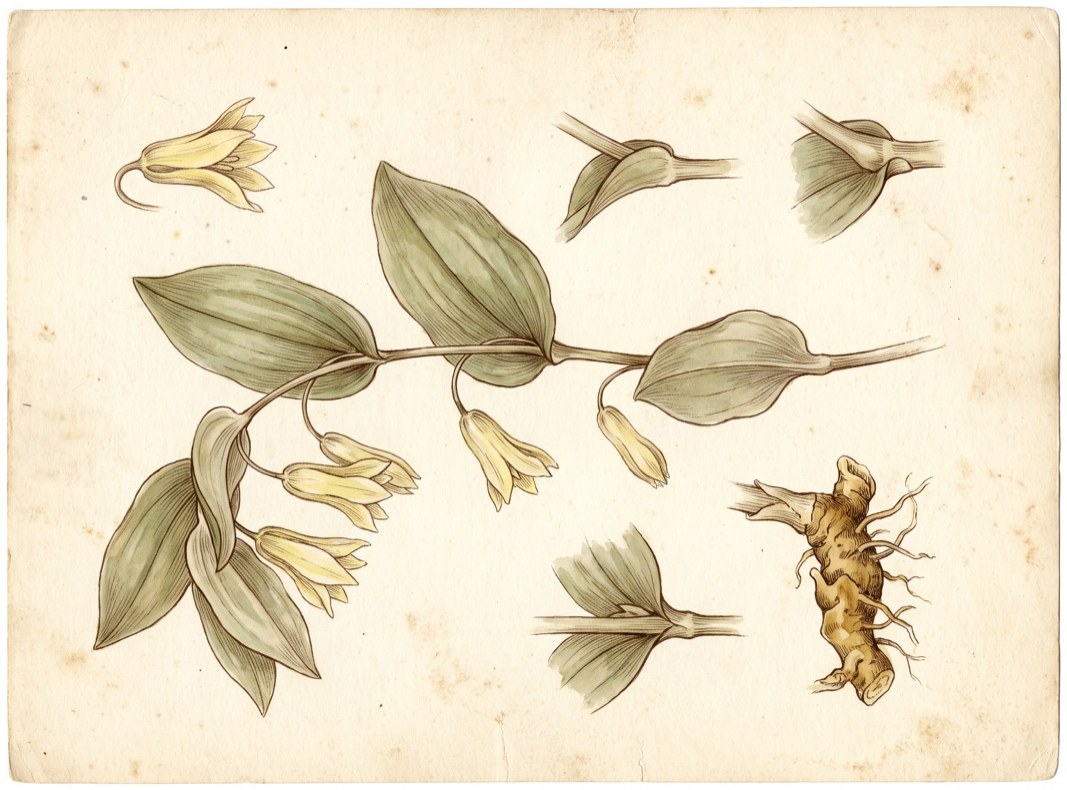
Western Herbalism
Bellwort
Uvularia
Also known as Mealy bellwort, Wild oats, Merrybells, Strawbell.
Bellwort is a woodland spring wildflower native to eastern North America, related botanically to Solomon's seal though placed in its own family. The dried or fresh rhizome and root were used by nineteenth century American eclectic physicians as a mucilaginous demulcent and mild tonic, taken internally for sore throat and applied externally as a poultice for boils and slow-healing sores. Several species, most often Uvularia perfoliata, were used interchangeably in this tradition, and the plant never entered mainstream European or Asian herbal systems.

Ask Herbert about Bellwort. Herbert is the master herbalist inside Bountiful Herbs: he answers from this plate and eleven hundred others, with dosing, pairing and cautions. Your first ten questions are free.
Ask HerbertActions
Indications what the tradition reached for it in
- Sore throat
- Aphthous mouth ulcers
- Dry irritating cough
- Dyspepsia with irritation
- Indolent ulcers and boils (topical)
- Minor wounds and abrasions (topical)
- Rheumatic joint pain (topical poultice, traditional)
- General debility (traditional tonic use)
Specific indications
Sore, raw throat with pain on swallowing, eased by the mucilaginous, soothing quality of the root
Slow-healing boils or indolent ulcers treated with a soft poultice of the fresh bruised root
Safety
Pregnancy: Not safe. Avoid in pregnancy due to a complete absence of safety data.
Breastfeeding: Not safe. Avoid during lactation due to a complete absence of safety data.
The record lists 3 contraindications; open the plate in the library to read them in full.
In practice
Bellwort belongs to the same eclectic category of soft, mucilaginous root demulcents as Solomon's seal and marshmallow, and it was reached for mainly as a soothing local remedy rather than as a systemic agent.
Dosing as the sources wrote it
| Preparation | As written | Metric |
|---|---|---|
| Infusion or mild decoction | 2-4 g dried root steeped or gently simmered, taken as needed for sore throat | |
| Tincture (1:5, 40%) | 1-3 mL three times daily | 1-3 mL |
| Fresh root poultice | Bruised fresh root applied topically to boils or indolent ulcers, changed daily |
Doses are reproduced from the sources for practitioners and are not a recommendation for any person.
From the sources
Overview. Bellwort is a woodland spring wildflower native to eastern North America, related botanically to Solomon's seal though placed in its own family. The dried or fresh rhizome and root were used by nineteenth century American eclectic physicians as a mucilaginous demulcent and mild tonic, taken internally for sore throat and applied externally as a poultice for boils and slow-healing sores. Several species, most often Uvularia perfoliata, were used interchangeably in this tradition, and the plant never entered mainstream European or Asian herbal systems.
Clinical Notes. Bellwort belongs to the same eclectic category of soft, mucilaginous root demulcents as Solomon's seal and marshmallow, and it was reached for mainly as a soothing local remedy rather than as a systemic agent.
Action, Medical Uses, and Dosage. Bellwort is a tonic, demulcent, and nervine, and may be used in decoction or powder, as a substitute for cypripedium. The decoction has proved beneficial in sore mouth and affections of the throat, also inflammation of the gums.
History. Bellwort is a smooth, handsome plant, common to the United States, growing in moist copses, woods, etc., and flowering in May. The root is the part employed, which., when recent, is acrid and mucilaginous. It imparts its properties to water.
Drawn from King's American Dispensatory, 18th edition (Felter and Lloyd), and the Bountiful Herbs editorial.
Nearby on the shelf
 BeechdropsOrobanche virginiana
 Beer YeastSaccharomyces cerevisiae
 BeggarticksBidens pilosa
 Beleric myrobalanTerminalia bellirica
 Benedict's HerbGeum urbanum
 BenzoinStyrax benzoin
 Betel leafPiper betle
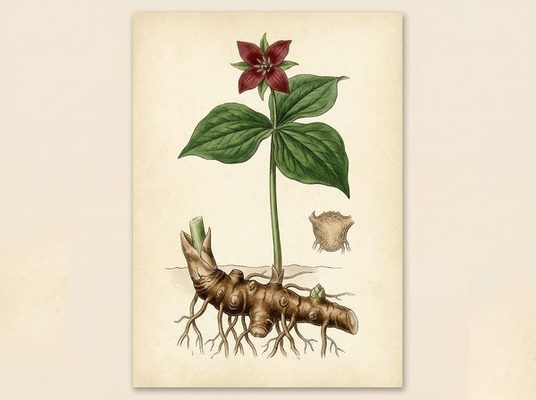 Beth RootTrillium erectum
The whole plate is in the library. The compass, Compare, the Sky of eleven hundred plants and the formulary open with an email address and a password, free, with the formula builder and its safety engine. Herbert in full, his formulating, clients, the handouts and the labels are the paid room.
Open the library, free