Western Herbalism
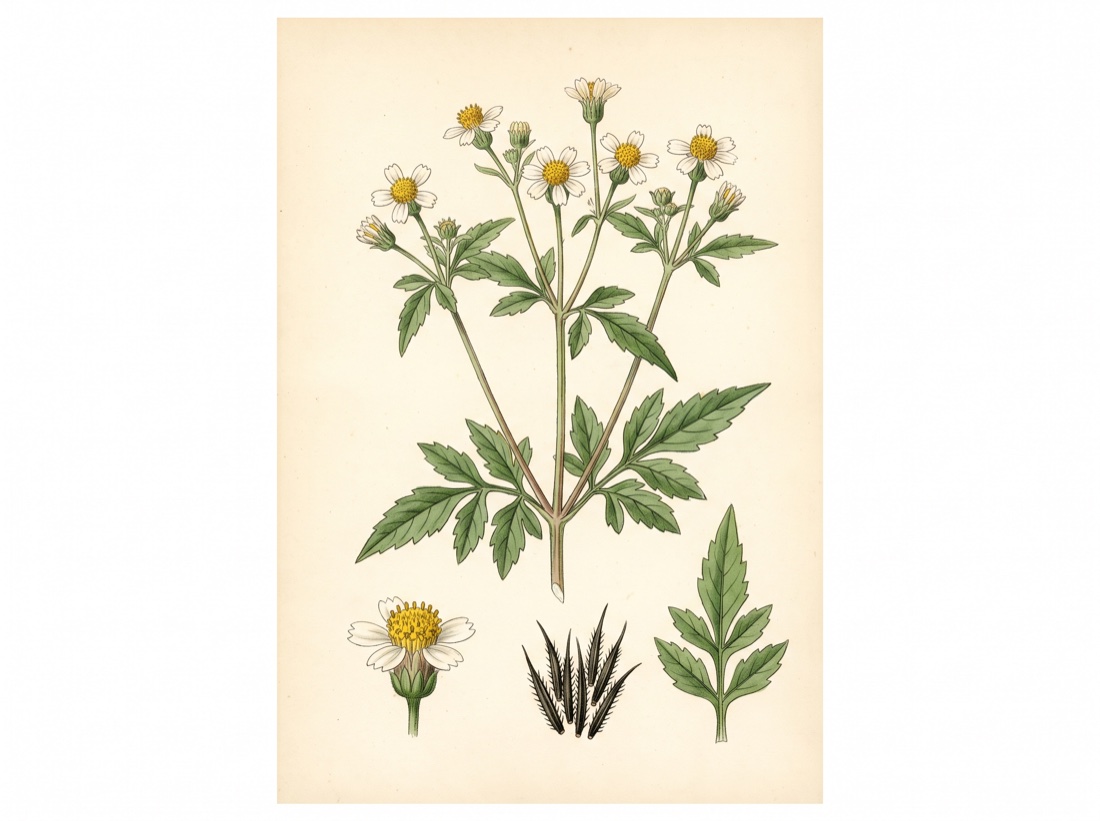
Beggarticks
Bidens pilosa
Also known as hairy beggarticks, black-jack, Spanish needle, cobbler's pegs, farmer's friend, pitchforks, devil's needles, guǐ zhēn cǎo.
Bidens pilosa is a fast-growing annual of the daisy family, native to tropical America and now a common weed across Africa, Asia, and the Pacific. The whole flowering plant is used, fresh or dried, with the leaves and young tops preferred. It is a folk medicine of enormous reach: in Africa and Latin America for infections, fevers, wounds, diabetes, and stomach complaints; in China as gui zhen cao for heat-toxin and dysentery; and in modern Western herbalism as an antimicrobial and mucous membrane restorative for stubborn infections.

Ask Herbert about Beggarticks. Herbert is the master herbalist inside Bountiful Herbs: he answers from this plate and eleven hundred others, with dosing, pairing and cautions. Your first ten questions are free.
Ask HerbertActions
Indications what the tradition reached for it in
- Urinary tract infection, acute and recurrent
- Chronic gastritis and gastric ulcer with mucosal irritation
- Infectious diarrhea and dysentery
- Upper respiratory infection with inflamed mucosa
- Chronic sinusitis with thick discharge
- Type 2 diabetes and impaired glucose tolerance (adjunct)
- Malaria and febrile illness (traditional, adjunct only)
- Hepatic inflammation and fatty liver (adjunct)
- Mild hypertension
- Wounds, ulcers, and skin infections (topical)
- Sore throat and mouth ulcers (gargle)
- Bacterial infections with antibiotic resistance (adjunct)
Specific indications
Recurrent cystitis in a patient whose bladder lining stays irritated between infections, with urgency and low-grade burning
Chronic inflamed mucous membranes anywhere in the body, gut, bladder, or sinuses, with a tendency to repeated infection
Blood sugar drifting upward in a patient who also has low-grade gut inflammation
Safety
The record lists 4 contraindications; open the plate in the library to read them in full.
In practice
Think of Bidens where a mucous membrane is inflamed and colonized: recurrent urinary infections, chronic gastritis, infectious diarrhea, and sinus or bronchial infections that keep returning. It seems to tone the membrane and reduce its reactivity while exerting direct antimicrobial action, so it is more useful as a several-week course than as a single acute dose.
Dosing as the sources wrote it
| Preparation | As written | Metric |
|---|---|---|
| Tincture (1:2 fresh plant) | 2-5 mL three times daily | 2-5 mL |
| Tincture (1:5, 45% dried herb) | 3-6 mL three times daily | 3-6 mL |
| Infusion | 3-6 g dried aerial parts per cup, up to three times daily | 3000-6000 mg |
| Topical | fresh leaf juice or strong infusion applied as a wash or compress two to three times daily |
Doses are reproduced from the sources for practitioners and are not a recommendation for any person.
From the sources
Overview. Bidens pilosa is a fast-growing annual of the daisy family, native to tropical America and now a common weed across Africa, Asia, and the Pacific. The whole flowering plant is used, fresh or dried, with the leaves and young tops preferred. It is a folk medicine of enormous reach: in Africa and Latin America for infections, fevers, wounds, diabetes, and stomach complaints; in China as gui zhen cao for heat-toxin and dysentery; and in modern Western herbalism as an antimicrobial and mucous membrane restorative for stubborn infections.
Clinical Notes. Think of Bidens where a mucous membrane is inflamed and colonized: recurrent urinary infections, chronic gastritis, infectious diarrhea, and sinus or bronchial infections that keep returning. It seems to tone the membrane and reduce its reactivity while exerting direct antimicrobial action, so it is more useful as a several-week course than as a single acute dose.
Nearby on the shelf
 BebeeruNectandra rodiei
 Bee BalmMonarda didyma
 BeechdropsOrobanche virginiana
 Beer YeastCerevisiae Fermentum
 Beleric myrobalanTerminalia bellirica
 BellwortUvularia
 Benedict's HerbGeum urbanum
 BenzoinStyrax benzoin
The whole plate is in the library. The compass, Compare, the Sky of eleven hundred plants and the formulary open with an email address and a password, free, with the formula builder and its safety engine. Herbert without limit, his formulating, clients, the handouts and the labels are the paid room.
Open the library, free