
Western Herbalism
Bebeeru
Nectandra rodiei
Also known as Bebeeru bark, Greenheart, Bibiru bark, Greenheart-bark, Bibiru, Sipiri (Cortex beberu, Nectandra cortex [Br.]).
Bebeeru, from the bark of the great South American forest tree now classified as Ocotea rodiaei, was known to nineteenth century physiomedical and eclectic practitioners for its intense bitterness and astringency, and for the bebeerine alkaloid it yielded. Native to Guyana and the northern coastal forests of South America, the tree was harvested for both its timber, prized as greenheart wood, and its bark, which entered European and American materia medica as a proposed substitute for cinchona bark in periodic fevers. In the physiomedical framework the bark was regarded as a relaxant-tonic bitter combined with astringent action, useful for restoring tone to atonic tissues during and after fever.

Ask Herbert about Bebeeru. Herbert is the master herbalist inside Bountiful Herbs: he answers from this plate and eleven hundred others, with dosing, pairing and cautions. Your first ten questions are free.
Ask HerbertActions
Indications what the tradition reached for it in
- General debility with poor appetite
- Convalescence after fever
- Intermittent fevers
- Atonic dyspepsia
- Chronic diarrhea
- Low-grade continued fevers
- Weak digestion in the elderly
- Malarial-type periodic fevers historically treated as a quinine substitute
Specific indications
Recurring intermittent fever with a weak, relaxed constitution where a bitter tonic and antiperiodic together are wanted
Slow convalescence with poor appetite and lax bowel tone following prolonged febrile illness
Safety
Low dose botanical. Used in drop doses in the classical practice; not a plant to dose freely.
Pregnancy: Avoid in pregnancy: there is no modern safety data and historical alkaloid content warrants caution.
Breastfeeding: Avoid in lactation: no safety data exists for this alkaloid-bearing bark in nursing mothers.
The record lists 5 contraindications; open the plate in the library to read them in full.
In practice
Historical practitioners reached for bebeeru bark chiefly as an economical alternative to Peruvian bark (cinchona) when treating intermittent and remittent fevers, particularly in constitutions described as relaxed or debilitated, where its combined bitter tonic and astringent qualities were thought to restore digestive and vascular tone together.
Dosing as the sources wrote it
| Preparation | As written | Metric |
|---|---|---|
| Decoction of bark (historical) | 2-4 g dried bark decocted daily, in divided doses | 2000-4000 mg |
| Bebeerine sulphate (historical antiperiodic dose) | 0.1-0.3 g of the extracted alkaloid salt, up to three times daily, short course only | 100-300 mg |
| Dose, as a tonic, one to two grains every six hours | 64.8-130 mg | |
| In doses of from | In doses of from 10 to 20 grains, in powder or infusion, pichurim beans are given as a stimulant tonic in mild intestinal disorders, as atonic diarrhoea and dysentery of a subacute or chronic character, and in intestinal weakness with flatulence. | 648-1296 mg |
| The bark, in doses of from 20 to 40 grains, has been employed in typhoid disorders, chronic vomiting, dyspepsia, intermittents, and atonic menstrual derangements. | 1296-2592 mg |
Doses are reproduced from the sources for practitioners and are not a recommendation for any person.
From the sources
Overview. Bebeeru, from the bark of the great South American forest tree now classified as Ocotea rodiaei, was known to nineteenth century physiomedical and eclectic practitioners for its intense bitterness and astringency, and for the bebeerine alkaloid it yielded. Native to Guyana and the northern coastal forests of South America, the tree was harvested for both its timber, prized as greenheart wood, and its bark, which entered European and American materia medica as a proposed substitute for cinchona bark in periodic fevers. In the physiomedical framework the bark was regarded as a relaxant-tonic bitter combined with astringent action, useful for restoring tone to atonic tissues during and after fever.
Clinical Notes. Historical practitioners reached for bebeeru bark chiefly as an economical alternative to Peruvian bark (cinchona) when treating intermittent and remittent fevers, particularly in constitutions described as relaxed or debilitated, where its combined bitter tonic and astringent qualities were thought to restore digestive and vascular tone together.
Properties and Uses. Bebeerin, and also the sulphate of bebeerin, as above prepared, are quite strong tonics, promoting digestion, sustaining the circulation, and mildly stimulating the nervous system. Many persons compare it to quinine; but it is not such an intense nerve stimulant as that article, and is more distinctly favorable to digestion, and to the improvement of the general tone of the system.
Action, Medical Uses, and Dosage. Beberine (and its sulphate) is a tonic and antiperiodic, and is applicable to the same forms of disease as those in which quinine is employed. It increases the appetite, raises the pulse a little, and improves the tone of the constitution generally, with but little tendency to produce ringing in the ears, headache, vertigo, or other nervous symptoms, as is the case with quinine, except when given in large or frequently-repeated doses.
Drawn from Cook's Physio-Medical Dispensatory; King's American Dispensatory, 18th edition (Felter and Lloyd), and the Bountiful Herbs editorial.
Nearby on the shelf
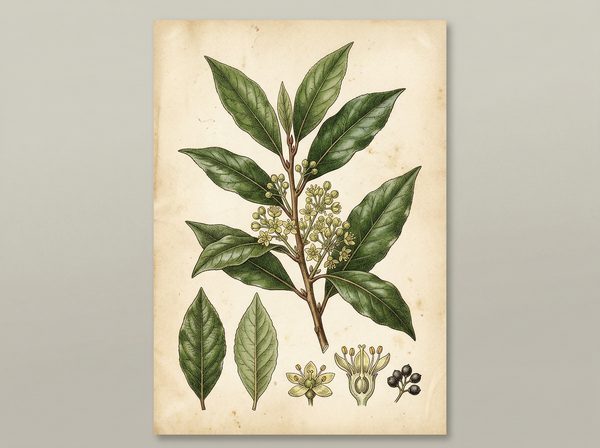 Bay LaurelLaurus nobilis
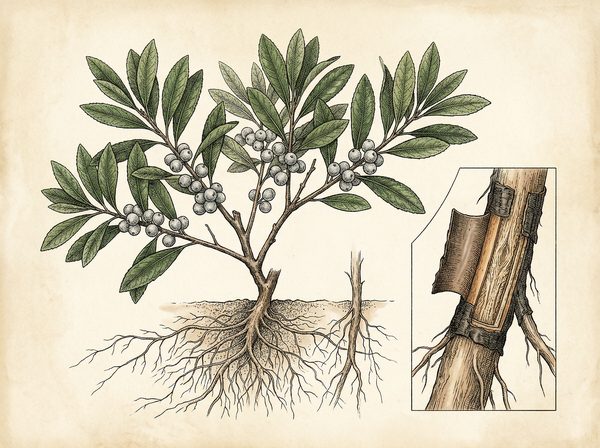 BayberryMyrica cerifera
 BearberryArctostaphylos uva-ursi
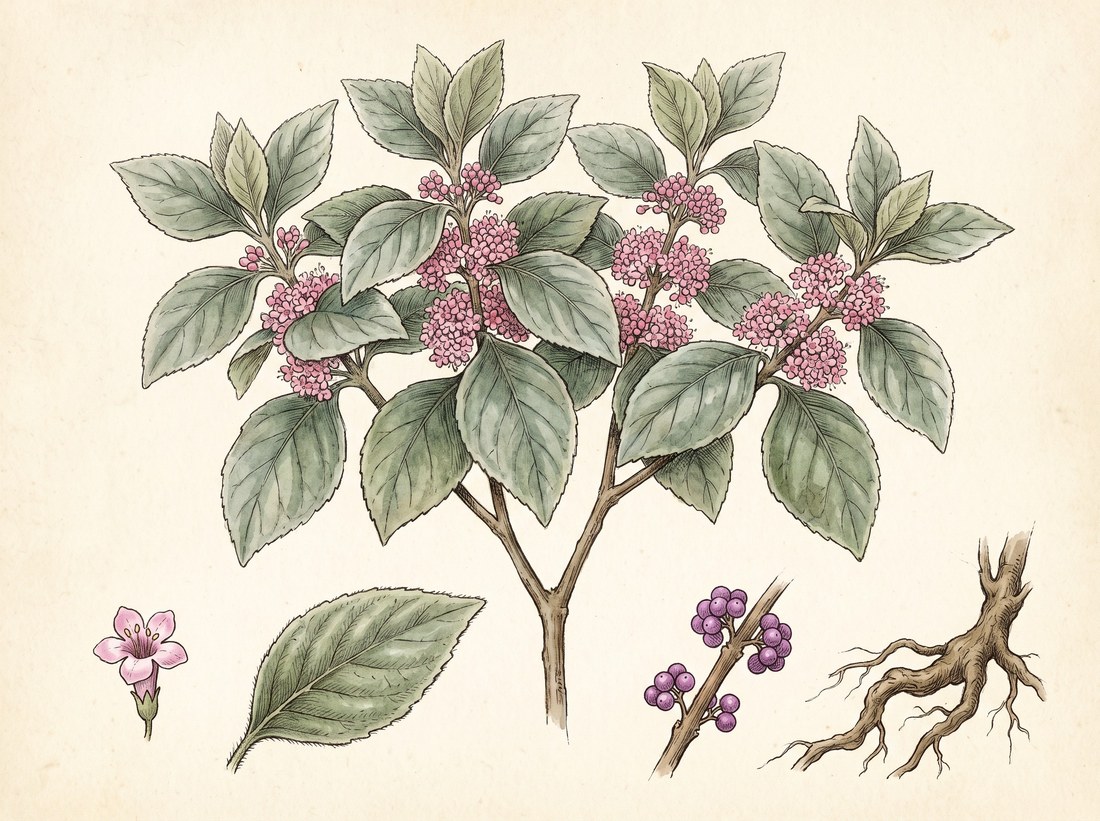 BeautyberryCallicarpa macrophylla
 Bee BalmMonarda didyma
 BeechdropsOrobanche virginiana
 Beer YeastCerevisiae Fermentum
 BeggarticksBidens pilosa
The whole plate is in the library. The compass, Compare, the Sky of eleven hundred plants and the formulary open with an email address and a password, free, with the formula builder and its safety engine. Herbert without limit, his formulating, clients, the handouts and the labels are the paid room.
Open the library, free