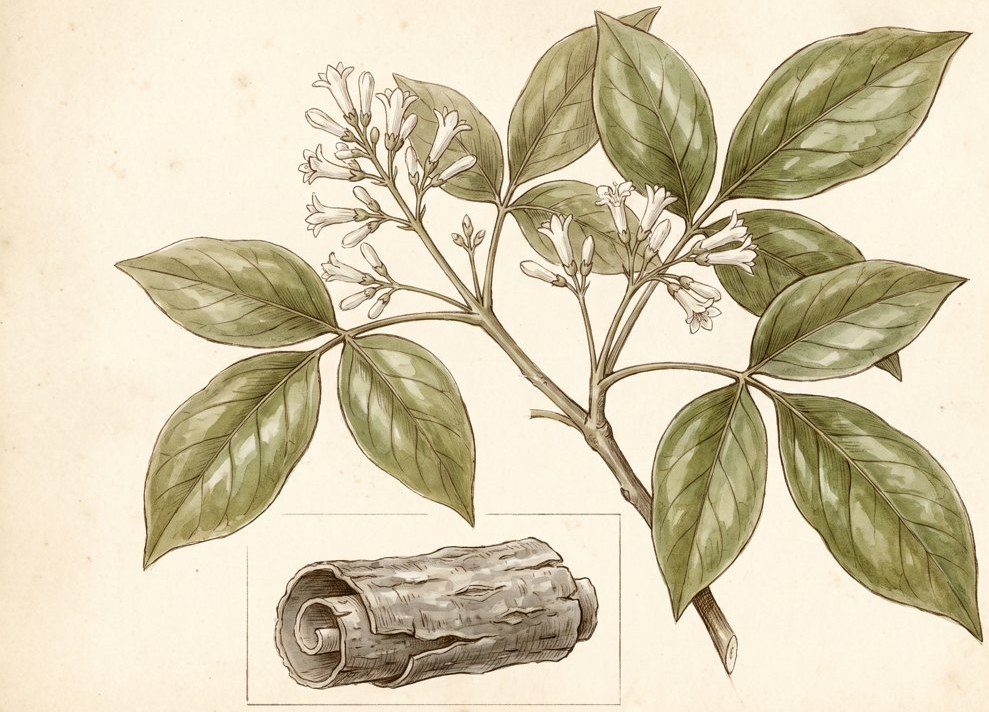
Western Herbalism
Angustura Bark
Angustura
Also known as Angostura bark, Cusparia bark, Cuspariae cortex.
Angostura bark is the dried stem bark of Galipea officinalis, a small tree native to the tropical forests of Venezuela and Colombia. It entered European and North American medicine in the late eighteenth century, taking its name from the town of Angostura (now Ciudad Bolivar) from which it was first exported, and became a staple simple bitter in Eclectic and physiomedical practice through the nineteenth century. Its intensely bitter, aromatic bark was valued as a digestive stimulant and tonic for those left weak and inappetent after fevers or chronic illness, though genuine use has declined sharply since the mid-1800s.

Ask Herbert about Angustura Bark. Herbert is the master herbalist inside Bountiful Herbs: he answers from this plate and eleven hundred others, with dosing, pairing and cautions. Your first ten questions are free.
Ask HerbertActions
Indications what the tradition reached for it in
- Anorexia
- Atonic dyspepsia
- Convalescent debility
- Poor appetite after febrile illness
- Flatulent colic
- Chronic dyspepsia in the elderly
- Intermittent fevers (historical use)
- Diarrhea and dysentery (historical use)
Specific indications
Weak, atonic digestion with poor appetite and a heavily coated tongue in a debilitated convalescent
Sluggish appetite and digestive torpor left behind after a fever has broken
Safety
Low dose botanical. Used in drop doses in the classical practice; not a plant to dose freely.
Pregnancy: Avoid in pregnancy: traditional sources note uterine stimulant and abortifacient reputation, and modern safety data are lacking.
Breastfeeding: Insufficient data to establish safety in lactation; avoid.
The record lists 5 contraindications; open the plate in the library to read them in full.
In practice
Eclectic physicians reached for angostura bark chiefly as a bitter tonic for the flagging appetite and sluggish digestion that follows a debilitating fever or prolonged illness, often combining it with gentian, chamomile, or orange peel to broaden the bitter action and improve palatability.
Dosing as the sources wrote it
| Preparation | As written | Metric |
|---|---|---|
| Infusion or decoction | 1-2 g dried bark three times daily before meals | 1000-2000 mg |
| Tincture (1:5, 45%) | 1-2 mL three times daily before meals | 1-2 mL |
| Action, Medical Uses, and Dosage: In large doses, of from 20 to 60 grains, it is emetic and cathartic; in doses of from 5 to 15 grains, non-astringent tonic and febrifuge. | 3888 mg | |
| bark | Dose of the bark, 10 to 30 grains; of the infusion (℥ss in Oj), 1 to 2 fluid ounces. | 648-1944 mg |
Doses are reproduced from the sources for practitioners and are not a recommendation for any person.
From the sources
Overview. Angostura bark is the dried stem bark of Galipea officinalis, a small tree native to the tropical forests of Venezuela and Colombia. It entered European and North American medicine in the late eighteenth century, taking its name from the town of Angostura (now Ciudad Bolivar) from which it was first exported, and became a staple simple bitter in Eclectic and physiomedical practice through the nineteenth century. Its intensely bitter, aromatic bark was valued as a digestive stimulant and tonic for those left weak and inappetent after fevers or chronic illness, though genuine use has declined sharply since the mid-1800s.
Clinical Notes. Eclectic physicians reached for angostura bark chiefly as a bitter tonic for the flagging appetite and sluggish digestion that follows a debilitating fever or prolonged illness, often combining it with gentian, chamomile, or orange peel to broaden the bitter action and improve palatability.
Drawn from King's American Dispensatory, 18th edition (Felter and Lloyd), and the Bountiful Herbs editorial.
Nearby on the shelf
 American SkullcapScutellaria lateriflora
 Amlavetasa (in the Ayurvedic sense)Garcinia pedunculata
 AndrographisAndrographis paniculata
 AnisePimpinella anisum
 AnkolaAlangium salviifolium
 AnnattoBixa orellana
 Anthemis cotulaAnthemis cotula
The whole plate is in the library. The compass, Compare, the Sky of eleven hundred plants and the formulary open with an email address and a password, free, with the formula builder and its safety engine. Herbert without limit, his formulating, clients, the handouts and the labels are the paid room.
Open the library, free